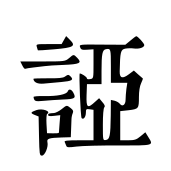
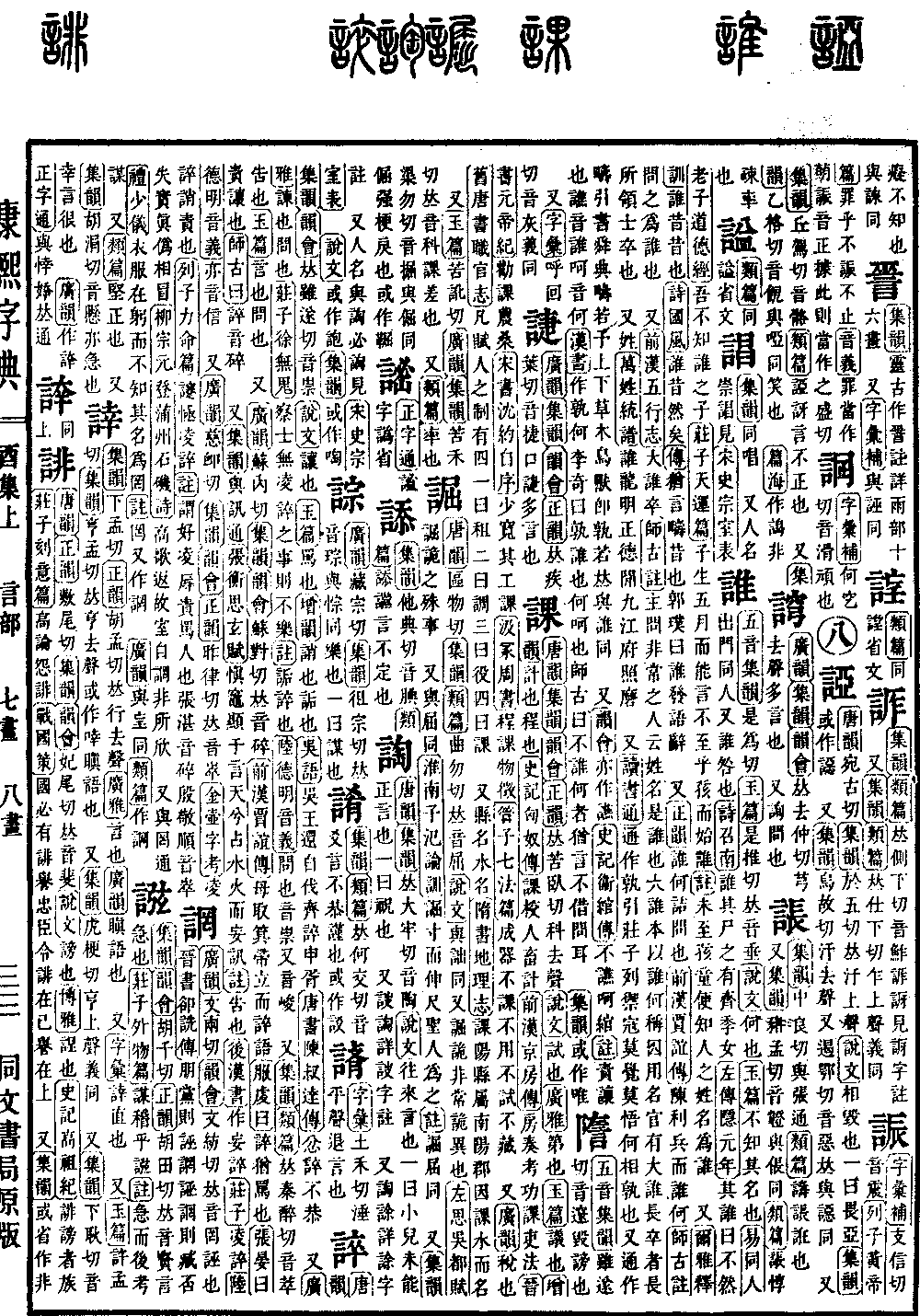
According to the "Guangyun" (Tang Yun), the pronunciation is *wan* (宛) *gu* (古) cut, pronounced *wu* (污) with a rising tone. According to the "Jiyun" (Jíyùn), it is pronounced *yu* (於) *wu* (五) cut, pronounced *wu* (污) with a rising tone. "Shuowen Jiezi" (Shuōwén Jiězì) explains it as mutual slander. Another interpretation is to fear and yield. The "Jiyun" records that it is sometimes also written as 䜑.
Furthermore, the "Jiyun" records a pronunciation of *wu* (乌) *gu* (故) cut, pronounced *wu* (污) with a departing tone. There is also *e* (遏) *e* (鄂) cut, pronounced the same as *e* (恶). It is the same as the character 䜑.
Additionally, the "Jiyun" records a pronunciation of *qiu* (丘) *jia* (驾) cut, pronounced the same as *ge* (骼). The "Leipian" (Lèipiān) explains it as 䛩讶, meaning improper speech.
Moreover, the "Jiyun" records a pronunciation of *yi* (乙) *ge* (格) cut, pronounced the same as *ya* (哑). It means to laugh. The "Pianhai" (Piānhǎi) writes it as, which is incorrect.