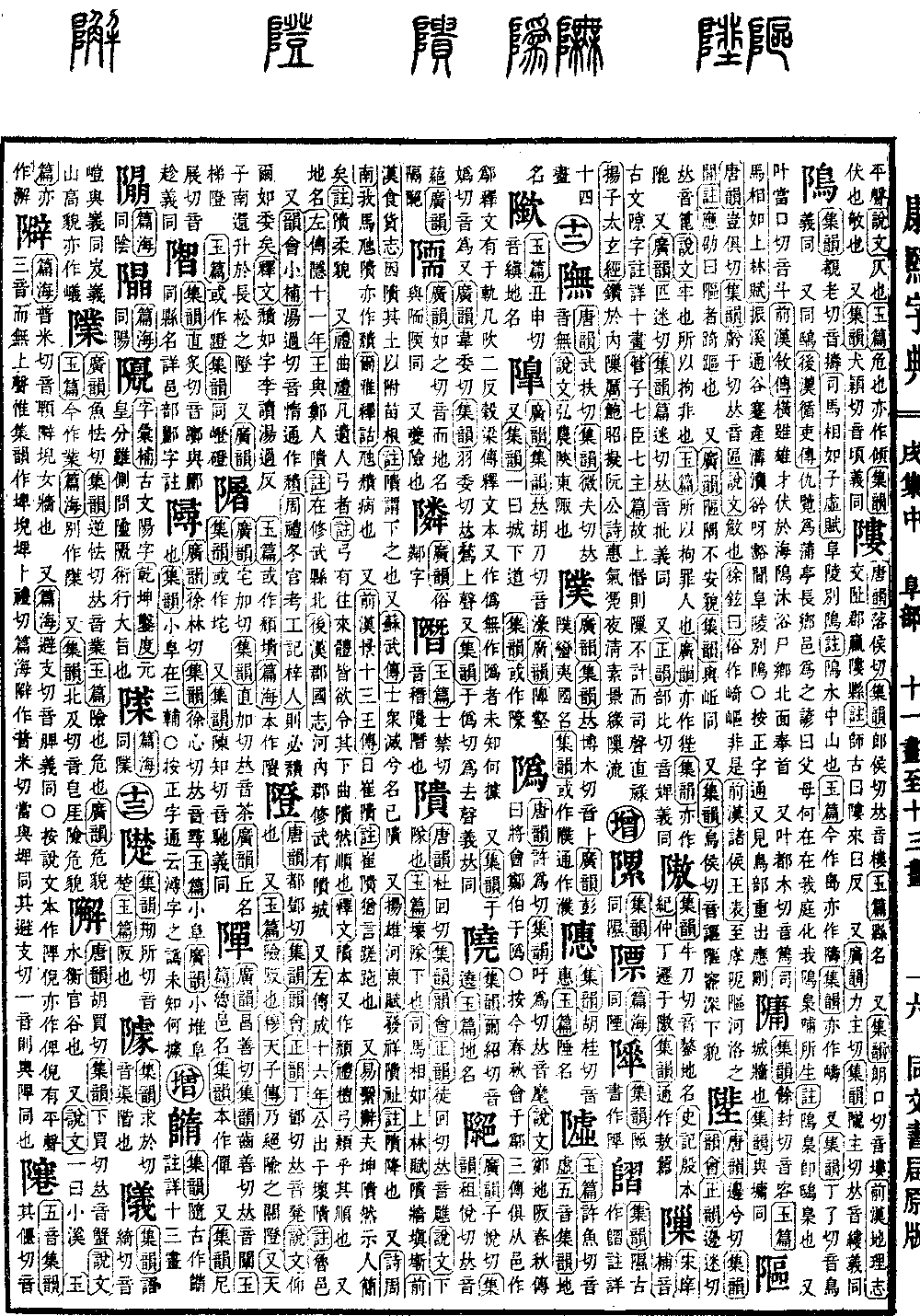
Zi Collection, Page Position: Upper
Radical: Mouth (kǒu)
Page 252, Entry 01
Pronounced hui (falling tone).
Pronounced xu (falling tone) in Tang Yun (Tang Yun).
Pronounced xu (falling tone) in Ji Yun (Ji Yun).
According to Shuowen Jiezi (Shuowen Jiezi), this refers to a place name on a slope in the state of Zheng. The Zuo Zhuan (Zuo Zhuan) states: "The commander will meet the Duke of Zheng at 䧦."
However, the currently circulated Chun Qiu (Chun Qiu) reads "will meet at 鄬", and all three commentaries follow this, using the variant with the 'city' radical, 鄬. The Shiyin (Shiyin) has two fanqie pronunciations: yu gui and ji chui. The Shiyin text of the Guliang Zhuan (Guliang Zhuan) is also written as "伪". It is not written as "䧦". It is unknown on what basis this is written.
Zi Collection, Page Position: Upper
Radical: Mouth (kǒu)
Page 252, Entry 02
Pronounced wei (rising tone) in Ji Yun (Ji Yun).
Zi Collection, Page Position: Upper
Radical: Mouth (kǒu)
Page 252, Entry 03
Pronounced wei (falling tone) in Guang Yun (Guang Yun).
Pronounced yu wei (falling tone) in Ji Yun (Ji Yun).
The pronunciation is like the third tone of 蔿.
Zi Collection, Page Position: Upper
Radical: Mouth (kǒu)
Page 252, Entry 04
Pronounced yu wei (falling tone) in Ji Yun (Ji Yun).
This is the departing tone of wei (wei). The meaning is the same.