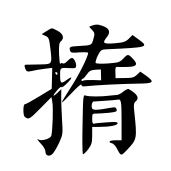
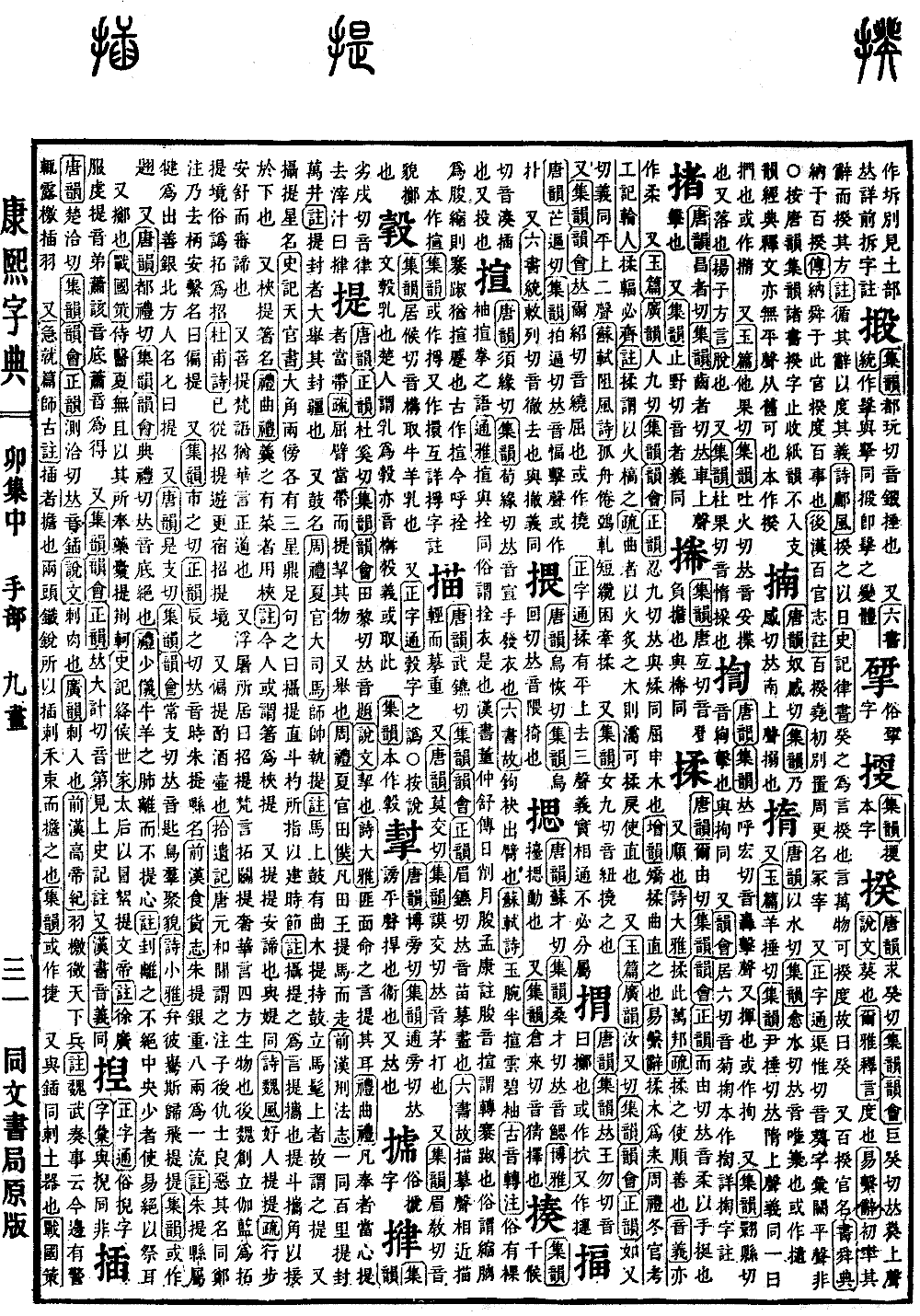
According to the "Guangyun" (Tangyun), the pronunciation is indicated by the characters "以" (yǐ) and "水" (shuǐ), and according to the "Jiyun" (Jiyun), it is indicated by "愈" (yù) and "水" (shuǐ). The pronunciation is the same as "唯" (wéi). The meaning is to abandon. Some versions write it as "".
Also, according to the "Yupian" (Yupian), the pronunciation is indicated by the characters "羊" (yáng) and "捶" (chuí), and according to the "Jiyun" (Jiyun), it is indicated by "尹" (yǐn) and "捶" (chuí). The pronunciation is the third tone of "隋" (suí). The meaning is the same. Another explanation is to stroke. Some versions write it as "".
Also, according to the "Yupian" (Yupian), the pronunciation is indicated by the characters "他" (tā) and "果" (guǒ), and according to the "Jiyun" (Jiyun), it is indicated by "吐" (tǔ) and "火" (huǒ). The pronunciation is the same as "妥" (tuǒ). The meaning is to count by numbers. Another meaning is to fall. The "Fangyan" (Yangzi Fangyan) explains it as to fall off.
Also, according to the "Jiyun" (Jiyun), the pronunciation is indicated by the characters "杜" (dù) and "果" (guǒ). The pronunciation is the same as "惰" (duò). The meaning is to measure.