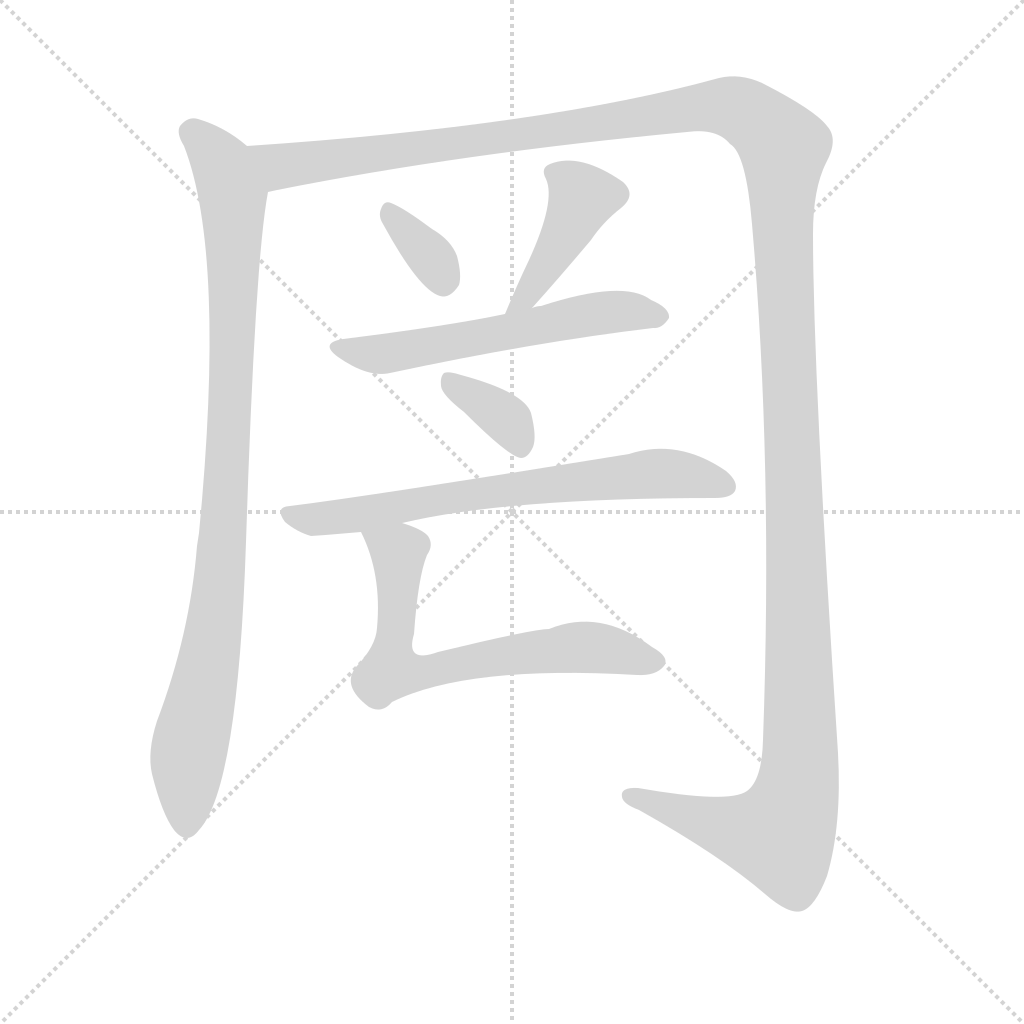
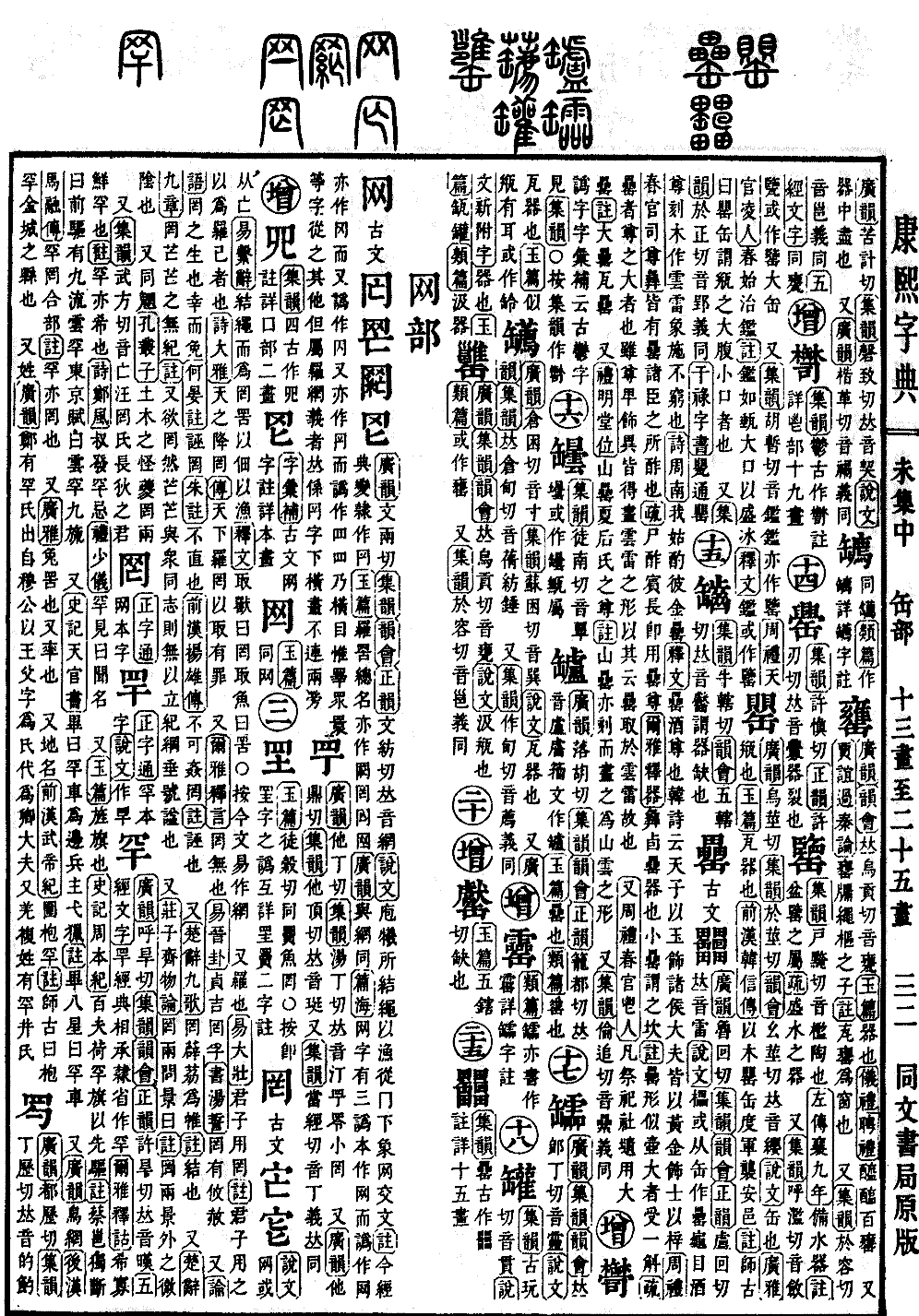
Wei Collection, Middle Volume Radical: Net (wǎng) 罔; Kangxi strokes: 9; Page: 946, Entry 30
Shuowen Jiezi (Shuowen): Some forms of the character "wǎng" add the "wáng" component.
Book of Changes (Yijing), Xici Commentary: Ropes were knotted to make nets, used for hunting and fishing. Commentary: Catching animals is called "wǎng", catching fish is called "wǎng". Note: Current versions of the Book of Changes (Yijing) write it as "wǎng".
Also means "net" or "snare". Book of Changes (Yijing), Dazhuang Hexagram: The noble person uses a net. Commentary: The noble person uses it to ensnare their own things.
Book of Odes (Shijing), Daya: Heaven sends down snares. Commentary: Heaven spreads out nets to capture the guilty.
Also: Erya, Shiyan: "Wǎng" means "nothing" or "without".
Book of Changes (Yijing), Jin Hexagram: Remaining upright brings good fortune, without integrity.
Book of Documents (Shujing), Tangshi: There will be no pardon.
Also: Analects of Confucius (Lunyu): To live without uprightness is merely to have luckily escaped disaster. He Yan's Commentary: To frame and deceive. Zhu Xi's Commentary: Not upright.
History of the Former Han (Qian Han Shu), Biography of Yang Xiong: Cannot be deceived. Commentary: To frame.
Also: Songs of Chu (Chuci), Jiu Ge: Binding wild pepper vines into curtains. Commentary: To bind or weave.
Also: Songs of Chu (Chuci), Jiu Zhang: Vast and boundless, without a clue. Commentary: If one wishes to be vast and boundless, aligning with the common people, then it will be impossible to establish laws and norms, or pass on one's name.
Also: Zhuangzi, Qiwulun: Wangliang asked the shadow. Commentary: Wangliang refers to the faint shadow at the edge of a shadow.
Also the same as "wǎng" (魍). Kong Congzi: Spirits of earth and wood are Kui and Wangliang.
Also: Jiyun: Read as "wǔ fāng qiē", pronounced "wáng". The Wangwang clan, rulers of the Changdi tribe.
Textual Research: Songs of Chu (Chuci), Jiu Ge: Binding wild pepper vines into curtains. Based on the original text, the character "xī" (兮) should be added after "bìlì" (薜荔).