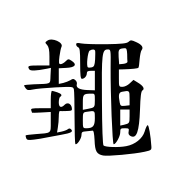
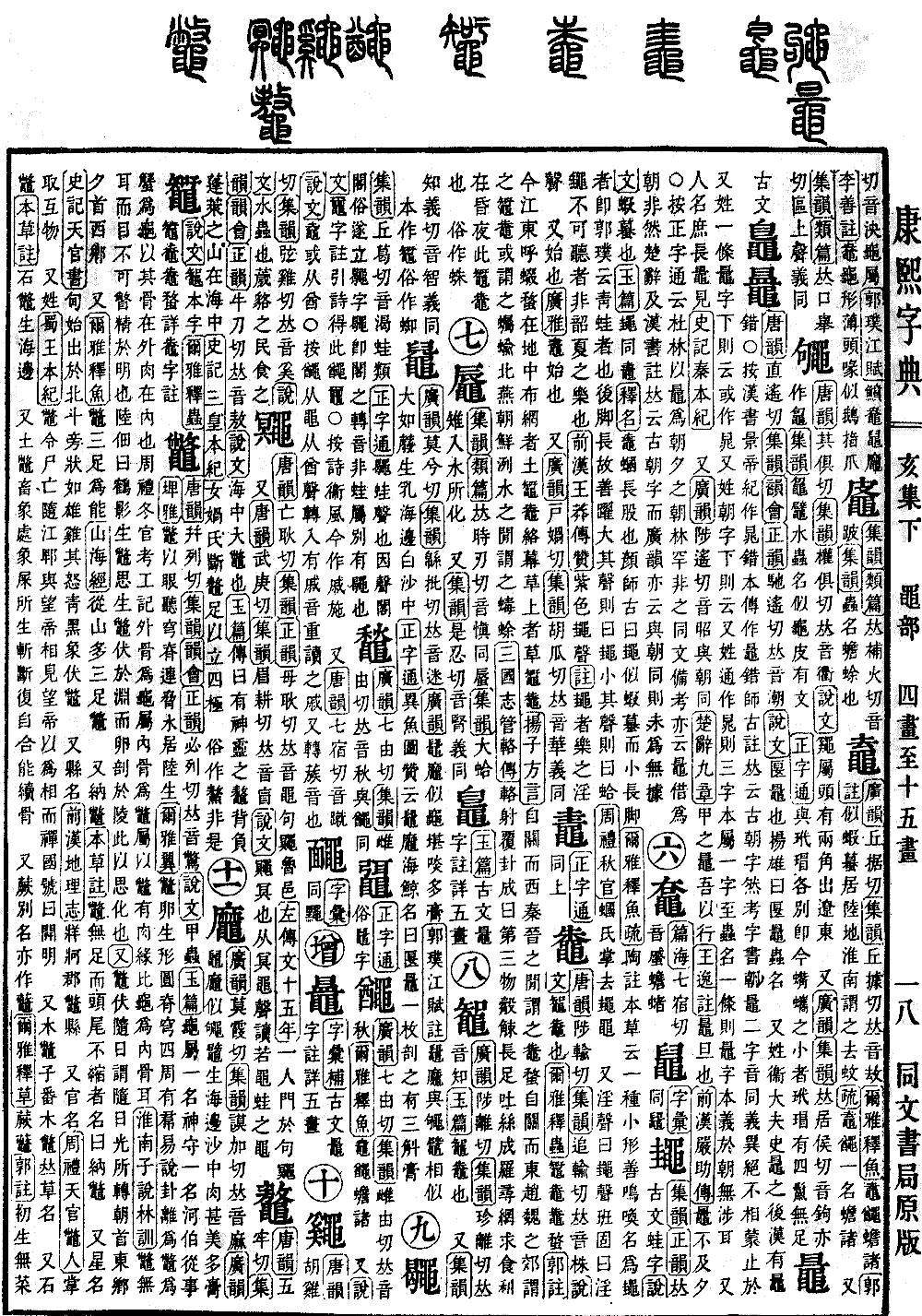
"Frog" (wā) is written in ancient script. "Shuowen Jiezi" explains it as "xiama" (frog). "Yupian" states that "䵷" is the same as "鼃". "Shiming" says that "鼃蟈" refers to creatures with long legs. Yan Shigu explains that "䵷" resembles a frog but is smaller, with long legs. In "Erya: Shiyu Shu," Tao Hongjing annotates "Bencao" stating that a small, loud-croaking creature called "䵷" is what Guo Pu referred to as a frog. Its long hind legs enable it to jump well. Those with loud croaks are called "䵷," while those with quiet croaks are called "ge" (frog). "Zhou Li: Qiuguan" records that the official position of "Guo Shi" was responsible for driving away "䵷" and "min" (types of frogs).
Furthermore, "䵷" can refer to decadent musical sounds. Ban Gu states that decadent "䵷" sounds are not worth listening to, unlike the elegant music of "Shao" and "Xia." "Qian Hanshu: Wang Mang Zhuan Zan" mentions "purple 䵷 sounds." The annotation clarifies that "䵷" refers to decadent sounds in music.
Additionally, "䵷" can mean "to begin." "Guangya" states that "鼃" means "to begin."
Moreover, "Guangyun" provides the pronunciation "huo wa qie," and "Jiyun" provides "hu guā qie," with the same pronunciation as "huá." The meanings are identical.