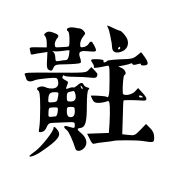
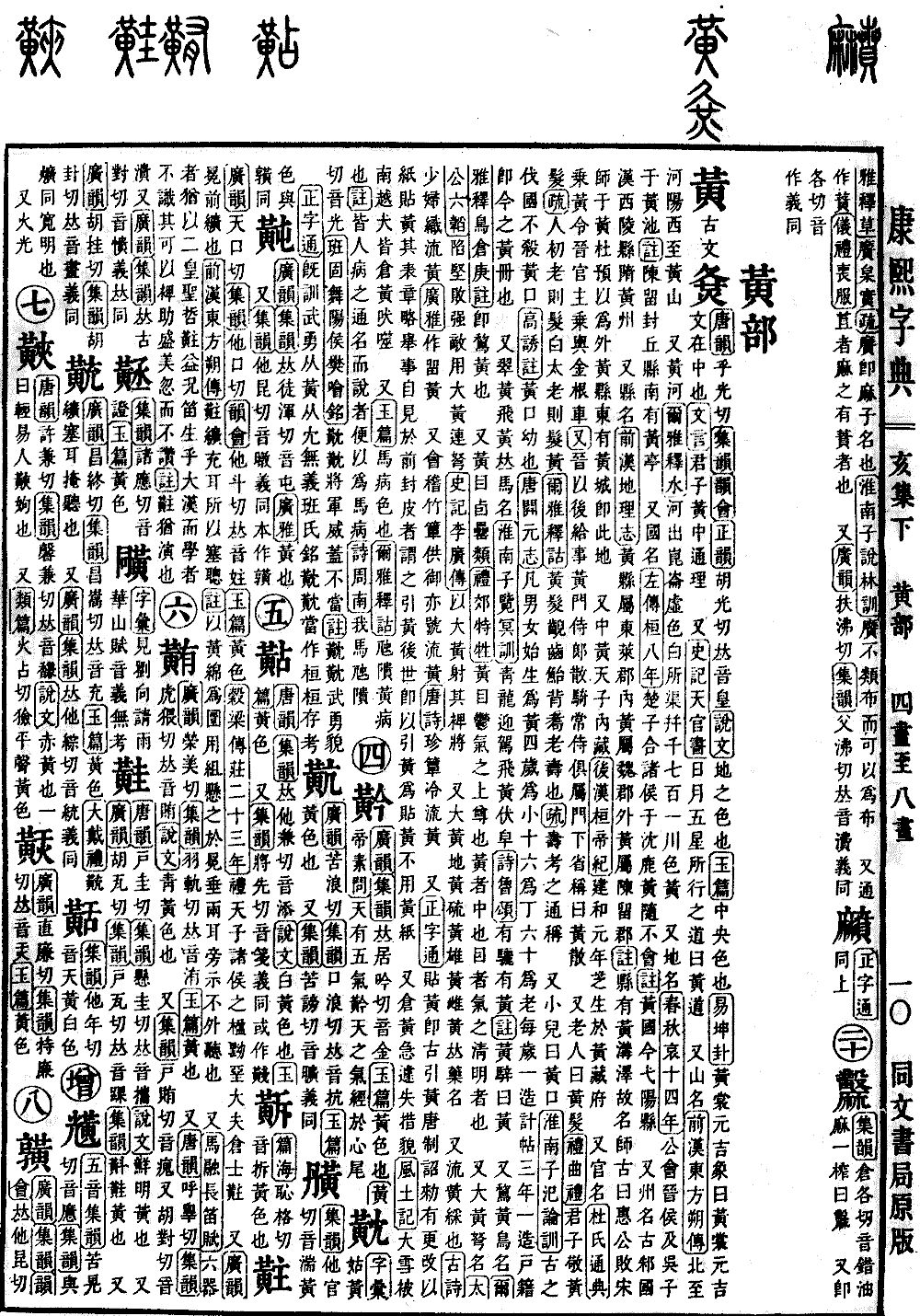
Hai Collection, Lower Volume
Radical: Yellow (huáng)
Kangxi Strokes: 17
Page 1516, Entry 12
Pronounced tǒu.
Yellow color.
According to the Annals of the Spring and Autumn Period (Guliang Zhuan), by the rites, the pillars of the Son of Heaven and the feudal lords were painted black and white, those of the grand masters were painted blue, and those of the scholars were painted yellow.
Also, it refers to the cotton pellets hanging from the front of a ceremonial cap.
In the Biography of Dongfang Shuo from the History of the Former Han Dynasty (Qian Hanshu), it states that yellow silk cotton was used to make small balls to plug the ears, signifying a refusal to listen to useless words. The commentary explains that yellow cotton was made into pellet shapes and suspended by silk cords on both sides of the cap to hang beside the ears, indicating a refusal to listen to biased or distracting external noises.
Also, in the Rhapsody on the Long Flute by Ma Rong, it notes that if the six musical instruments were refined and augmented by the sage rulers of the past, how much more so should the flute be valued, as it originated in the Great Han; yet scholars do not realize it can assist in enhancing the beauty of a prosperous age, neglecting to praise it. The commentary explains that the term here carries the meaning of to elaborate or to develop.
Textual Research: In the Biography of Dongfang Shuo from the History of the Former Han Dynasty, the text mentions using yellow cotton pellets to plug the ears to block sound. The commentary describes this as yellow cotton made into a round shape. We have carefully corrected the original note from round shape to pellet shape.