You Collection, Middle Volume
Radical: Foot (zú)
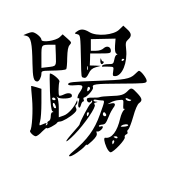
Character: tang
Kangxi Strokes: 16
Page 1229, Entry 37
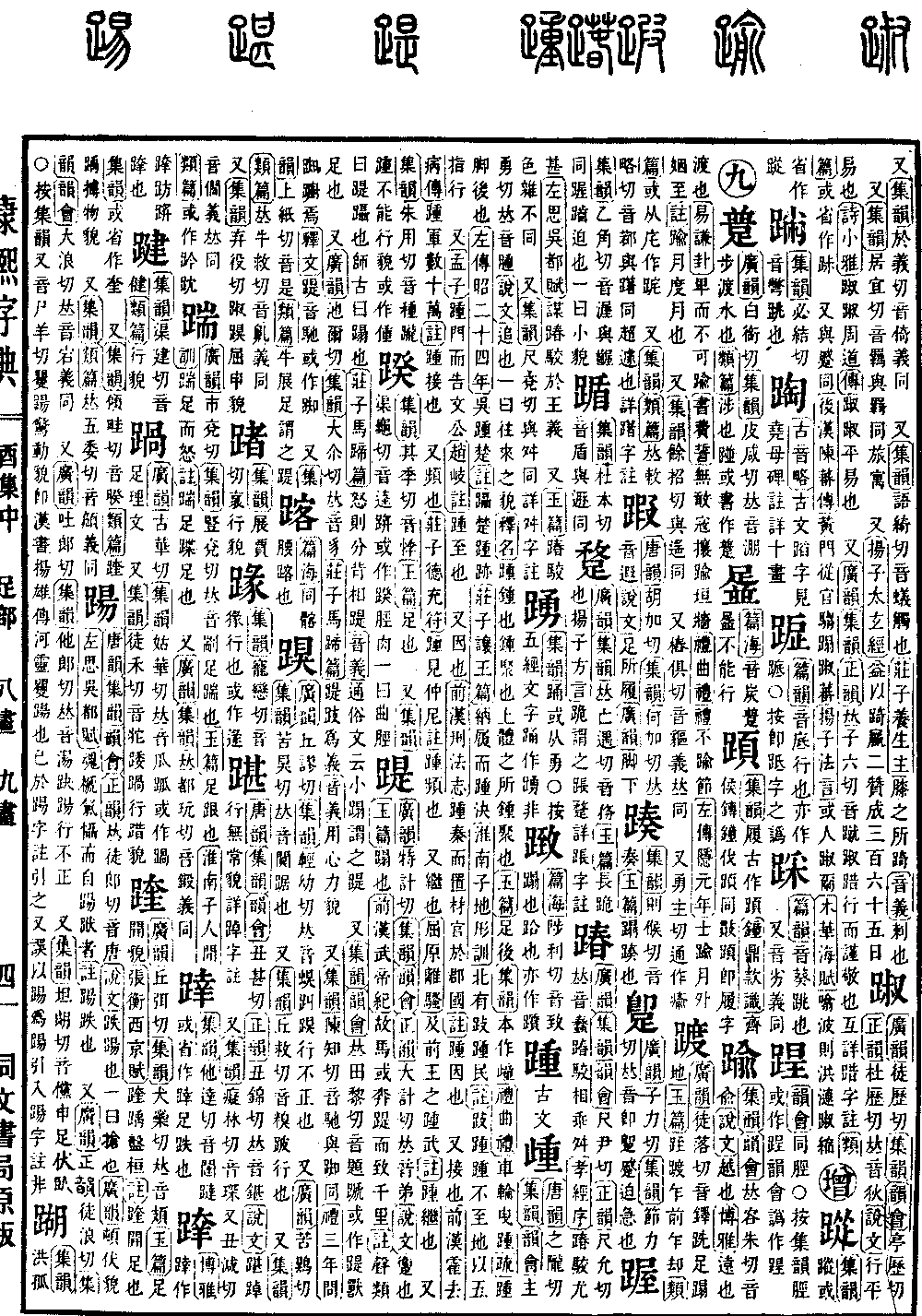
Tangyun, Jiyun, Yunhui, and Zhengyun dictionaries state: Pronounced tang. According to the Shuowen Jiezi (Shuowen), it means to stumble. Another source says it means to rush. Guangyun dictionary defines it as the appearance of falling prostrate. In the Rhapsody on the Capital of Wu (Wudu Fu) by Zuo Si, it is written: Souls are stripped away and spirits are terrified, causing them to stumble of their own accord. The commentary states that this refers to stumbling.
Also, Guangyun and Zhengyun dictionaries state: Pronounced tang (falling tone). Jiyun and Yunhui dictionaries state: Pronounced dang (falling tone). The meaning is the same.
Also, Guangyun dictionary states: Pronounced tang. In the compound juetang, it describes an unsteady gait.
Also, Jiyun dictionary states: Pronounced tang (rising tone). It means to stretch out one's legs and lie prone. According to the Jiyun, it is also pronounced shi (level tone) and yang (level tone). In the compound juetang, it describes the appearance of being startled or agitated, as seen in the Biography of Yang Xiong in the Book of Han (Hanshu). This has already been cited in the commentary for the character ti, but it was mistakenly identified as tang and included here in the entry for tang, which is incorrect.