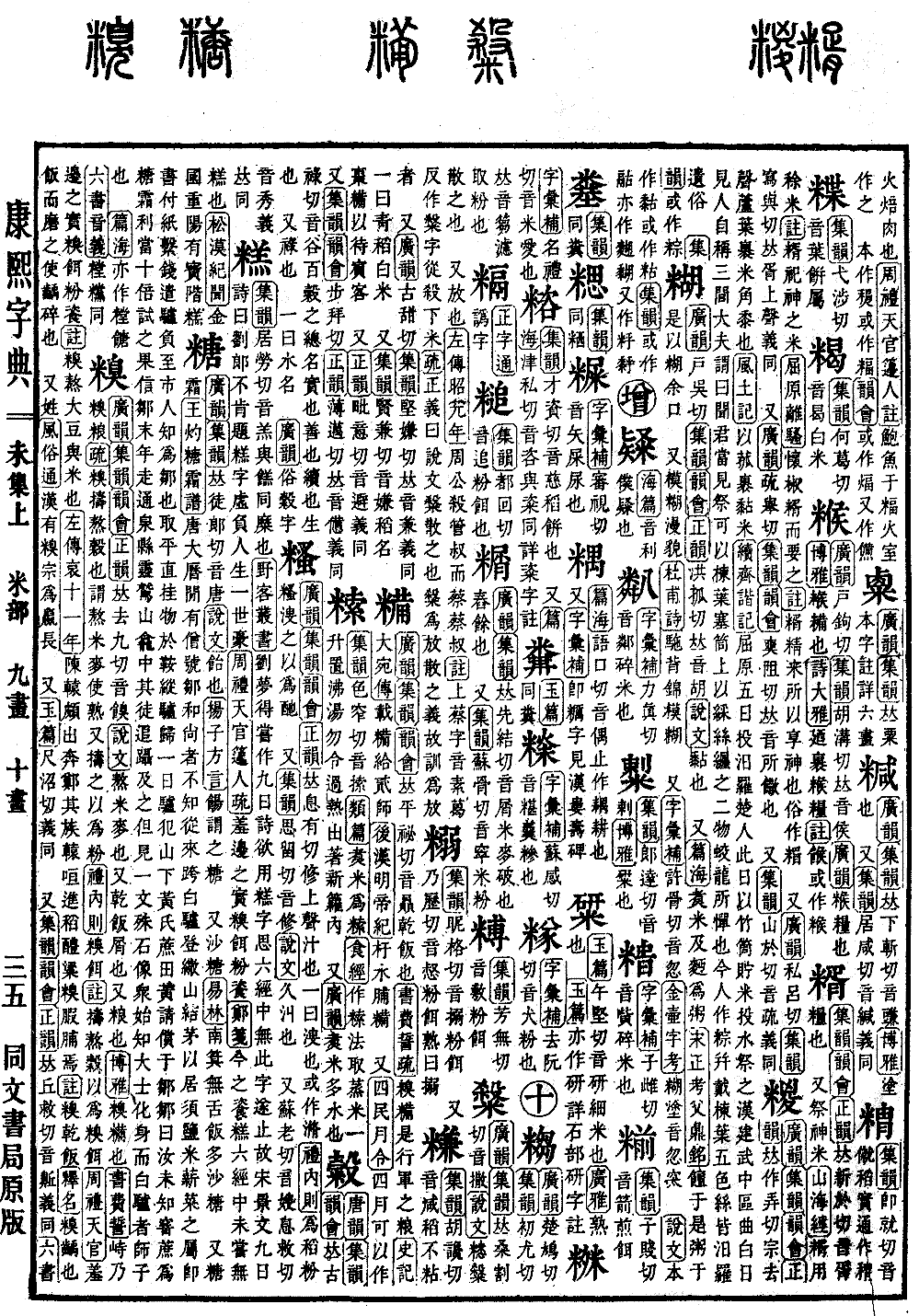
Wei Collection, Upper Volume
Radical: Rice (mǐ)
Kangxi Strokes: 16
Page 911, Entry 38
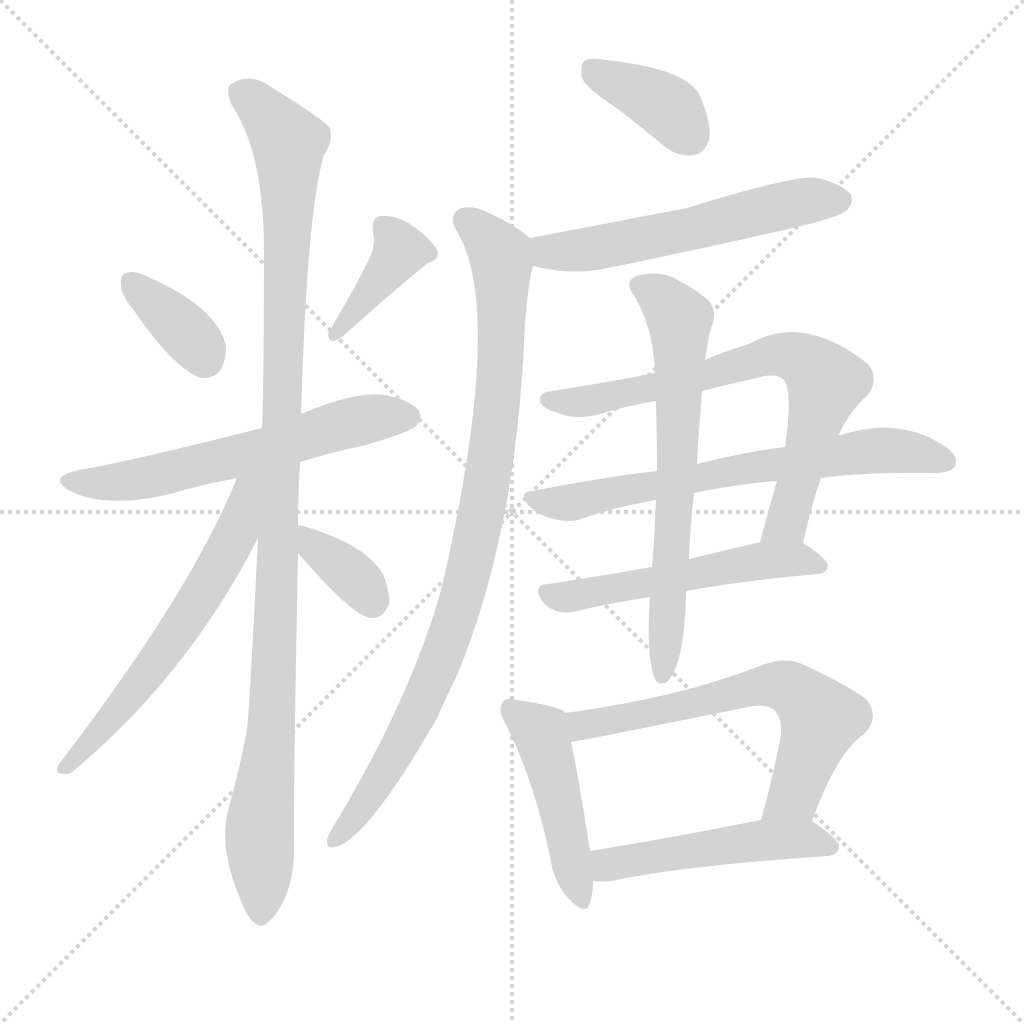
Pronounced tang.
Shuowen Jiezi (Explanation of Simple and Compound Characters) defines it as maltose. Yangzi’s Fangyan (Regional Dialects) states that the term xing refers to this same substance. It also refers to granulated sugar.
The Yilin (Forest of Changes) states: The Southern Winnowing Basket constellation has no tongue, and the rice is filled with granulated sugar.
It also refers to sugar frost. According to the Sugar Frost Treatise (Tangshuang Pu) by Wang Zhuo, during the Dali era of the Tang Dynasty, a monk known as Priest Zou appeared from parts unknown. He rode a white donkey and climbed Umbrella Mountain, where he built a thatched hut to dwell in. Whenever he needed items such as salt, rice, firewood, or vegetables, he would write a list on paper, attach money, and have the donkey carry it to the market. People knew the donkey belonged to the priest and would hang the requested items on the saddle for a fair price, then send the donkey back. One day, the donkey trampled a sugarcane field belonging to a man named Huang, who demanded compensation from the priest. Priest Zou replied, You do not yet know how to store sugarcane to produce sugar frost, which would increase your profits tenfold. Huang tried the method and found it to be true. In his later years, Priest Zou went to a Buddhist niche on Lingjiu Mountain in Tongquan County. When his disciples followed him, they found only a stone statue of the Bodhisattva Manjushri. The people then realized he was an incarnation of the Bodhisattva, and the white donkey was a lion.
The Pianhai (Sea of Characters) notes that it is also written in the variant forms tang and tang. The Liushu Yinyi (Meaning of Sounds in the Six Writings) states that the character tang is the same as this.