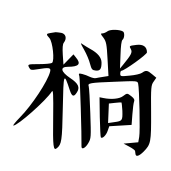
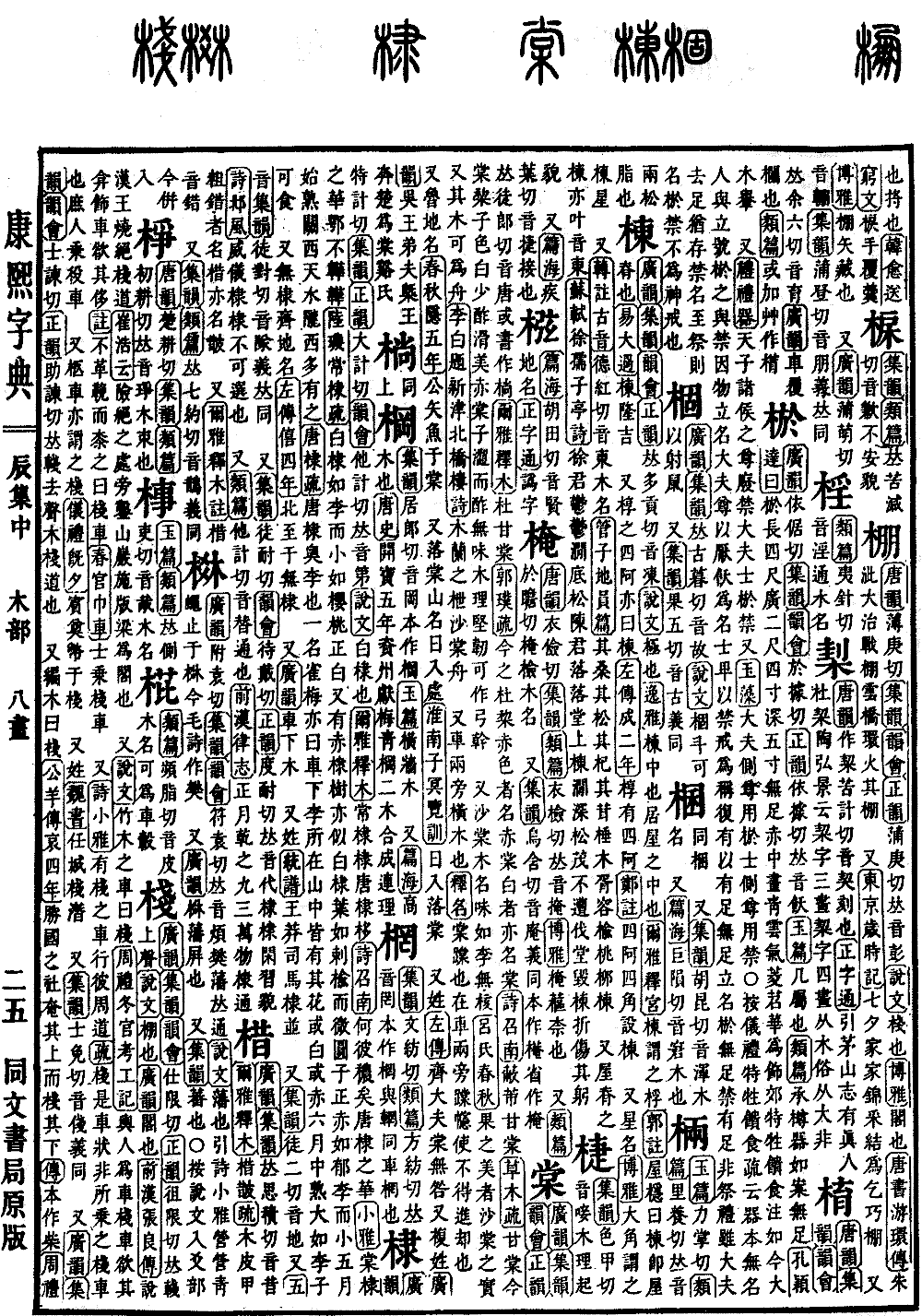
Chen Collection, Middle Volume, Radical: Tree (mù)
táng; Kangxi Stroke Count: 12; Page: 533, Entry 14
Pronounced táng. Also written as 𣘺.
"Wild pear, sweet pear" — Er Ya (Shuowen Jiezi), section on trees. Guo Pu's commentary: It is the wild pear of today. The red ones are called red táng, and the white ones are also called táng.
"Shade beneath the sweet pear tree" — Book of Odes (Shijing), section Nan.
"Sweet pear, today's wild pear. Its fruit is white, slightly sour, smooth and delicious. Red pear, its fruit is astringent and sour, tasteless. The wood is strong and tough, suitable for making bow staves." — Cao Mu Shu.
Also, shātáng, a type of tree. Its fruit tastes like plum and has no pit.
"The finest of fruits is the fruit of shātáng." — Lüshi Chunqiu.
Its wood can be used for boats.
"Magnolia planks for the paddle, shātáng boats for the journey." — Li Bai, Poem "On the North Bridge Tower at Xinjin."
Also, the horizontal wooden beams on either side of a carriage. "Táng, [carriages]. On the sides of the carriage are the head coverings, preventing them from moving forward or backward." — Shiming.
Also, a place name in Lu.
"The Duke shot fish at Táng." — Spring and Autumn Annals (Chunqiu), fifth year of Duke Xuan.
Also, Luòtáng, a mountain name. Where the sun sets.
"The sun sets beyond Luòtáng." — Huainanzi, chapter Minglan.
Also, a surname.
"Qi high official Táng Wújiù." — Zuo Zhuan.
Also, a compound surname.
"The King of Wu's younger brother, King Fúgài, fled to Chu and became Tángxī clan." — Guangyun.