Hai Collection, Upper Volume
Radical: Carriage (mǎ)
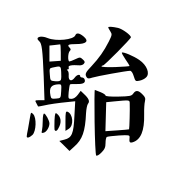
駘
Kangxi Strokes: 15
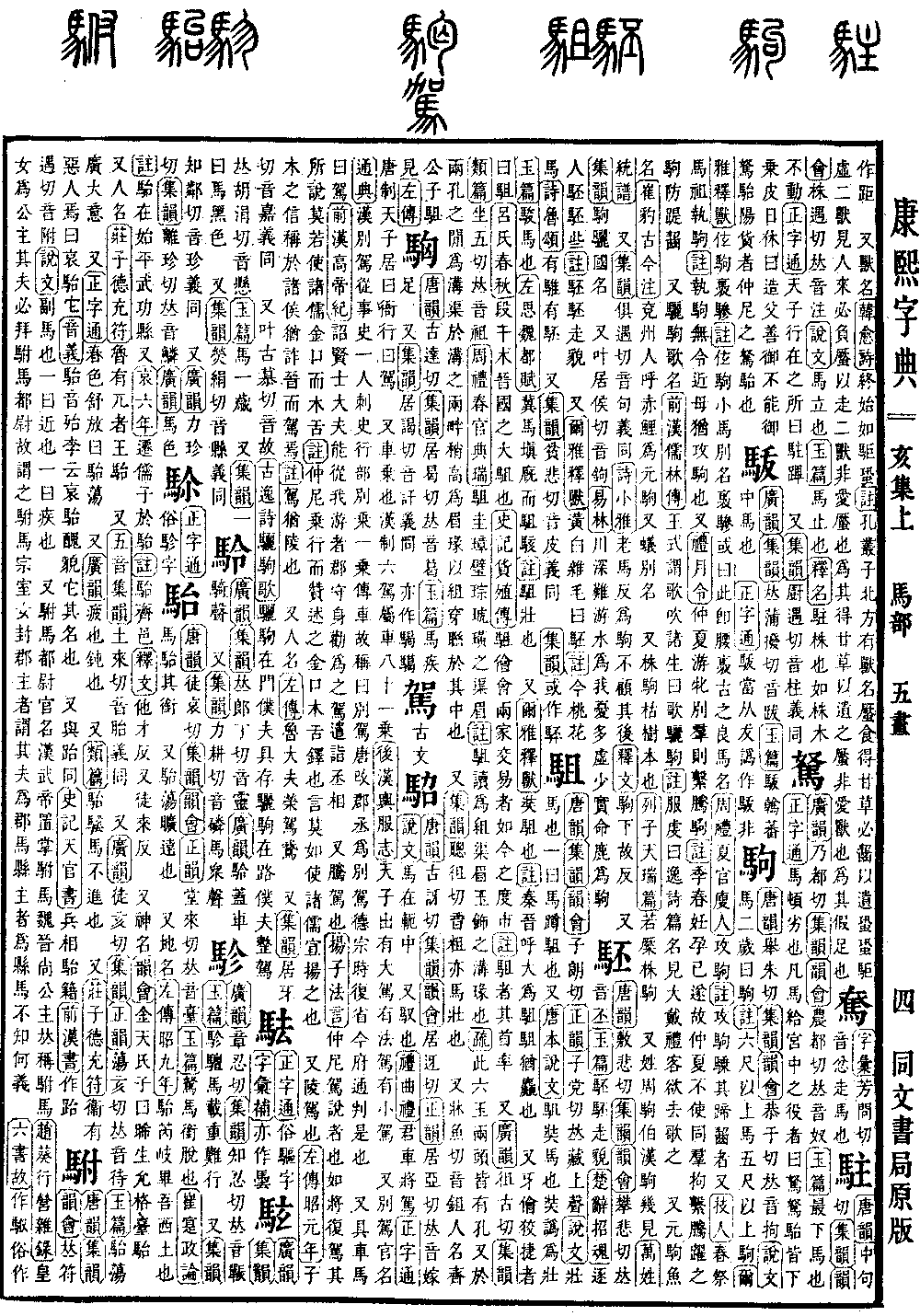
Page 1436, Entry 16
Pronounced tái. According to the Tang Rhyme (Tangyun), the Jiyun, the Rhyme Collection (Yunhui), and the Correct Rhymes (Zhengyun), it is pronounced tái. According to the Jade Chapter (Yupian), it refers to a poor horse that has broken free from its bit. According to the Political Treatise (Zheng lun) by Cui Shi, a horse that has broken free from its bit. Also, tai dang refers to a vast and distant expanse. It also refers to a place name. According to the Zuo Commentary (Zuozhuan), Year 9 of Duke Zhao, Wei, Tai, Rui, Qi, and Bi were our western territories. The commentary notes that Tai was located in Wugong County, Shiping. Furthermore, in Year 6 of Duke Ai, the young child was moved to the territory of Tai. The commentary notes that Tai was a city-state of Qi. The Explanation of Texts (Shiwen) notes it is pronounced both tāi and tái. Also refers to the name of a deity. According to the Rhyme Collection (Yunhui), the son of the Golden Sky Emperor (Jintianshi) was named Xi, who fathered Yunge and Taitai. Also refers to a personal name. According to the Zhuangzi (Zhuangzi), in the state of Lu there was a man who had his feet cut off named Wang Tai. According to the Five Sounds Rhyme Collection (Wuyin jiyun), it is pronounced tāi, with the same meaning. According to the Broad Rhymes (Guangyun), the Jiyun, and the Correct Rhymes (Zhengyun), it is pronounced dài. According to the Jade Chapter (Yupian), tai dang refers to the meaning of vast and profound. According to the Correct Meaning Guide (Zhengzitong), the spreading and relaxing of spring colors is called tai dang. According to the Broad Rhymes (Guangyun), it refers to being fatigued or dull. According to the Classified Chapters (Leipian), tai xi refers to a horse refusing to move forward. According to the Zhuangzi (Zhuangzi), in the state of Wei there was a man with an ugly appearance named Aitai Tuo. The phonetic commentary states that Tai is pronounced like dài. Li Yi states: Aitai is the appearance of ugliness, and Tuo is his name. It is also used interchangeably with tai. According to the Records of the Grand Historian (Shiji), Book of Celestial Officials, armies trampling upon one another. In the Former Han History (Qian Hanshu), it is written as tai.
Textual research: In the Zuo Commentary, Year 9 of Duke Zhao, it lists Tai, Rui, Qi, and Bi. According to the original text, the character Wei has been added before Tai. In Year 6 of Duke Ai, it refers to moving the young child to Tai. According to the original text, the characters for young child have been corrected.