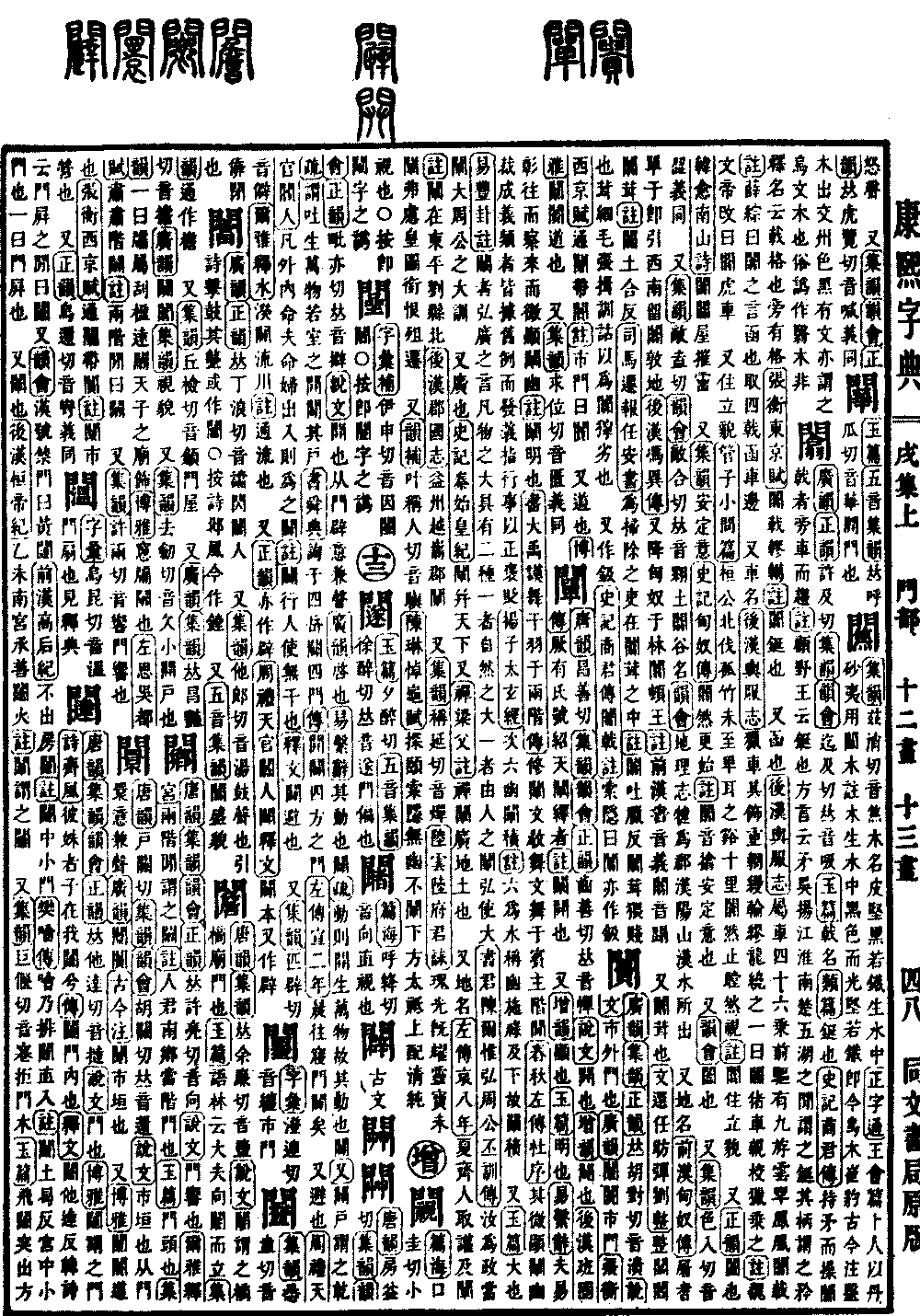
Xu Collection, Upper Volume
Radical: Gate (mén)
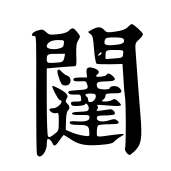
Tat
Kangxi Strokes: 21
Page 1342, Entry 20
Pronounced ta.
Shuowen Jiezi (Shuowen): A gate.
Guangya (Boya): A gate is called a ta.
Book of Odes (Shijing), Odes of Qi: That beautiful woman, she is within my gate.
Commentary: Ta refers to the space inside a gate.
Explanation of Texts (Shiwen): Ta, pronounced ta. Han school interpretations state the space between the gate and the screen is called a ta.
Also, Dictionary of Rhymes (Yunhui): During the Han dynasty, the restricted gates of the palace were called the yellow gates (huangta).
History of the Former Han (Qianhan), Annals of Empress Dowager Gao: Did not leave the chamber gate.
Annotation: Ta refers to a small, central gate.
Biography of Fan Kuai: Kuai then pushed open the gate and entered directly.
Annotation: Ta, pronounced ta. A small gate within a palace. Another interpretation suggests it refers to a gate screen.
Also refers to palace buildings.
History of the Later Han (Houhan), Annals of Emperor Huan: On the day of yiwei, fire broke out at the Chengshan Gate of the Southern Palace.
Annotation: Palace buildings are called ta.
Also, Collected Rhymes (Jiyun): Pronounced jian. The wooden beam at the top of a gate.
Yupian: Flying ta, a protruding square beam.
Also, Supplement to Rhymes (Yunbu): Rhymes with tuo.
Cui Yin, Meaning of Attainment (Dazhi): Ascending the steps to gaze into the purple palace gates, leaning against the high pavilion to view the vermilion watchtowers.
Also rhymes with zhui.
Cao Zhi, Eulogy for Wang Can: My king established the state, with officials both worthy and capable; you, because of your prominence, were recommended to manage the vital machinery and frequent the inner palace.