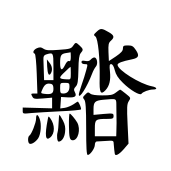
Pronounced tu (falling tone) with the rhyme of he (entering tone) according to Guangyun, and da (falling tone) with the rhyme of he (entering tone) according to Jiyun. The pronunciation is the same as "ta". The meaning is black.
It also refers to a messy and numerous appearance. The "Yüpiān" (Jade Lexicon) records the term "䵬伯" (liáng bó) in the "Book of Jin". The "Yánshì jiāxùn" (Family Instructions of the Yan Clan) mentions that the "Annals of the Jin Dynasty's Revival" records that Yang Man, a native of Mount Tai, was unrestrained, uninhibited, fond of chivalry, and drank excessively. He was known as "濌伯" (liáng bó) in Yanzhou. There is a folk saying "濌濌" (liáng liáng), which probably means using everything and accommodating everything. Gu Yewang's "Yüpiān" mistakenly wrote the character with the black radical plus "ta". In the several versions I have seen, it is not written with the black radical. "Chóngdá" (重沓) means abundant and heavy, with much accumulation, so adding the black radical is meaningless. ○According to "Zìhuì" (Dictionary of Characters), this character should have the "chóng" (重) radical.
Also, according to Jiyun and Zhengyun, the pronunciation is tuo (falling tone) with the rhyme of he (entering tone), and the pronunciation is the same as "tuó". The meaning is the same.