Wei Collection, Lower Volume
Radical: Meat (ròu)
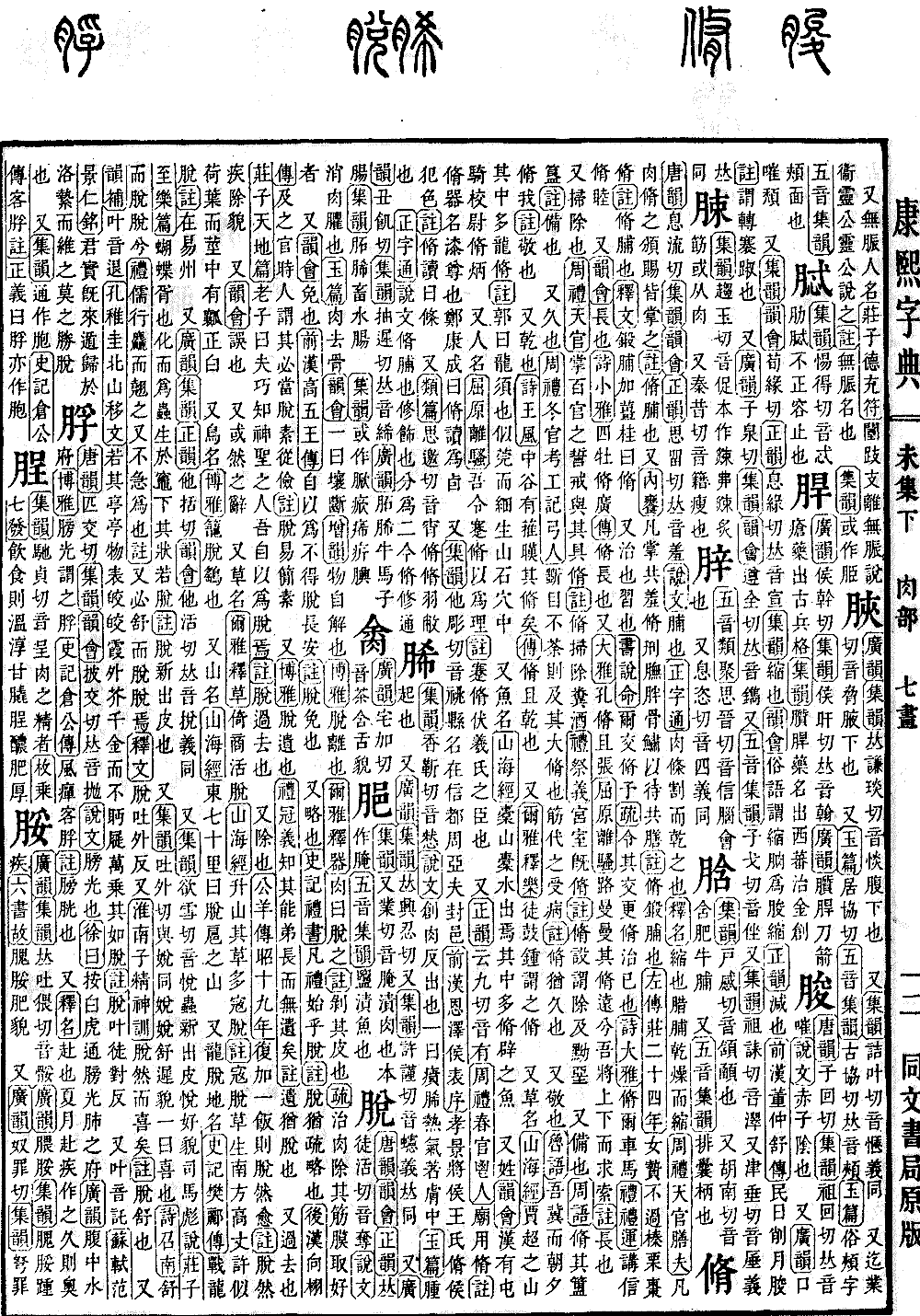
Page 984, Entry 12
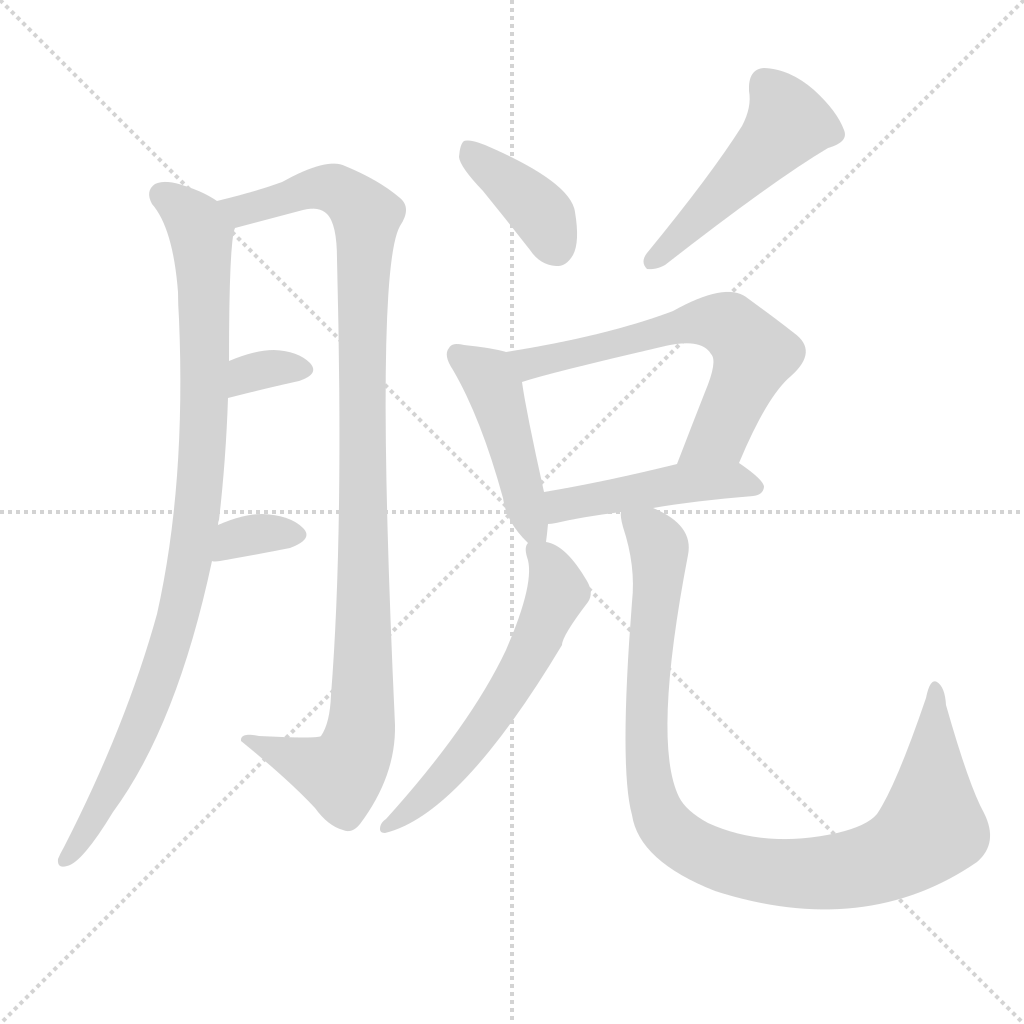
Pronounced duó.
In the Explanation of Characters (Shuowen), it means meat that has wasted away. In the Jade Chapters (Yupian), it means meat removed from the bone. In the Rhyme Collection (Yunhui), it also means to break off. In the Extended Rhymes (Zengyun), it refers to things coming apart by themselves. In the Extensive Eulogies (Boya), it means to separate. In the Literary Expositor (Erya), on the explanation of implements, it states: for meat, it is called stripping it. The commentary says: this means to peel off its skin. The sub-commentary says: when processing meat, one removes the sinews and membranes to select the choice parts.
Also, in the Rhyme Collection, it means to escape. In the History of the Former Han (Qianhan), biographies of the five sons of Emperor Gao, it says: they considered themselves unable to escape Chang'an. The commentary says: here it means to avoid or escape.
Also, it means negligent. In the Records of the Grand Historian (Shiji), book of rites, it says: all rites begin with simplification. The commentary says: here it means to be coarse and negligent. In the History of the Later Han (Houhan), biography of Xiang Xu, it says: when he reached his official post, people of the time said he would certainly cast off his simple ways and follow thrift. The commentary says: to cast off the plain.
Also, in the Extensive Eulogies, it means to omit. In the Book of Rites (Liji), on the meaning of the capping ceremony, the commentary says: to omit is like to strip away.
Also, it means to pass by. In the Zhuangzi, heaven and earth chapter, Laozi says: as for those who are cleverly wise and divinely sagacious, I consider myself to have transcended them. The commentary says: here it means to have passed beyond.
Also, it means to eliminate. In the Gongyang Commentary (Gongyangzhuan), 19th year of Zhao, it says: adding another meal, then he was suddenly healed. The commentary says: appearing as if the illness had been completely cured.
Also, in the Rhyme Collection, it means a mistake.
Also, it is a word indicating possibility.
Also, the name of a plant. In the Literary Expositor (Erya), on the explanation of plants, it mentions yishang and huotuo. In the Classic of Mountains and Seas (Shanhaijing), it says: on Mount Sheng, there is much koutuo grass. The commentary says: koutuo grass grows in the south, reaches about one zhang in height, resembles lotus leaves, and has a pithy, pure white center in its stalk.
Also, the name of a bird. In the Extensive Eulogies, the longtuo is a sparrowhawk.
Also, a mountain name. In the Classic of Mountains and Seas, seventy li to the east is the mountain of Tuohu.
Also, Longtuo is a place name. In the Records of the Grand Historian (Shiji), biography of Fan and Li, it mentions a battle at Longtuo. The commentary says: it is located in Yizhou.
Pronounced tuó. The meaning is the same as the above.
Pronounced yuè. Refers to the appearance of an insect just emerged, with fresh and attractive skin. According to Sima Biao's interpretation in the Zhuangzi, supreme joy chapter: the butterfly is the xu. It transforms into an insect, born beneath the kitchen stove, and its appearance is like that which has just molted. The commentary says: this refers to newly grown skin.
Pronounced tuì. Same as the character for being at ease. Tuotuo describes a leisurely and relaxed manner. One theory suggests it denotes joy. In the Book of Odes (Shijing), Shao South section: slow and at ease. In the Book of Rites (Liji), on the conduct of a scholar, the commentary says: one must be slow and at ease. In the Commentary on the Pronunciation (Shiewen), it says: pronounced tǔwài.
In the Huainanzi, on the training of the spirit, it says: suddenly joyful. The commentary says: at ease and satisfied.
In the Rhyme Supplement (Yunbu), it rhymes with tuì. In Kong Zhigui's North Mountain Removal Proclamation: if one stands tall above the world, bright beyond the clouds, one ignores a thousand pieces of gold without a glance. To discard wealth and power is like stripping off old clothes. The commentary says: here it is read as túduì.
Also rhymes with tuō. In Su Shi's inscription for Fan Jingren: Junshi had already arrived, fleeing back to Luo. Tied and bound, unable to escape.