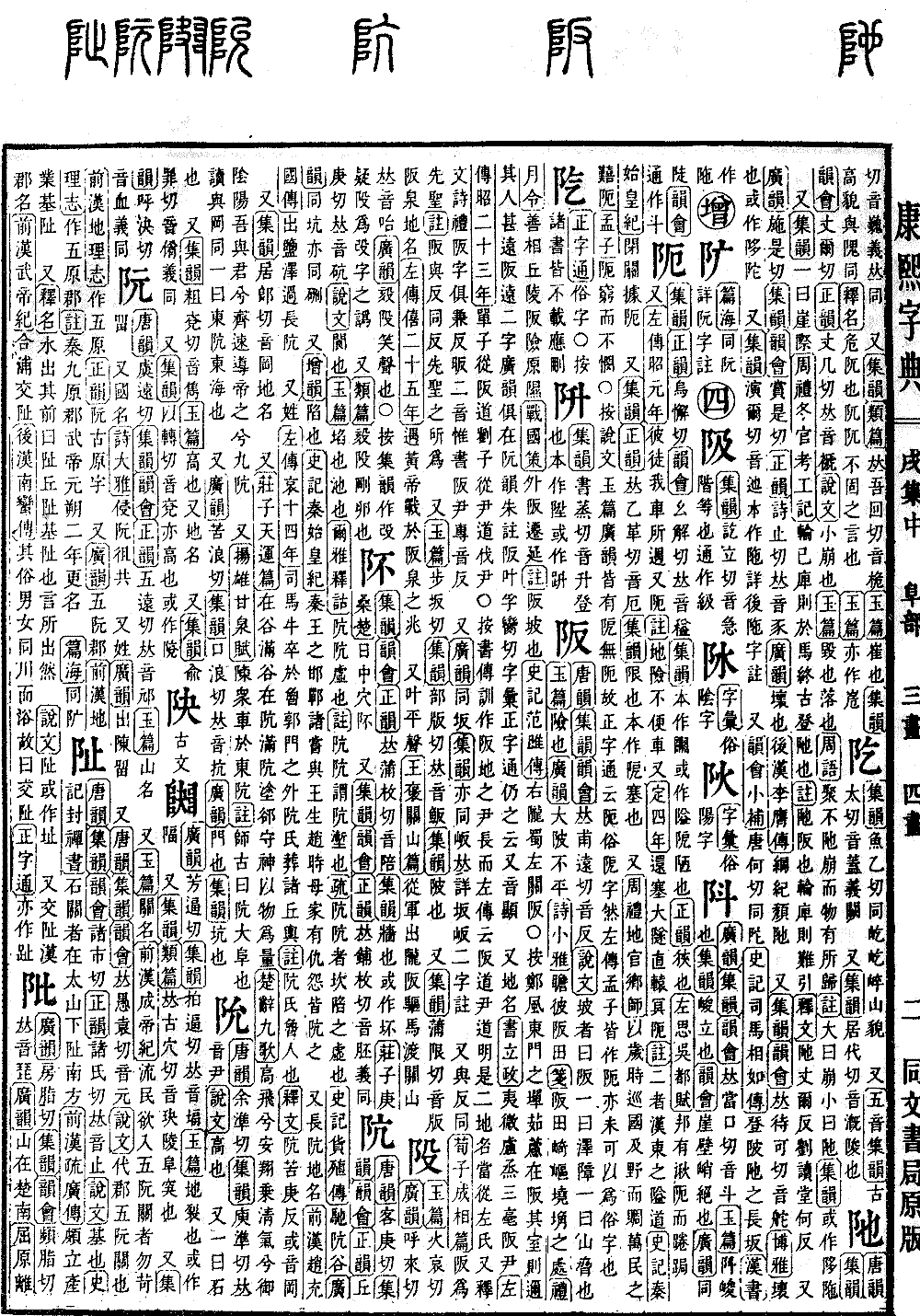
Xu Collection, Middle Volume, Radical: Mound (fù)
Page 1346, Entry 02
Pronounced chi (falling tone) — Zhùn Yùn, Jí Yùn, Yùn Huì, Zhèng Yùn: zhàng ěr qiè; Zhèng Yùn: zhàng jī qiè.
"Small collapse." — Shuō Wén
"To destroy; to fall." — Yù Piān
"The gathering did not collapse, and things returned to their place." — Zhōu Yǔ
Note: A large collapse is called bēng, a small one is called tuī.
"Also written as 陊 or 陁." — Jí Yùn
"Also, edge of a cliff." — Jí Yùn
"When the wheel rim is low, it is difficult to ascend the slope." — Zhōu Lǐ · Dōng Guān Kǎo Gōng Jì
Note: Tuī means slope; when the wheel rim is low, it is difficult to pull.
"Tuī, pronounced zhàng ěr. Liu reads it as táng hé." — Shì Wén
Pronounced shǐ — Guǎng Yùn: shī shì qiè; Jí Yùn, Yùn Huì: shǎng shì qiè; Zhèng Yùn: shī zhǐ qiè.
"To ruin." — Guǎng Yùn
"The laws and discipline were ruined." — Hòu Hàn · Lǐ Yīng Zhuàn
Pronounced duò — Jí Yùn, Yùn Huì: dài kě qiè.
"To ruin." — Bó Yǎ
"Also written as 陊 or 陀."
Pronounced yǐ — Jí Yùn: yǎn ěr qiè. Originally written as 陁. See notes for 陁.
"Also, from Yùn Huì Xiǎo Bǔ: Táng Hé qiè. Same as tuó."
"Ascending the long slope of the embankment." — Shǐ Jì · Sī Mǎ Xiàng Rú Zhuàn
"Written as 陁 in Hán Shū."