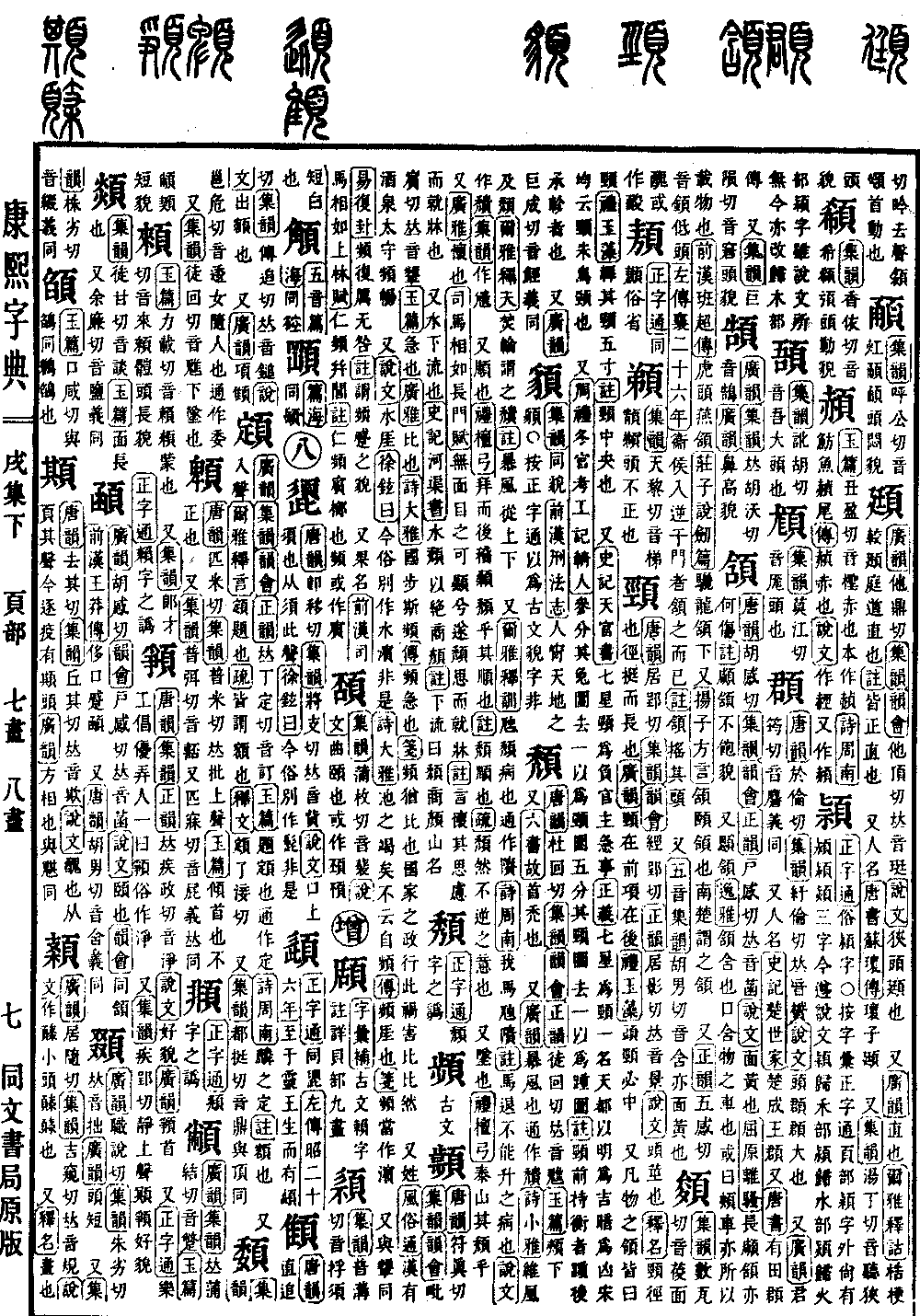
Xu Collection, Lower Volume
Radical: Page (yè)
Kangxi Strokes: 16
Page 1405, Entry 24
Pronounced tui.
According to the Jade Mirror (Yupian), the area under the cheek.
According to the Origins of the Six Writings (Liushugu), a bald head.
According to the Broad Rhymes (Guangyun), a violent wind. Often written as tui.
With winds and with collapse. — Book of Odes (Shijing)
A revolving wind is called tui. — Literary Expositor (Erya)
Note: A violent wind blowing from above.
Also in the Literary Expositor (Erya), hui-tui refers to an illness. Often written in a variant form.
My horses are exhausted and weary. — Book of Odes (Shijing)
Note: The ailment of a horse retreating and unable to ascend.
In the Explanation of Writing (Shuowen), it is written as tui. In the Collected Rhymes (Jiyun), it is written as tui.
Also, to be compliant.
To bow and then touch the forehead to the ground, so compliant and submissive. — Book of Rites (Liji)
Note: Tui means compliant.
Commentary: The meaning of being naturally compliant and not resistant.
Also, to fall.
Mount Tai is perhaps collapsing. — Book of Rites (Liji)
According to the Broad Erudition (Guangya), to ruin.
Without a face that can be displayed, I thus ruin my thoughts and go to bed. — Sima Xiangru, Rhapsody on the Long Gate (Changmen Fu)
Note: Meaning to corrupt one's thoughts and go to bed.
Also, for water to flow downward.
The water flowed down to cut off Shangyan. — Records of the Grand Historian (Shiji)
Note: A downward flow is called tui. Shangyan is the name of a mountain.
Textual Research:
In the Book of Odes (Shijing), my horses are exhausted and weary. The note mentions the ailment of a horse retreating and unable to ascend. We have corrected this to refer to the Explanation of Pronunciations (Shiwen) according to the original text.
In the Broad Erudition (Guangya), the entry for ruin was corrected from the character for cherish to the character for ruin according to the original text in Sima Xiangru's Rhapsody on the Long Gate (Changmen Fu).