Xu Collection, Middle Volume
Radical: Mound (fù)
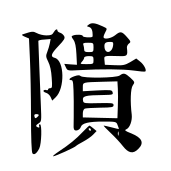
Character: 隤
Kangxi Strokes: 20
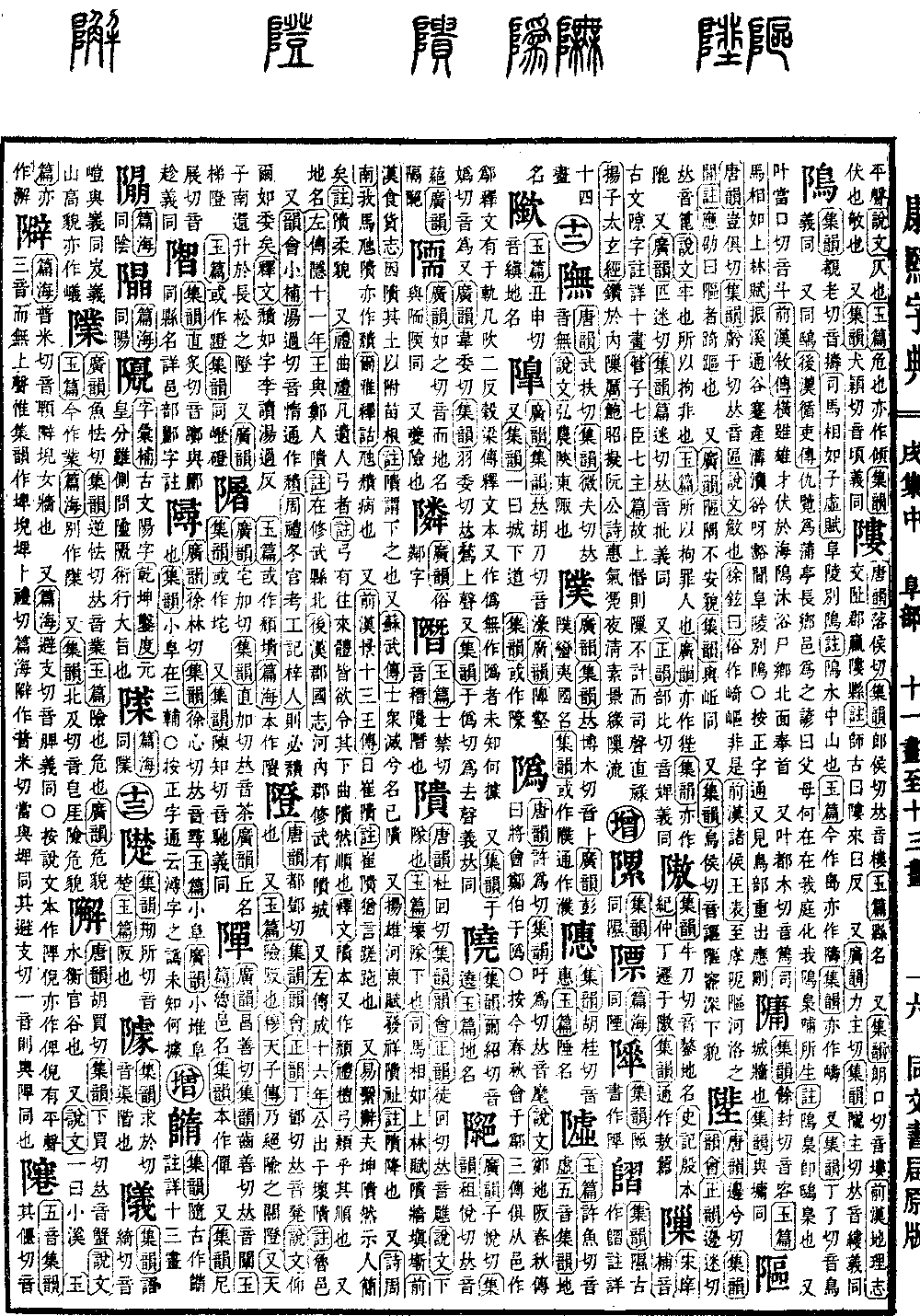
Page Number: 1360, Entry 24
According to Tang Rhymes (Tangyun), pronounced tuí. According to Collected Rhymes (Jiyun), Rhyme Compendium (Yunhui), and Correct Rhymes (Zhengyun), pronounced tuí.
According to Shuowen Jiezi, to fall downwards.
According to Jade Chapters (Yupian), to collapse and sink.
In Sima Xiangru's Rhapsody on the Imperial Park (Shanglin Fu), "destroyed walls and filled up ditches."
In the Former Han's Treatise on Food and Money (Shihuo Zhi), "to bank up the soil, close to the roots of the seedlings." The commentary states that tuí refers to covering with soil.
Also, in the Biography of Su Wu (Su Wu Zhuan), "soldiers are almost all casualties, and one's reputation has also fallen."
Also, in Yang Xiong's Rhapsody on Hedong (Hedong Fu), "heaven bestows auspicious blessings." The commentary states that tuí means to descend.
Also, in the Book of Odes (Shijing), Zhou Nan section, "my horses are weary and collapsed." Also written as tuí (穨).
In Erya's Explanations of Words (Shigu), huǐtuí refers to an illness.
Also, in the Former Han's Biographies of the Thirteen Princes of Jing (Jing Shisan Wang Zhuan), "time passes by idly." The commentary states that cuītuí is like saying to waste time.
Also, in the I Ching's Appended Remarks (Xici), "the yielding appearance of the Kun trigram, revealed to people." The commentary states that tuí means a soft and compliant appearance.
Also, in the Book of Rites (Liji), Summary of the Rules of Propriety (Quli), "when presenting a bow to someone." The commentary states that a bow has an undulating, curved form, and it should always be made to bend downwards, soft and natural. Explanations of Text (Shiwen) states that some versions write tuí as tuí (颓). In the Book of Rites (Liji), Tan Gong, "soft and natural."
Also, a place name. In the Zuo Commentary (Zuozhuan), Duke Yin, 11th year, "King Zhou granted the land of Tuí to the people of Zheng." The commentary states that it is located north of Xiuwu County. In the Later Han's Treatise on Commanderies and Kingdoms (Junguozhi), "Xiuwu County in Henei Commandery has Tuí City."
Also, in the Zuo Commentary (Zuozhuan), Duke Cheng, 16th year, "Duke Lu fled from Huaituí." The commentary states that it is a city in the state of Lu.
Also, in the Small Supplement to the Rhyme Compendium (Yunhui Xiaobu), pronounced duò. Often used interchangeably with tuí (穨).
In the Rites of Zhou (Zhouli), Winter Offices, Artificers' Record (Kaogong Ji), The Carpenter section, "it will invariably resemble a bent and drooping appearance." Explanations of Text (Shiwen) states that tuí (穨) is read with its original pronunciation, while Li Gui reads it as duò.
Jade Chapters (Yupian) states that it is sometimes written as tuí (颓) or chuài (墤).
Sea of Characters (Pianhai) states that the original character is tuí (𨽾).