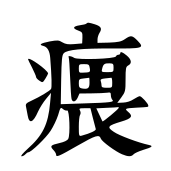
Pronounced hui (falling tone) according to "Guangyun" (Guangyun), and hui (falling tone) according to "Jiyun" (Jiyun), with the same pronunciation as "hui". Originally written as "尵" (zhuó), referring to a sick horse. Also written as "䝇" (zhuó).
According to "Jiyun" (Jiyun), it is pronounced huāi (falling tone), with the same meaning.
It is also pronounced huǐ (falling tone), with the same pronunciation as "wěi". "㾯㾼" (wěi) refers to a wind illness. It can also be written as "痿" (wěi).
It is also pronounced tuí (rising tone), with the same pronunciation as "tuí". It refers to a yin illness.
It is also pronounced huí (level tone), with the same pronunciation as "huí". It refers to an illness. One theory states it refers to a swelling that grows outwards.
It is also pronounced kuī (falling tone), with the same pronunciation as "kuī". It is the same as "尵" (zhuó). "Leipian" (Leipian) explains: "㞂" (ruì) refers to a debilitating illness. The characters "尵" (zhuó) and "㞂" (ruì) originally belonged to the "尣" (wǎng) radical.