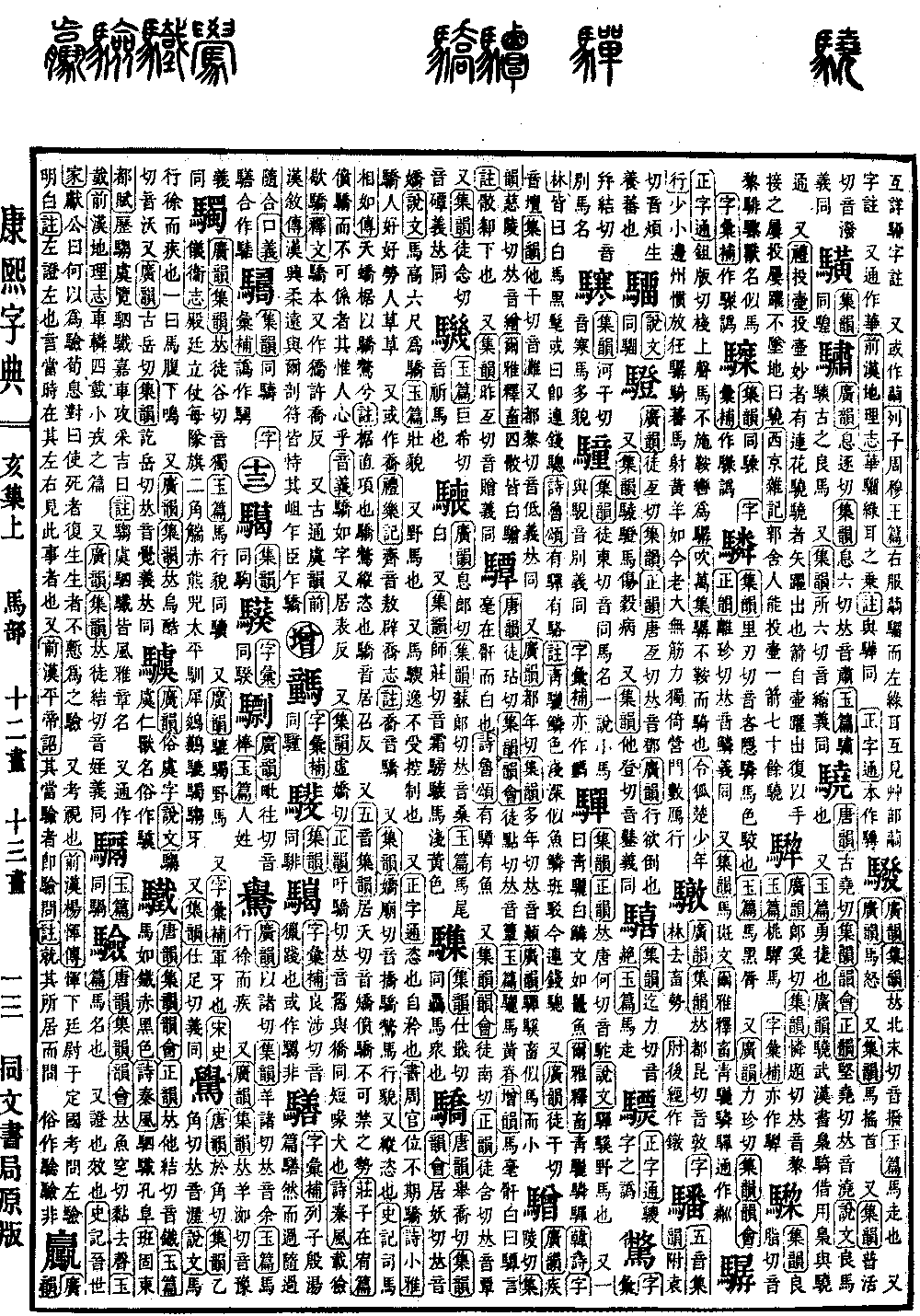
Hai Collection, Upper Volume
Radical: Horse (mǎ)
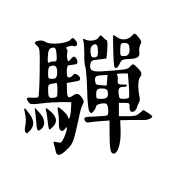
Entry: Tuo
Kangxi Dictionary Strokes: 22
Page 1445, Entry 19
According to the Collection of Rhymes (Jiyun) and the Correct Rhymes (Zhengyun), it is pronounced tuo.
According to the Explaining Graphs and Analyzing Characters (Shuowen), tuo-xi refers to a wild horse. Another interpretation is that it is a blue-black horse with white scales, with patterns resembling a crocodile.
According to the Literary Expositor (Erya), in the section explaining animals, it is described as a blue-black horse marked with patterns like those of a horse, known as tuo.
The Poetry of Han (Han Shi) and the Forest of Characters (Zilin) both define it as a white horse with a black mane. Some say it is what is known as a horse with linked-ring markings.
In the Book of Odes (Shijing), within the Odes of Lu, it is written: There are tuo and there are luo. The commentary notes that blue-black horses with scale-like coloring, showing light and dark shades like the mottled scales of a fish, are what are today called horses with linked-ring markings.
Additionally, according to the Broad Rhymes (Guangyun), it is pronounced tan. According to the Collection of Rhymes (Jiyun), it is pronounced tan.
It is also pronounced di. The meaning remains the same.
Additionally, according to the Broad Rhymes (Guangyun) and the Collection of Rhymes (Jiyun), it is pronounced dian. According to the Broad Rhymes (Guangyun), tuo-xi refers to a beast that resembles a horse but is smaller.