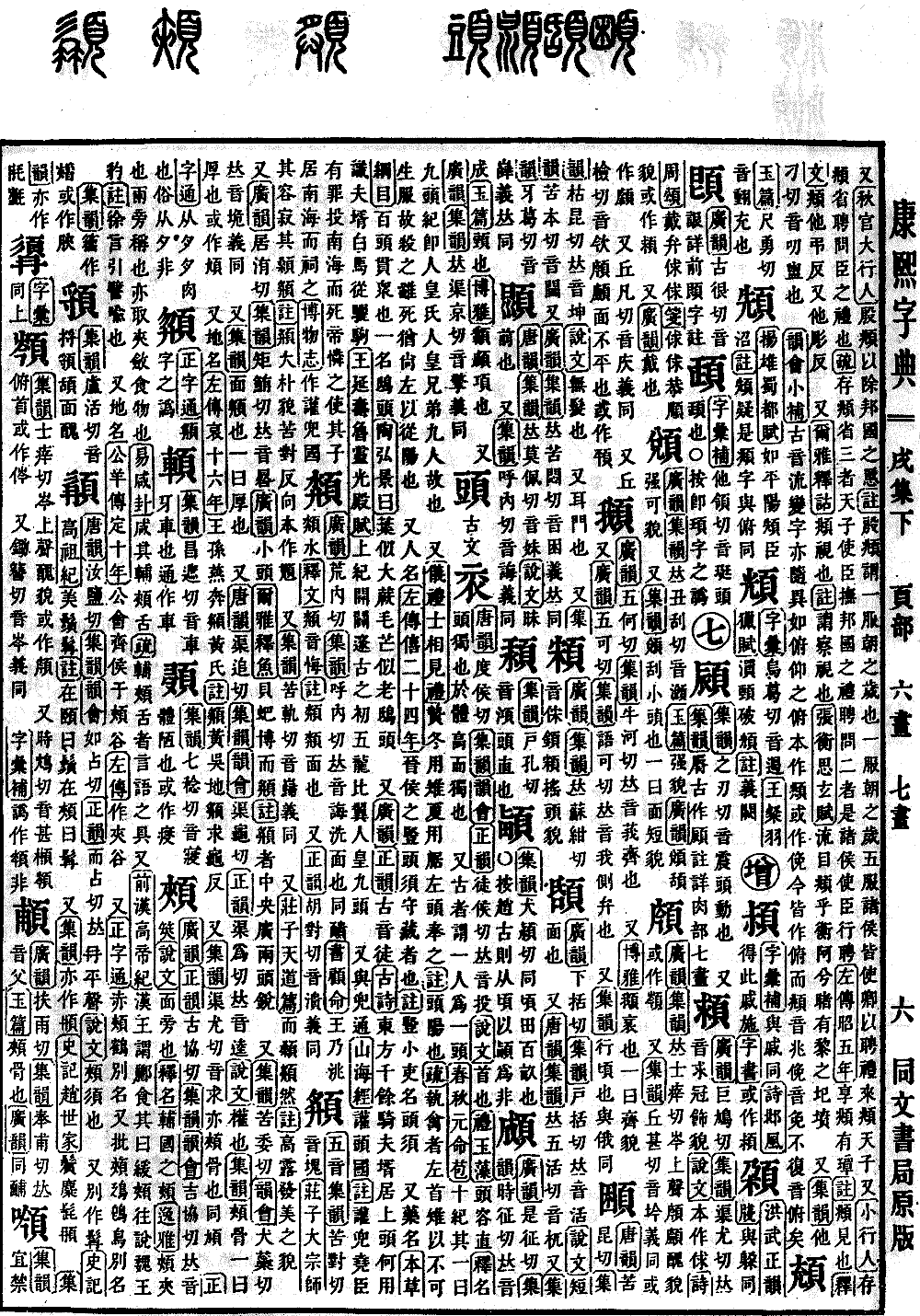
Xu Collection, Lower Volume
Radical: Page (yè)
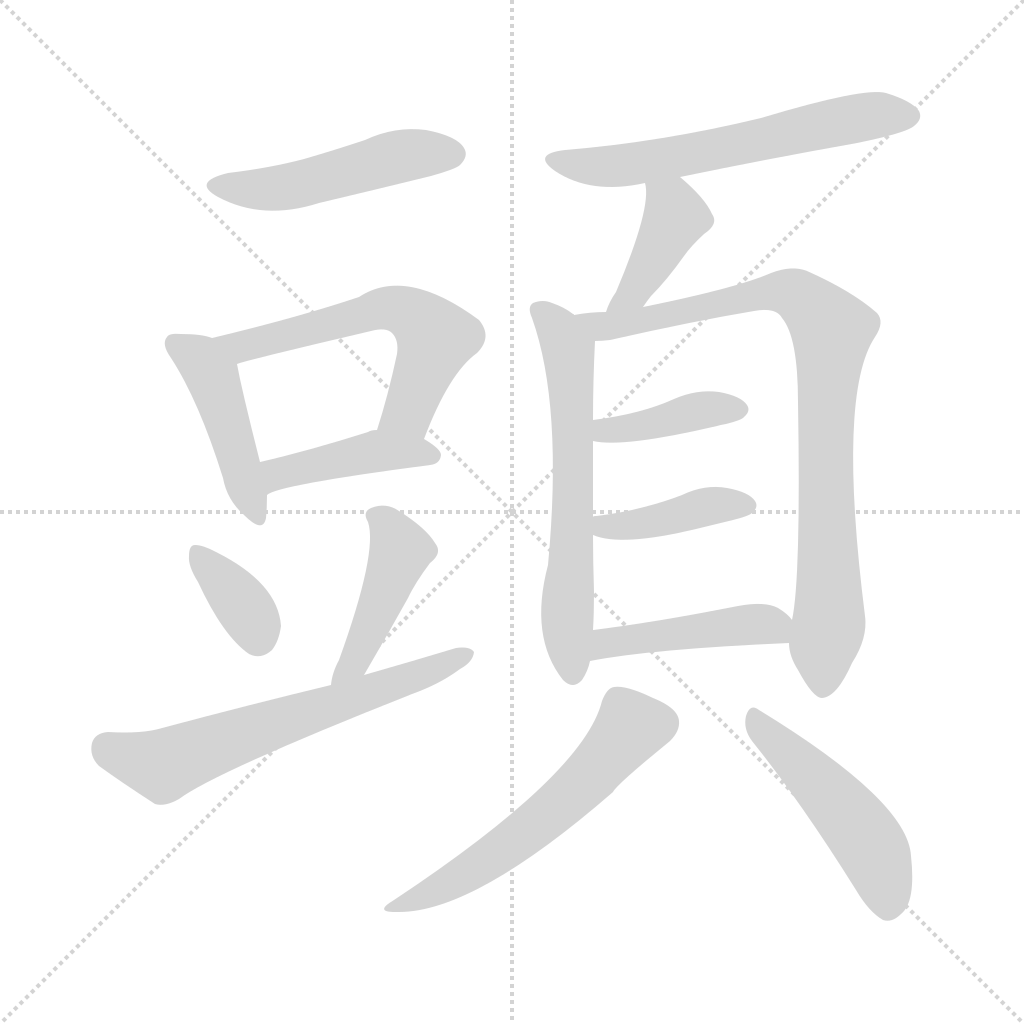
Head
Kangxi strokes: 16
Page 1404, Entry 20
Ancient form. Pronounced tou.
According to the Explaining and Analyzing Characters (Shuowen Jiezi), it means head.
Book of Rites (Yuzhao): The head should be held straight.
According to the Explaining Names (Shiming): The head is that which is singular, positioned at the highest point of the body and standing alone.
Also, in ancient times, one person was referred to as one head.
According to the Spring and Autumn Annals: Basic Registers of Origins (Chunqiu Yuanmingbao): The ten eras, the first era is called the Nine-Head Era, which refers to the Human Emperor clan. This is because the Human Emperor had nine brothers.
Also, in the Book of Etiquette and Ceremonial (Yili): In the ceremony of officials meeting, in winter one uses a pheasant, and in summer one uses dried bird meat, holding the head with the left hand when presenting it. Note: The head represents the yang principle. Commentary: Those who hold game birds use the left hand to grasp the head. Pheasants cannot be caught alive, so they are killed. Although dead, one still uses the left hand to hold the head, in order to follow the yang energy.
Also, a person's name. In the Zuo Tradition (Zuozhuan): The minor official of the Duke of Jin, Tou Xu, was a person who guarded the granaries. Note: Shu, a minor official, his name was Tou Xu.
Also, a medicinal name. In the Compendium of Materia Medica (Bencao Gangmu): Baitou is Guanzhong. Another name is Chitou. Tao Hongjing said: The leaves resemble large ferns, and the bristles resemble the head of an old owl.
Also, pronounced tu. In an old poem: In the east there are over a thousand cavalrymen, my husband walks at the very front. How to recognize my husband, he rides a white horse followed by a black foal.
In the Rhapsody on the Lingguang Hall of Lu (Lu Lingguangdian Fu) by Wang Yanshou: It records the opening of heaven and earth, the beginning of the remote past. Five dragons fly side by side, and the Human Emperor has nine heads.
Also, interchangeable with the character dou. In the Classic of Mountains and Seas (Shanhaijing): The Huantou country. Note: Huan Dou was a minister of Emperor Yao who committed a crime and died by being cast into the South Sea; Emperor Yao pitied him and allowed his son to live in the South Sea and perform sacrifices to him. In the Treatise on Curiosities (Bowuzhi), it is written as Huandou country.
Textual Research: According to the original text, the pronunciation is noted as tu, but this is not found in the Broad Rhymes (Guangyun) or the Standard Rhymes (Zhengyun). It has been verified that the reading appears in the Tang Rhymes (Tangyun). The reference to Broad Rhymes and Standard Rhymes has been corrected to Tang Rhymes and Standard Rhymes.