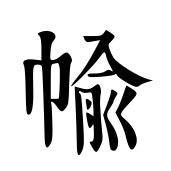
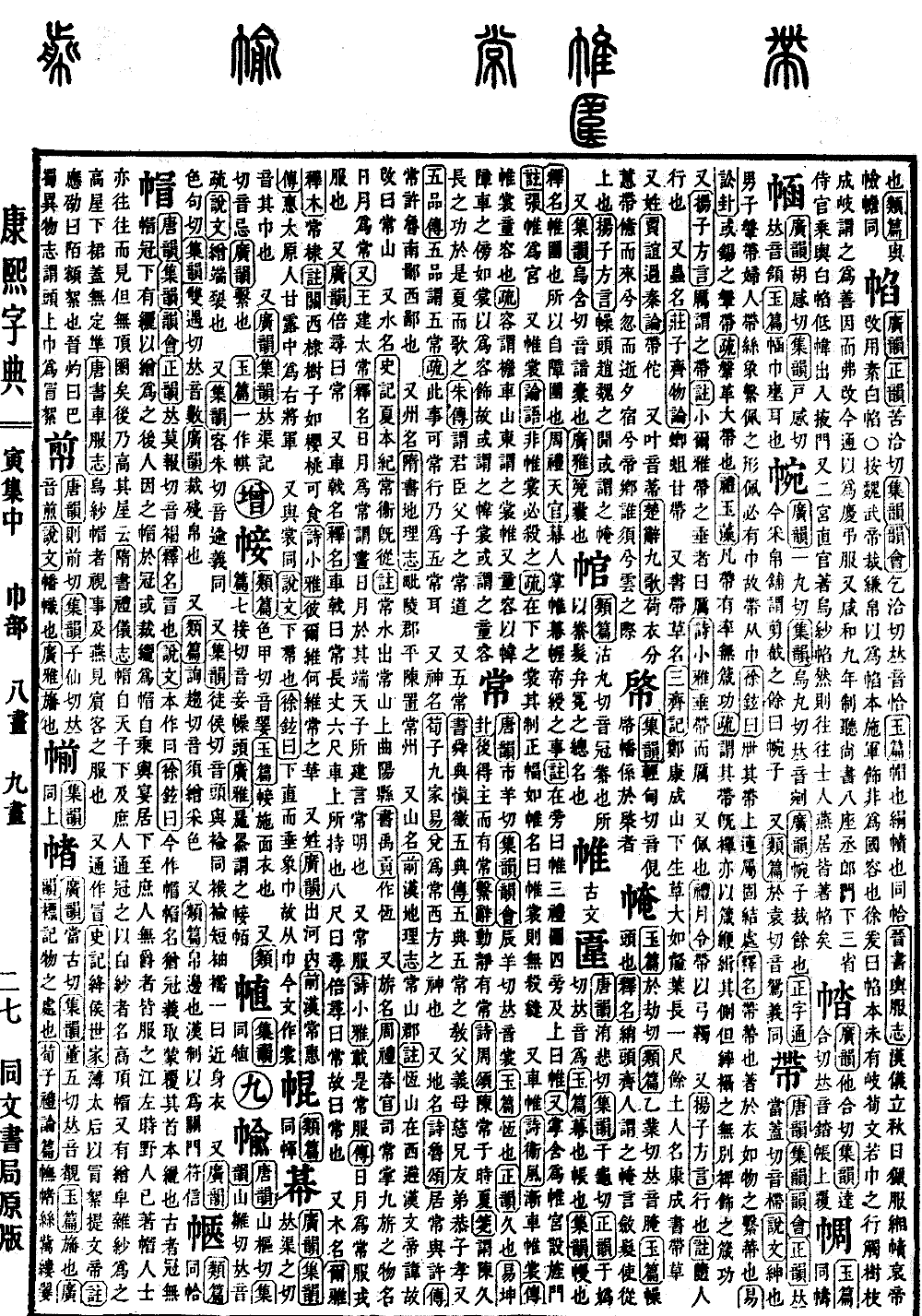
In the "Guangyun" (Guangyun), the sound is obtained by cutting with the characters "shan" (山) and "shu" (枢). In the "Jiyun" (Jiyun), the sound is obtained by cutting with the characters "shan" (山) and "chu" (雏), with the same pronunciation as "shu" (疏). The "Shuowen Jiezi" (Shuowen Jiezi) explains it as the frayed end of silk fabric.
Also, in the "Jiyun" (Jiyun), the sound is obtained by cutting with the characters "rong" (容) and "zhu" (朱), with the same pronunciation as "yu" (逾). The meaning is the same.
Also, in the "Jiyun" (Jiyun), the sound is obtained by cutting with the characters "tu" (徒) and "hou" (侯), with the same pronunciation as "tou" (头). It is the same as the character "yu" (褕). "Pan yu" (䙈褕) refers to a short-sleeved, short garment. Another interpretation is an undergarment.
Also, in the "Guangyun" (Guangyun), the sound is obtained by cutting with the characters "se" (色) and "ju" (句). In the "Jiyun" (Jiyun), the sound is obtained by cutting with the characters "shuang" (双) and "yu" (遇), with the same pronunciation as "shu" (数). The "Guangyun" (Guangyun) explains it as leftover silk fabric after cutting.
Also, in the "Leipian" (Leipian), the sound is obtained by cutting with the characters "xun" (询) and "qu" (趋), with the same pronunciation as "xu" (须). It refers to silk fabric with colored patterns.
Also, in the "Leipian" (Leipian), it refers to the edge of silk fabric, which was used in the Han Dynasty system as a tally for closing gates.