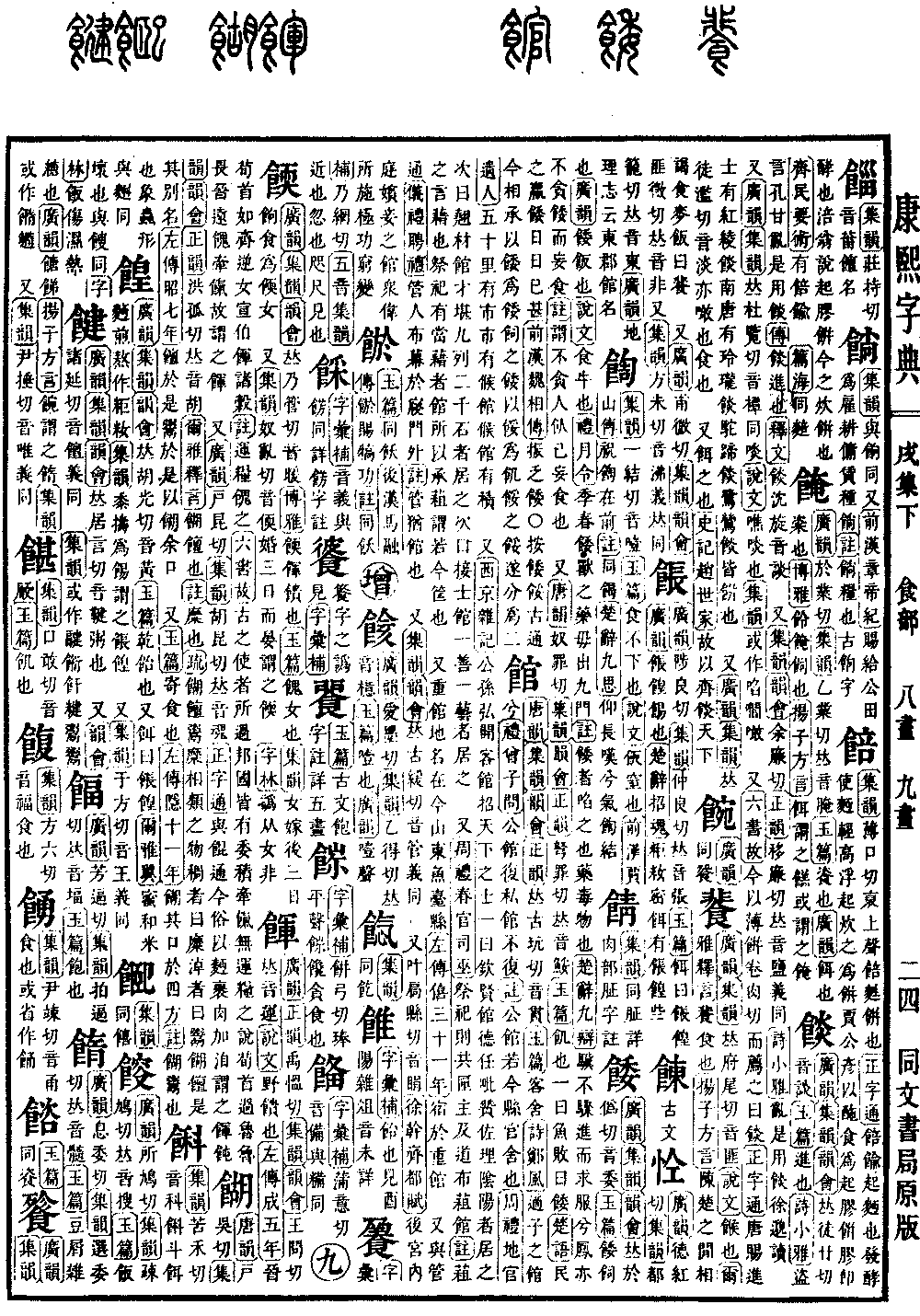
Xu Collection, Lower Volume
Radical: Food (shí)
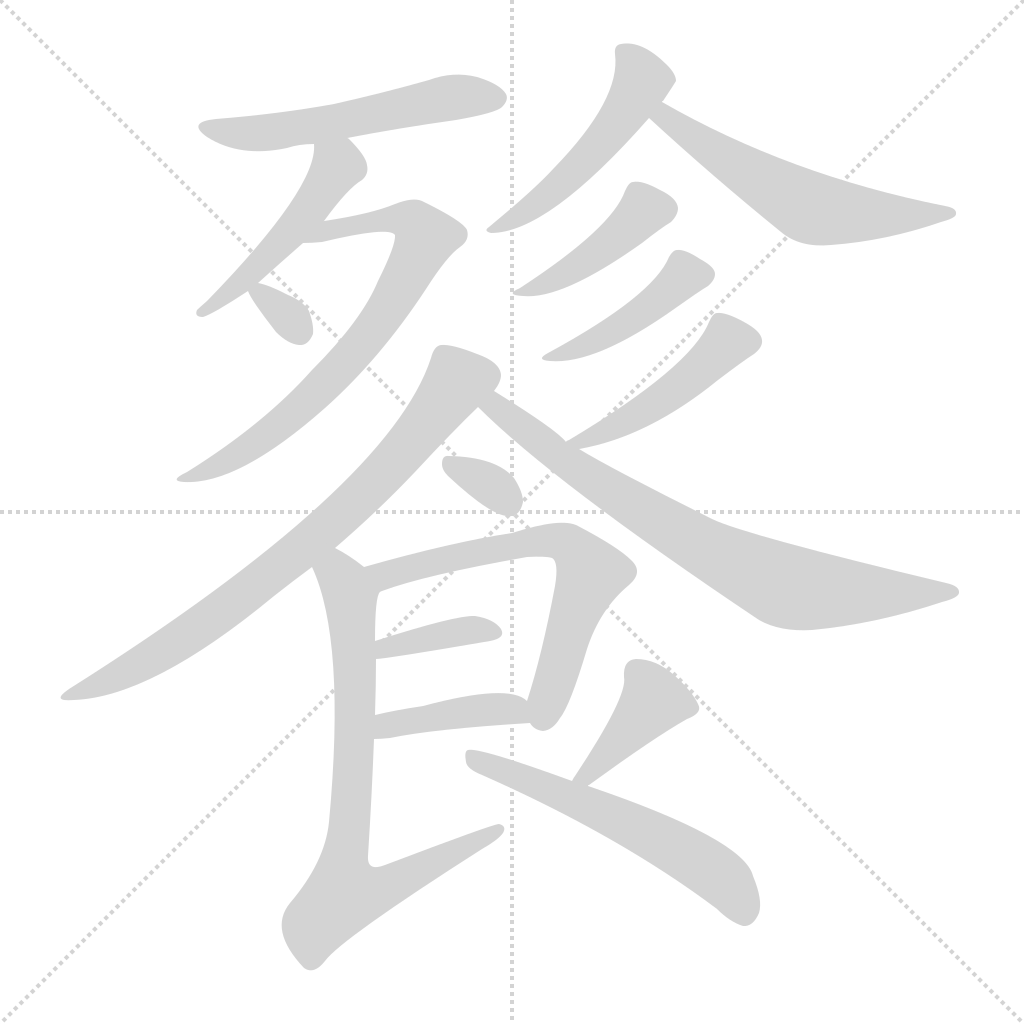
Character: Tie
Kangxi stroke count: 18
Page 1422, Entry 39
Guangyun (Broad Rhymes), Jiyun (Collection of Rhymes), Yunhui (Collection of Rhymes), and Zhengyun (Correct Rhymes) all define this as pronounced tie.
Yupian (Jade Chapters) states it is identical to the character meaning gluttony.
Zuo Zhuan (Zuo Commentary) states: The Jinyun clan had an inept son who was greedy for food and drink and craved wealth; the people of the world called him Taotie. Note: Greed for wealth is called tao, and greed for food is called tie; these were the Three Miao.
Lu Shi Chunqiu (Master Lu's Spring and Autumn Annals) states: The Taotie patterns on Zhou dynasty bronze vessels feature a head but no body. The creature is depicted as having consumed a person without yet swallowing, resulting in calamity befalling itself.
Zhengzitong (Correction of Character Meaning) states: Ancient vessels often feature Taotie patterns, depicted with pendulous bellies and gaunt faces, seated in a human-like posture. Beneath them appear objects resembling serving platters. On vessels such as the dun and yi, only the animal face is shown without a body, serving as a symbolic warning. According to the Classic of Mountains and Seas (Shanhaijing), Hundun, Qiongqi, Taowu, and Taotie are the names of wicked beasts, which is why they were used as epithets for four villainous men.
Jiyun (Collection of Rhymes) also notes it is pronounced tian, with the same meaning.