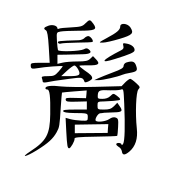
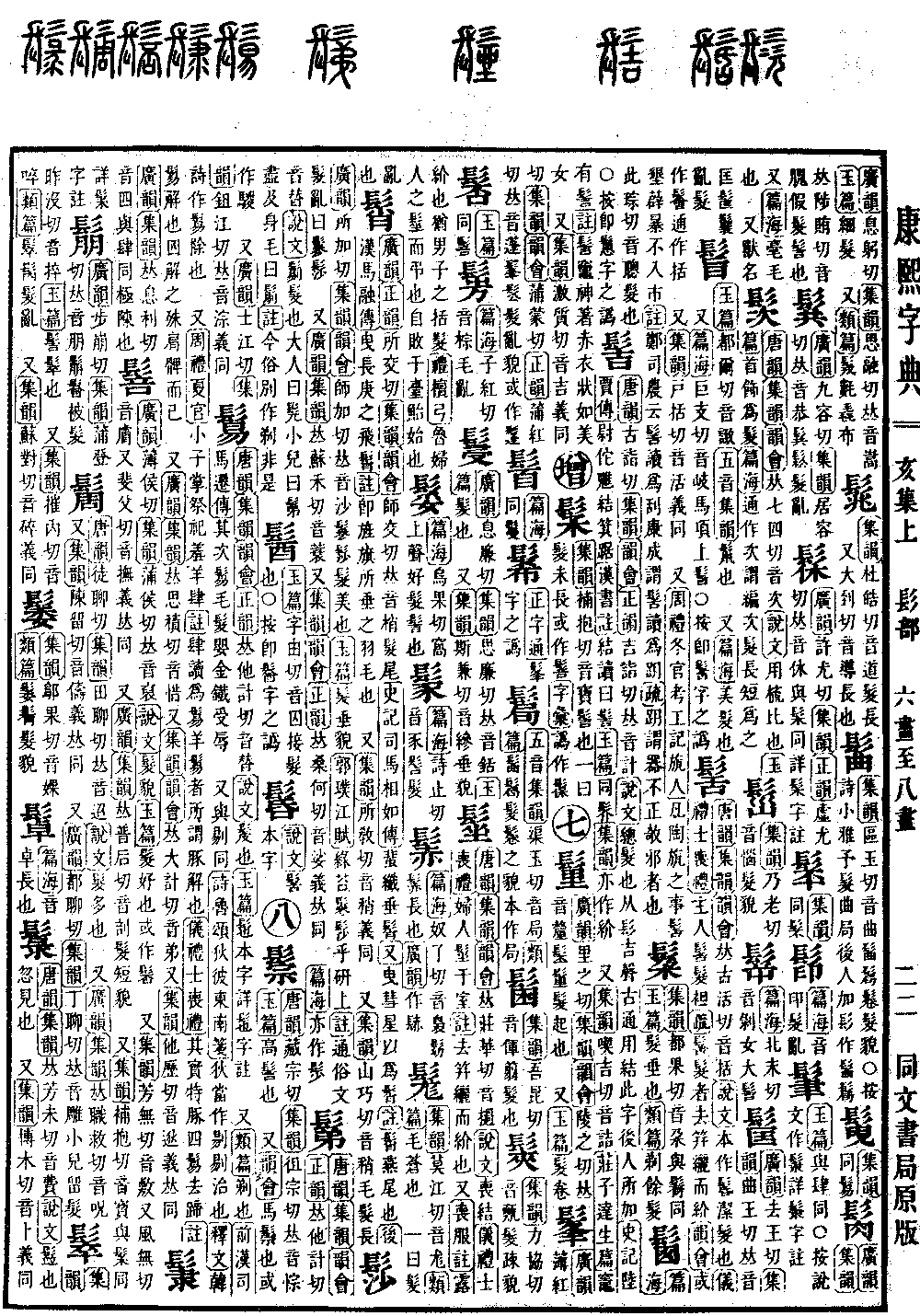
In the "Guangyun" (Guangyun), it is pronounced "tu liao qie" (falling tone), and in the "Jiyun" (Jiyun), it is pronounced "tian liao qie" (falling tone), with the same pronunciation as "tiao" (falling tone). The "Shuowen Jiezi" (Shuowen Jiezi) explains it as having thick hair.
Also, in the "Guangyun" (Guangyun) and "Jiyun" (Jiyun), it is noted as pronounced "zhi jiu qie" (rising tone), with the same pronunciation as "zhu" (rising tone).
Furthermore, in the "Jiyun" (Jiyun), it is noted as pronounced "liu qie" (rising tone), with the same pronunciation as "chou" (rising tone). The meaning is the same.
Additionally, in the "Guangyun" (Guangyun), it is pronounced "du liao qie" (falling tone), and in the "Jiyun" (Jiyun), it is pronounced "ding liao qie" (falling tone), with the same pronunciation as "diao" (falling tone). This refers to children leaving their hair long.