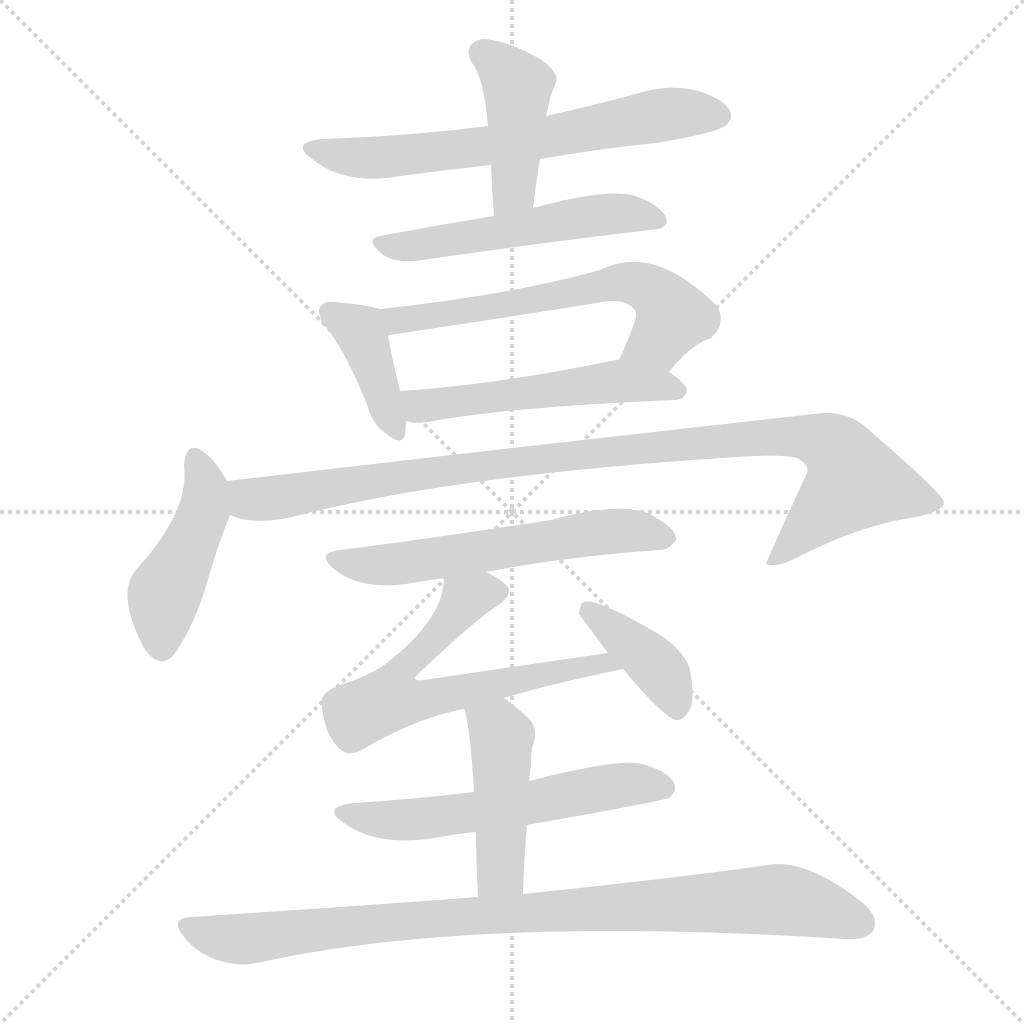
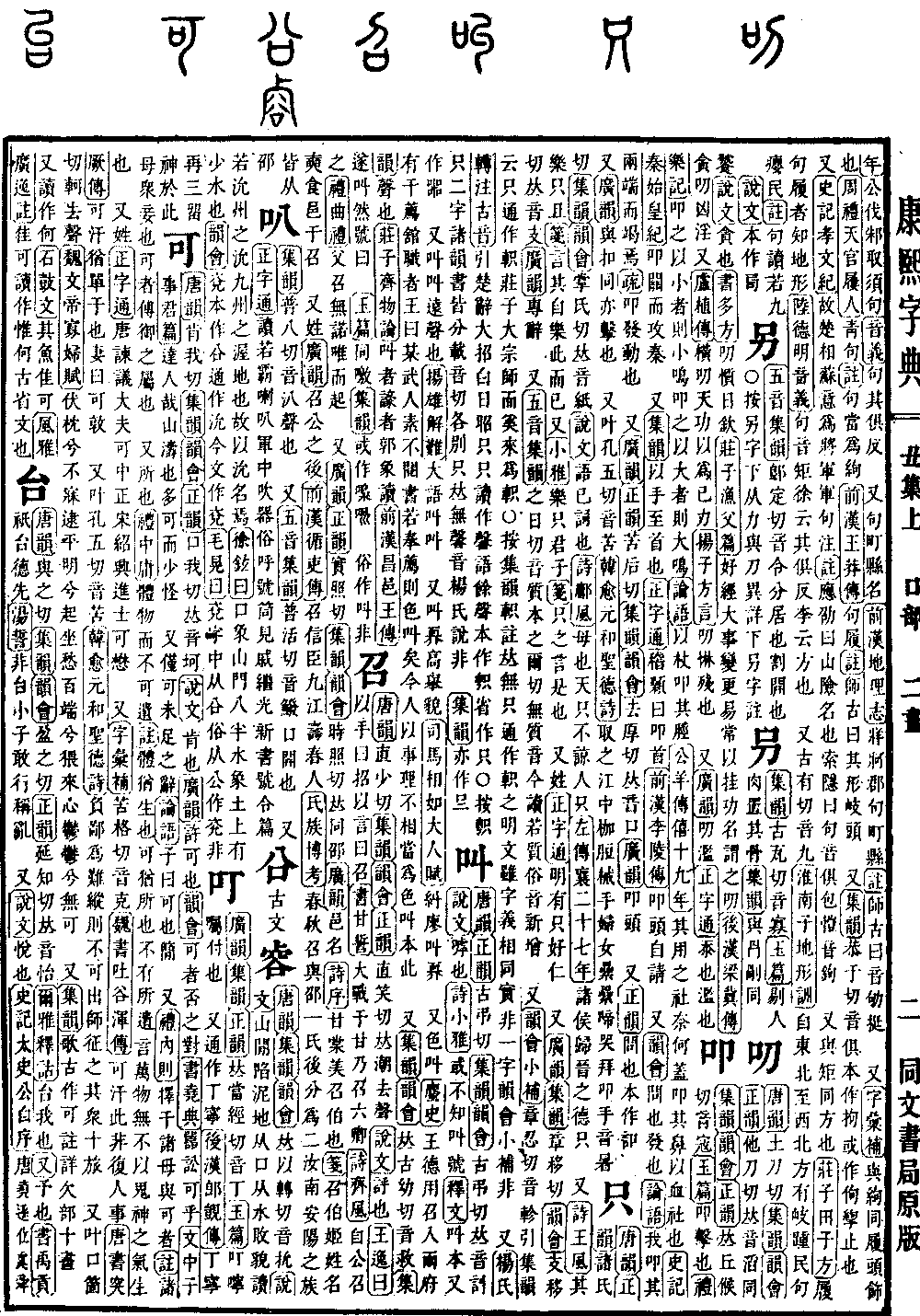
Wei Collection, Lower Volume
Radical: Arrived (zhì)
Page 172, Entry 01
In the Guangyun, pronounced tai. In the Jiyun, Yunhui, and Zhengyun, pronounced tai. The pronunciation is the same as tai (moss).
Shuowen Jiezi defines it as: A building with all four sides raised high, suitable for observation from a distance.
Shi Ming explains: Tai means to hold. It is built of earth to a high and solid shape, capable of maintaining its own stability.
Erya, Explanation of Palaces states: A She is called a Tai. The commentary explains: Earth piled up into a square shape.
Book of Rites (Liji), Monthly Ordinances records: In the second month of summer, one may reside in a high terrace pavilion (tai xie). The commentary explains: Built by piling up earth, used for climbing to view far distances.
Wujing Yaoyi records: The Son of Heaven has three terraces; the Lingtai (Terrace of Spirits) is used to observe the heavens, the Shitai (Terrace of Seasons) is used to observe seasonal changes, and the Futai (Terrace of Gardens) is used to observe birds and animals.
Gujin Zhu records: City gates were all built of earth. Piled earth is called a Tai, thus they are also called Taimen (Terrace Gates).
Also refers to official titles.
Zhengzitong, Biography of Yuan Shao, notes on the Three Terraces: In the Han dynasty, the official positions were as follows: the Secretariat was called the Central Terrace, the Censorate was called the Constitutional Terrace, and the Attendants were called the Outer Terrace.
Hanshu, Table of Officials notes: Officials of Rites and Music were well-versed in the forms of ritual, so the Ministry of Rites was called the Rongtai (Terrace of Deportment).
Wang Yanwei authored the thirty-volume Qutai Xinli (New Rituals of the Bent Terrace); thus the Court of Imperial Sacrifices was called the Qutai (Bent Terrace).
During the Han dynasty, the Secretariat Monitor was called the Yuntai (Cloud Terrace). The Tang dynasty changed the Secretariat into the Lintai (Qilin Terrace). Tang dynasty Records of Officials records that the Secretariat (Menxia Sheng) was called the Luantai (Luan Bird Terrace). The Song dynasty Silver Terrace Office was responsible for receiving memorials from across the realm.
Boya defines: Tai means to support.
Also refers to people of low status.
Zuo Zhuan, Year 7 of Duke Zhao records: Servant Tai. The commentary explains: Refers to the lowest levels of servants, such as those responsible for cleaning, carriages, and slaves.
Mencius records: Perhaps from this point on, the Tai had no one to bring them food. The commentary explains: Tai refers to low-ranking officials responsible for menial labor.
Chuo Geng Lu records: Slaves who are themselves served by other slaves are called Chongtai (Layered Terraces).
Su Shi, Poem on Plum Blossoms writes: Heaven allows the peach and plum to serve as carriages and servants (yutai).
Boya defines: Tai means peer or equal.
Yangzi, Fangyan defines: Tai means to match or correspond. In the region between the sea and Mount Dai in East Qi, it is called Tai. West of Hangu Pass, in the region between Qin and Jin, those of equal material strength are called Taidi (Terrace equals).
Zhuangzi, Gengsangchu writes: Cannot let it enter the Lingtai (Terrace of Spirits). The commentary explains: Lingtai refers to the heart.
Also a surname. During the Han dynasty, there was a Palace Attendant named Tai Tong. There is also the double-surname Dantai.
Zihui Bu records: In ancient times, tombs were called Tai, such as the three terraces of the Yedu capital, or the Emperor Yao Terrace and Emperor Ku Terrace in the Classic of Mountains and Seas (Shanhaijing).
Haitai is the sound of snoring.
Shishuo Xinyu records: Xu Zao made a loud noise in the Prime Minister's tent, producing a great snoring sound like haitai.
Tongya explains: Haitai was a term commonly used by people of the Jin dynasty.
Also a mountain name.
Yudi Zhi records: Mount Wutai, located in Yanmen Commandery.
Classic of Mountains and Seas (Shanhaijing) records: Mount Lutai. The commentary explains: Now called Mount Lutai.
Huainanzi, Treatise on Topography records: The Ji River originates from Mount Wangwu; the Shi, Si, and Yi rivers originate from the Mount Taitaishu. The commentary explains: Shi, Si, and Yi are names of rivers. Taitaishu is a mountain name.
Baopuzi, Chapter on Ascending and Climbing records: Long ago, Zhang Gaida and Ou Gaocheng both practiced refined cultivation together in a stone chamber on Mount Yuntai.
Also a god's name.
Zuo Zhuan, Year 1 of Duke Zhao records: Long ago, a descendant of the Golden Heaven clan named Mei served as a Water Official and gave birth to Yunge and Tai Tai. Tai Tai is the god of the Fen River.
Classic of Mountains and Seas (Shanhaijing) records: Mount Xiuyu; on the mountain, there is a stone called the Go-board of Emperor Tai. The commentary by Guo Pu says: Emperor Tai is the name of a spirit man.
Also a star name. Jiantai is the name of a star constellation.
Also a palace name.
Zou Yang, Letter to the Prince of Wu writes: The State of Qin relied on the Qutai Palace to control the world.
Sanfu Huangtu records: Weiyang Palace had a Qutai Hall.
Also a plant name.
Erya, Explanation of Plants records: Mugwort, also known as Bingtai. The commentary explains: Ai, also known as Bingtai, is what is now called mugwort.
Book of Odes (Shijing), Lesser Odes writes: On the southern mountains grows Tai grass. The commentary explains: Tai is the fushu plant. The commentary explains: Fushu is sedge grass, which can be used to make rain capes and hats.
Also writes: Those people of the capital city wear hats made of Tai grass and small black caps. The commentary explains: Tai (grass hat) is used to protect against the heat. Li (hat) is used to protect against the rain. The gloss explains: Tai is fushu. People of the capital use the skin of Tai grass to make hats.
Zihui notes: Pronounced hu. Tai Tai is a place name in the State of Zhu.
Book of Rites (Liji), Tan Gong records: (The army of the State of Lu) was defeated at Taitai. The commentary explains: Tai is pronounced hu, Tai is pronounced tai. The character Tai is likely a scribal error for the character Hu. One version writes it as Hutuo, or Foxuo.
Zhengzitong explains: Tai has the pronunciation of hu; it is not the case that Tai and Hu are the same character. Zihui believes Tai is the ancient form of the character Hu, which is incorrect.
Zihui Bu points out: In the Zuo Zhuan, it is written as Taidai. Examining all various commentaries, there is no pronunciation of hu. Zihui does not know on what basis it makes this claim; it is also incorrect.
Yunbu rhymes it: Pronounced ti.
Cantongqi (Token for the Alignment of the Three) writes: Pure white as if lifting a curtain, close the eyes and ascend the high terrace; the six hundred chapters of the Fire Records (Huoji) pursue a purpose that contains no confusion.
Also rhymes it: Pronounced tu.
Yilin writes: The classics and legal documents are stored within the Lantai (Orchid Terrace).