Mao Collection, Middle Volume
Radical: Hand (shǒu)
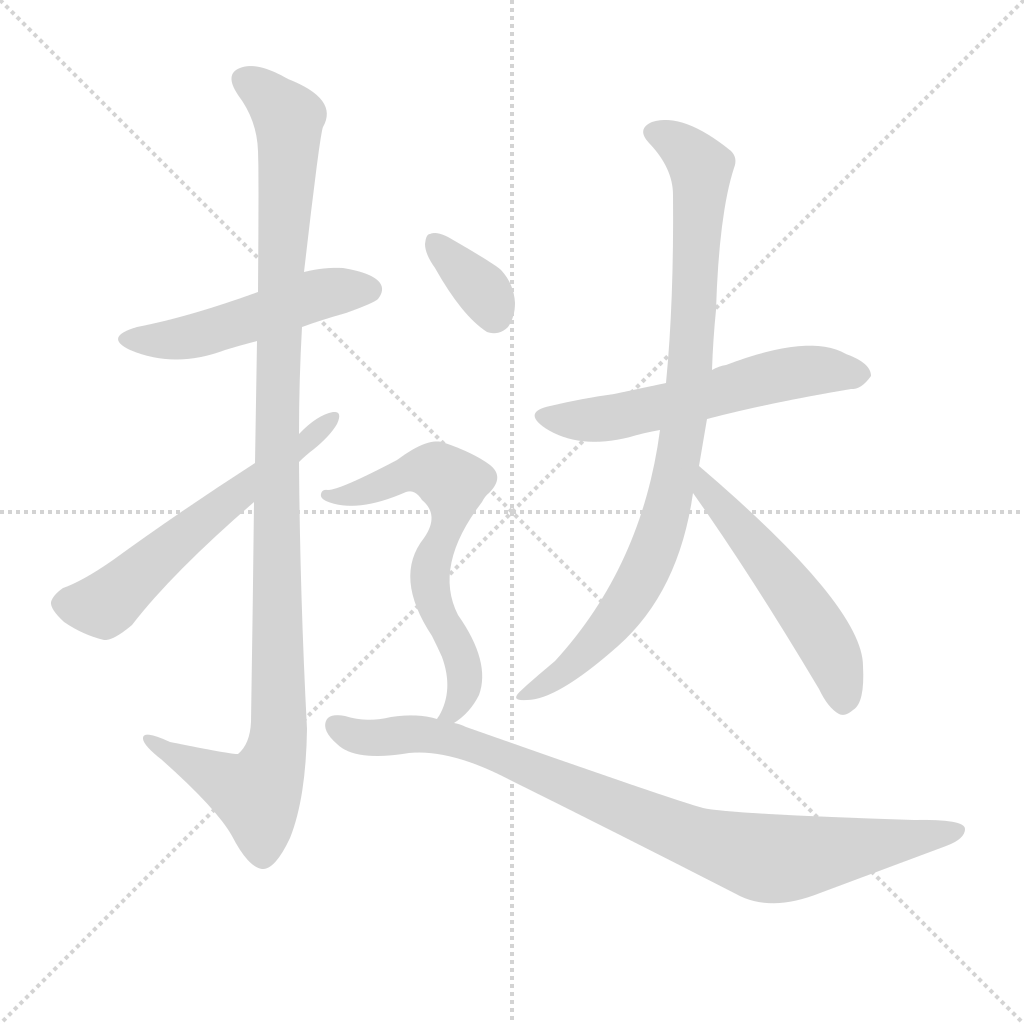
Tart (tà)
Kangxi strokes: 17
Page 457, Entry 06
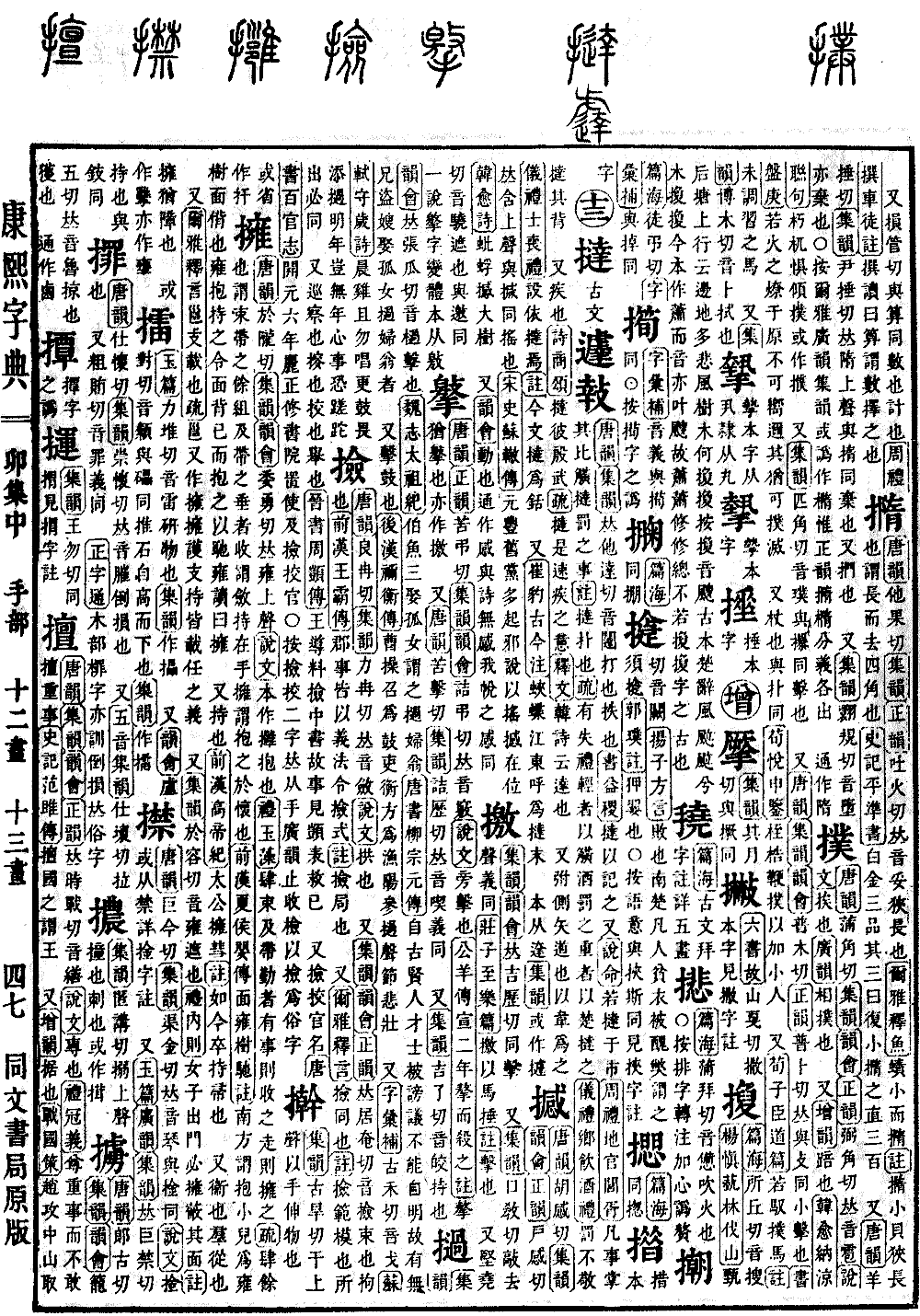
Ancient script. According to the Tang Rhyme (Tangyun) and the Collected Rhymes (Jiyun), it is pronounced ta. Meaning to strike or to whip. Book of Documents (Shangshu), chapter Yi Ji: "Whip them to serve as a reminder." Also, in the chapter Yue Ming: "As if whipped in the marketplace." Rites of Zhou (Zhouli), Earth Offices, Lu Xu: "For all affairs, manage matters regarding the comparison, the gong-cup, the whipping, and the punishments." Commentary: "Whipping means to strike." Sub-commentary: "When there is a failure in etiquette, the lighter cases are punished with the gong-cup of wine, the heavier cases are punished with the whip." Book of Etiquette and Ceremonial (Yili), chapter Xiang Yin Jiu Li: "For lack of respect, whip their backs."
Also meaning to be swift. Book of Odes (Shijing), Shang Hymns: "Swift is that martial king of Yin." Sub-commentary: "Whipping conveys the meaning of being fast and swift." Explanation of Text (Shiwen): Han Poetry says it means to reach.
Also refers to the path for arrows on the side of a bow's grip, made of leather. Book of Etiquette and Ceremonial (Yili), chapter Shi Sang Li: "Set up the wooden screen and the arrow path." Commentary: "In the modern text, this is written as xian."
According to Cui Bao in Records of Ancient and Modern Things (Gujin Zhu): The butterfly is called ta-mo in the region east of the Yangtze River. Originally derived from a different radical. According to the Collected Rhymes (Jiyun), sometimes written in a variant form. The original character was mistakenly written using a different radical.