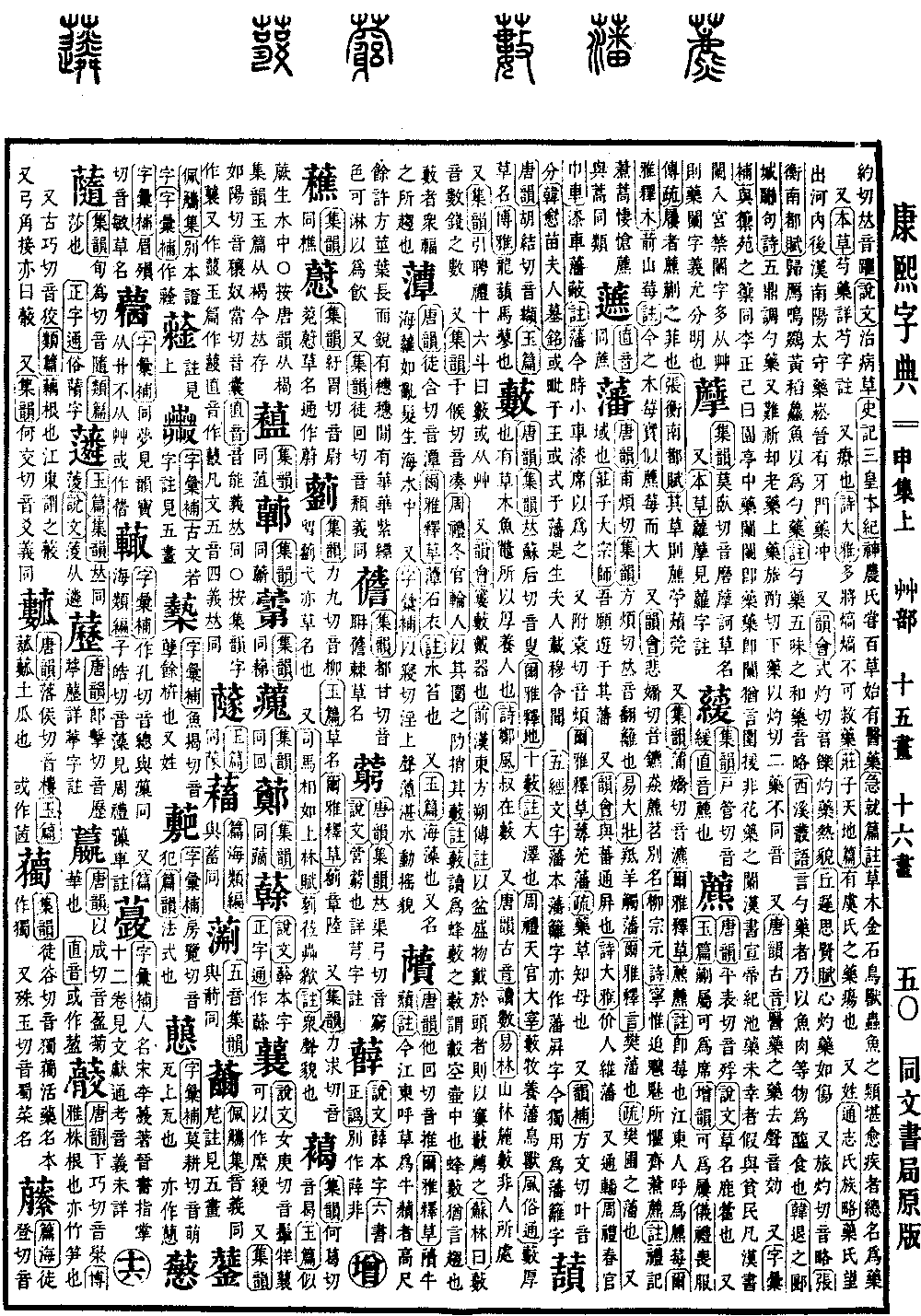
Shen Collection, Upper Volume
Radical: Grass (cǎo)
Sou
Kangxi stroke count: 21
Page 1066, Entry 01
Pronounced sou (rising tone).
Approximations of Geography (Erya, Shidi): Ten marshes.
Commentary: A great marsh.
Rites of Zhou (Zhouli), Offices of Heaven, Grand Administrator: Manage the pastures and raise birds and beasts.
Comprehensive Customs (Fengsu Tong): A marsh is that which is abundant. Because it contains grasses, trees, fish, and turtles, it is that which abundantly nourishes mankind.
Book of Odes (Shijing), Odes of Zheng: The uncle is in the marsh.
Also, ancient pronunciation of Tang Rhymes (Tangyun): Pronounced shu (falling tone).
Forest of Changes (Yilin): Mountain forests and marshy foothills are not places for men to dwell.
Also, according to the Collected Rhymes (Jiyun), citing the Book of Etiquette and Ceremonial (Pinli): Sixteen dou equals a bushel. Sometimes written with the grass radical.
Also, according to the Collection of Rhymes (Yunhui): A headband ring used to support an object carried on the head.
Commentary on the Biography of Dongfang Shuo in the History of the Former Han Dynasty (Qianhan Shu): When using a basin to carry things on the head, one uses a headband ring as a cushion.
Su Lin says: Pronounced shu, like the shu in counting money.
Also, according to the Collected Rhymes (Jiyun): Pronounced cou (falling tone).
Rites of Zhou (Zhouli), Winter Offices, Wheelwright: By its circumference, measure the gap of the hub.
Commentary: Read as the sou in the swarm of bees; it refers to the hollow cavity inside the hub. The swarm of bees is similar to saying a gathering; the marsh is that toward which all spokes converge.