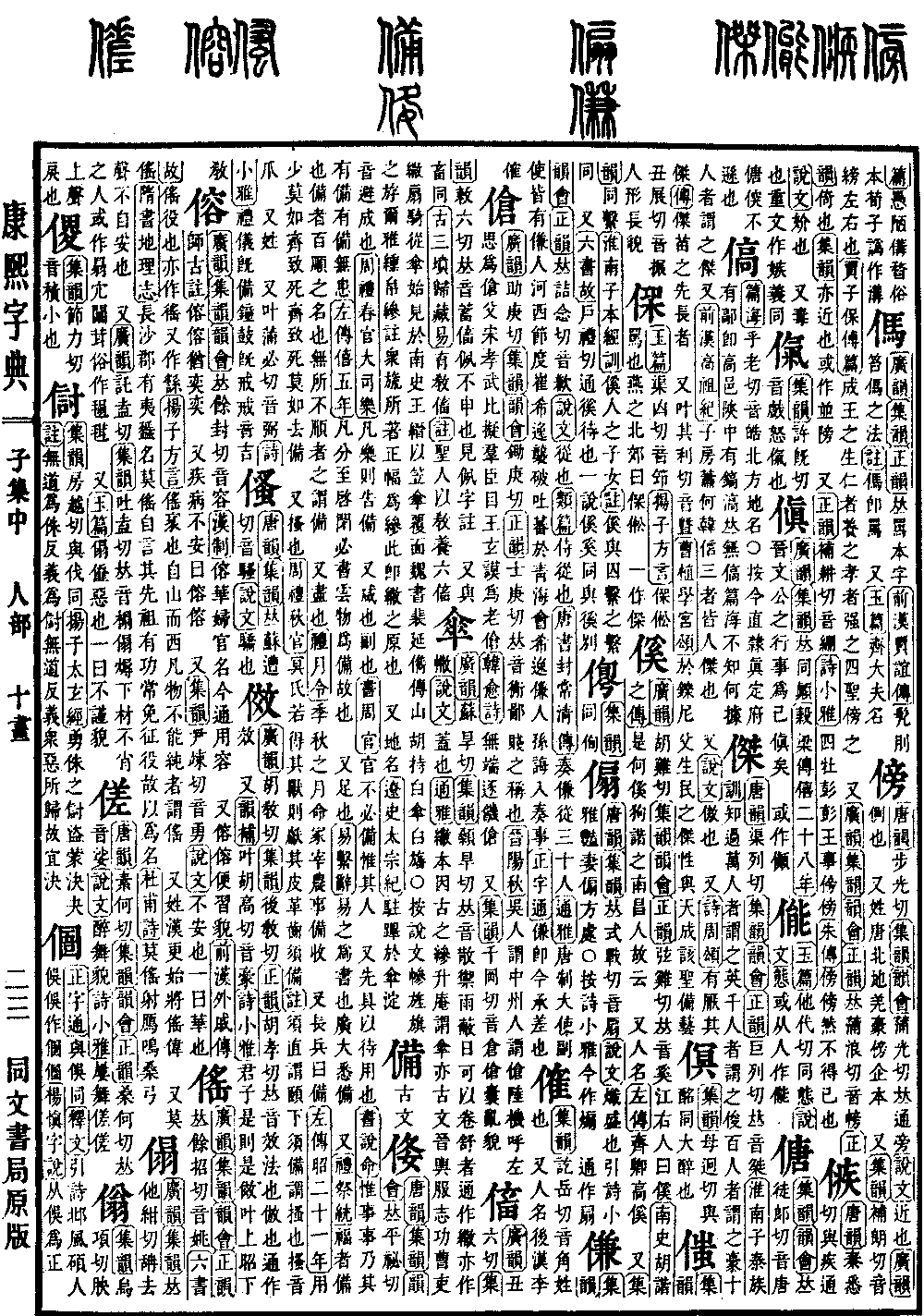
Zi Collection, Middle Volume
Radical: Person (rén)
sǎn; Kangxi strokes: 12; Page: 113, Entry 20
Guangyun (Guangyun) gives the fanqie spelling sū hǎn qiē; Jiyun (Jiyun) gives the fanqie spelling sǎng hǎn qiē; both pronounced sǎn. An item used to shelter from rain and block the sun, which can be folded and unfolded. It is also written using the character sǎn. It is also written using another variant character pronounced sǎn. Explaining Characters and Analyzing Compounds (Shuowen Jiezi) explains it as "a cover" (a covering object). The Tongya (Tongya) states that the character sǎn originally derived from the ancient character shān. Yang Shen (Shēng'ān) considered sǎn also to be an ancient character. The Treatise on Carriages and Attire (Yúfúzhì) from the Jin Dynasty records that when officials traveled, they were accompanied by cavalry holding sǎn and fans. The character sǎn first appeared in the History of the Southern Dynasties (Nánshǐ), recording Wang Jin using a bamboo hat and sǎn to cover his face. The Biography of Pei Yanjun (Péi Yánjùn zhuàn) in the Book of Wei (Wèishū) records that the people of the Shanhu tribe carried white sǎn and white banners. According to Explaining Characters and Analyzing Compounds (Shuowen Jiezi), the character sān refers to the streamers of a banner. The Erya (Erya) states "dark red silk shān." The commentary explains: "The main body of a flag, connected by many streamers, is called shān." This is the origin of the character sǎn. It is also a place name. The Annals of Emperor Taizong (Tàizōng jì) in the History of Liao (Liáoshǐ) records that the emperor once stopped at Sandian while traveling.