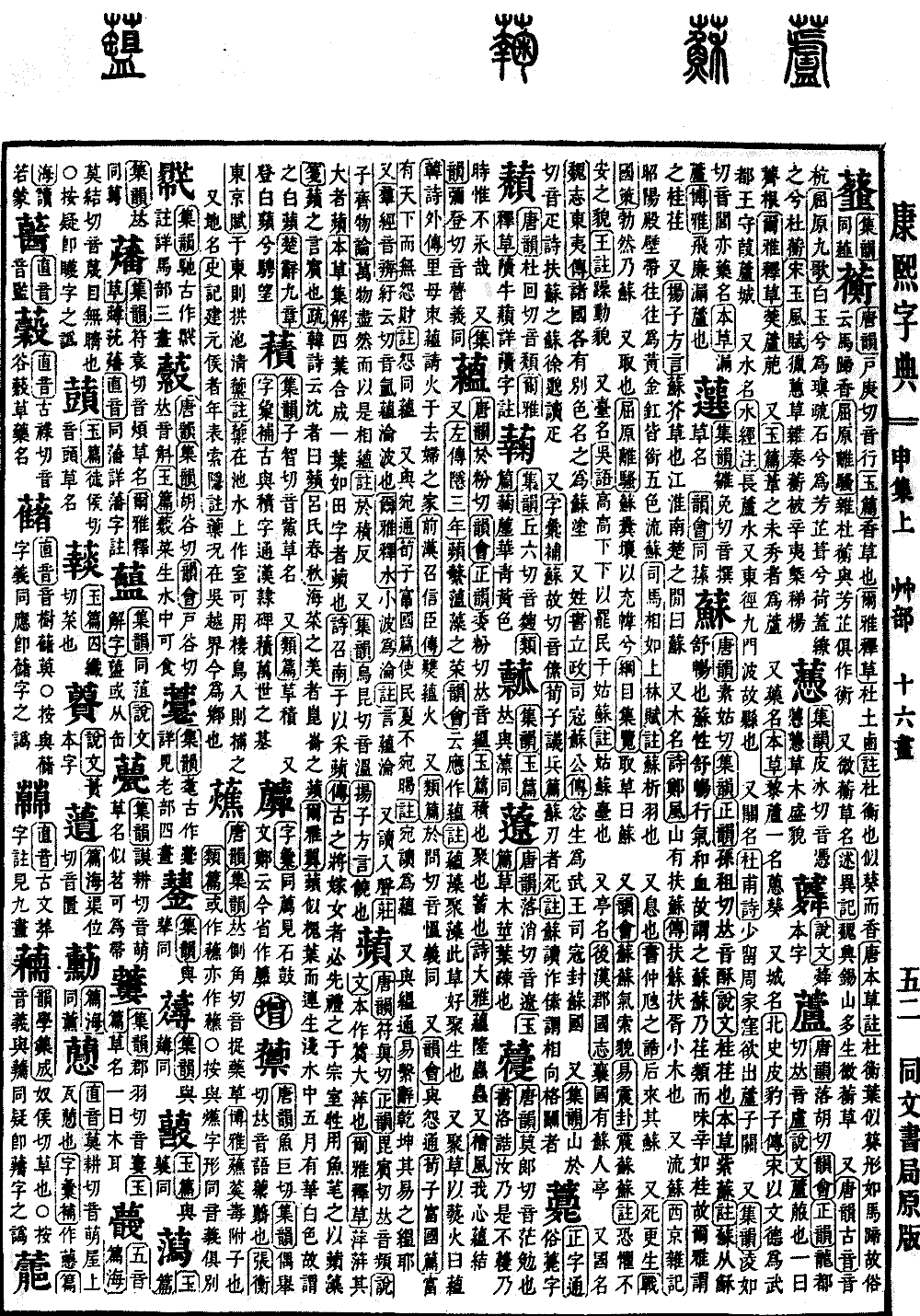
Shen Collection, Upper Volume
Radical: Grass (cǎo)
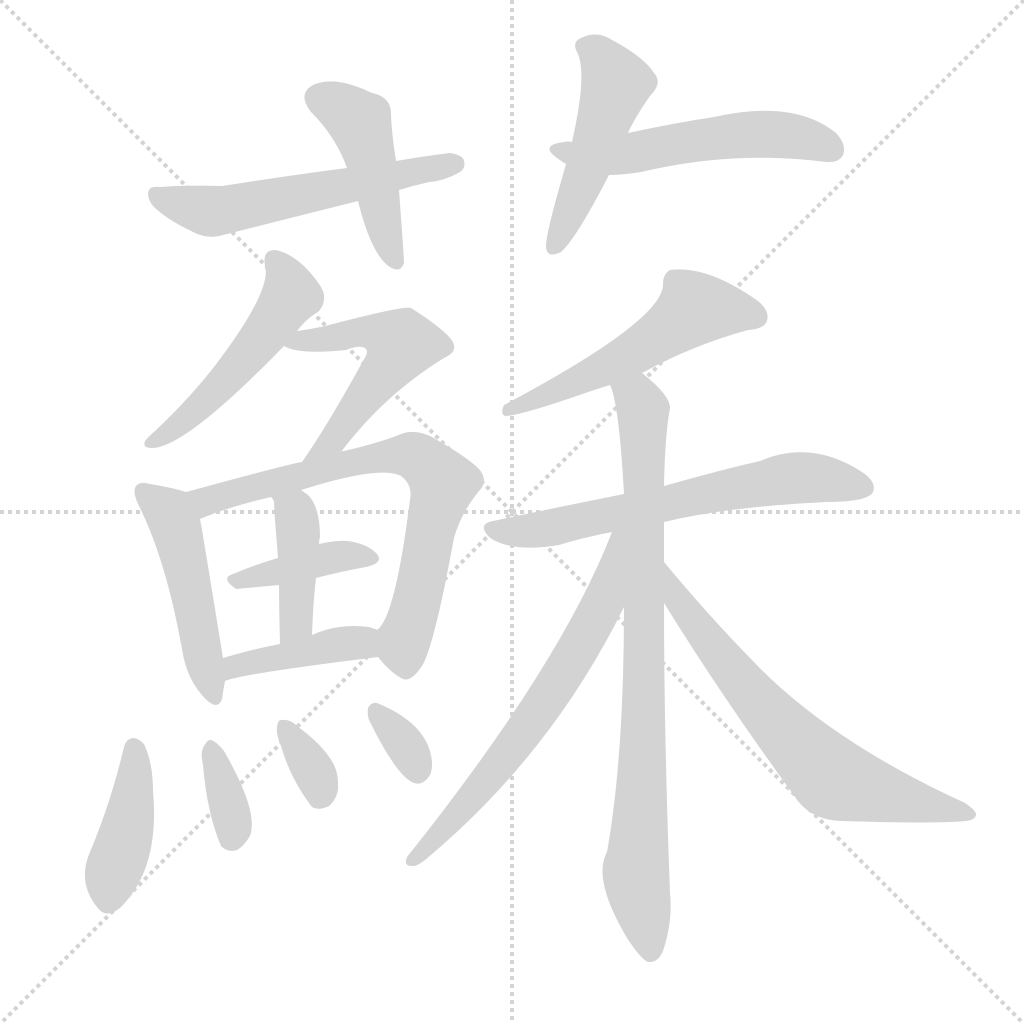
Su
Kangxi stroke count: 22
Page 1068, Entry 07
Tang Dynasty Rhyme Dictionary (Tangyun): Pronounced su. Collected Rhymes (Jiyun) and Orthography of Rhymes (Zhengyun): Pronounced su.
According to the Explanation of Graphs and Analysis of Characters (Shuowen Jiezi), it refers to a perilla-like plant. According to the Materia Medica (Bencao), it is purple perilla. Note: The character Su is derived from the character meaning to relax or ease. The nature of this plant is to provide ease and relaxation, capable of promoting the circulation of qi and harmonizing the blood, hence the name Su. It is a type of perilla, with a pungent flavor similar to cinnamon, which is why the Literary Expositor (Erya) refers to it as cinnamon-perilla.
Also, according to the Regional Speech (Fangyan) by Yang Xiong, Su refers to mustard greens; in the regions of Jiang, Huai, Southern Chu, and the Yangtze, it is called Su.
Also a type of tree. In the Book of Odes (Shijing), Zheng Airs: There are fusu on the mountains. The Commentary states: Fusu refers to fuxu, a small tree.
Also tassels (liusu). According to Miscellaneous Records of the Western Capital (Xijing Zaji), the walls of the Zhaoyang Hall were often adorned with golden rings inlaid with multicolored tassels. According to the notes in Sima Xiangru's Rhapsody on the Shanglin Park, Su refers to feather decorations.
Also means to revive. In the Book of Documents (Shujing), Announcement of Zhong Hui: The king will come and we shall be revived.
Also to return from death to life. According to the Strategies of the Warring States (Zhanguo Ce): Suddenly he revived.
Also means to take or gather. In Qu Yuan’s Encountering Sorrow (Lisao): Gathering the dung and soil to fill the sachet. According to the Comprehensive Guide to the Compendium of History (Gangmu Jilan), gathering grass is called su.
Also, according to the Collection of Rhymes (Yunhui), susu describes a state of weak breath. In the Book of Changes (Yijing), Hexagram of Shock (Zhen): Shocked and tremulous. The Commentary states: It indicates a state of fear and restlessness. Wang’s commentary states: It describes a state of agitation.
Also the name of a terrace. According to the Discourses of Wu (Wuyu): High and low, to exhaust the people at Gusu. The Commentary states: Gusu is the name of a terrace.
Also the name of a pavilion. According to the Records of Commanderies and States (Junguo Zhi) of the Later Han, Xiangguo has the Surin Pavilion.
Also the name of a country. According to the Records of the Three Kingdoms (Weizhi), Eastern Barbarians account: Various countries each have different insignia, referred to as sutu.
Also a surname. In the Book of Documents (Shujing), Establishment of Government: Minister of Justice, Duke of Su. The Commentary states: Fensheng served as Minister of Justice for King Wu and was enfeoffed in the state of Su.
Also, according to the Collection of Rhymes (Jiyun): Pronounced pi. Xu Miao reads the Su in the fusu of the Book of Odes (Shijing) as pi.
Also, according to the Supplement to the Collection of Characters (Zihuibu): Pronounced su. In the Xunzi, Discussion of Military Affairs: Those who face their blades will die. The Commentary states: Su is read as su, referring to meeting and fighting face to face.