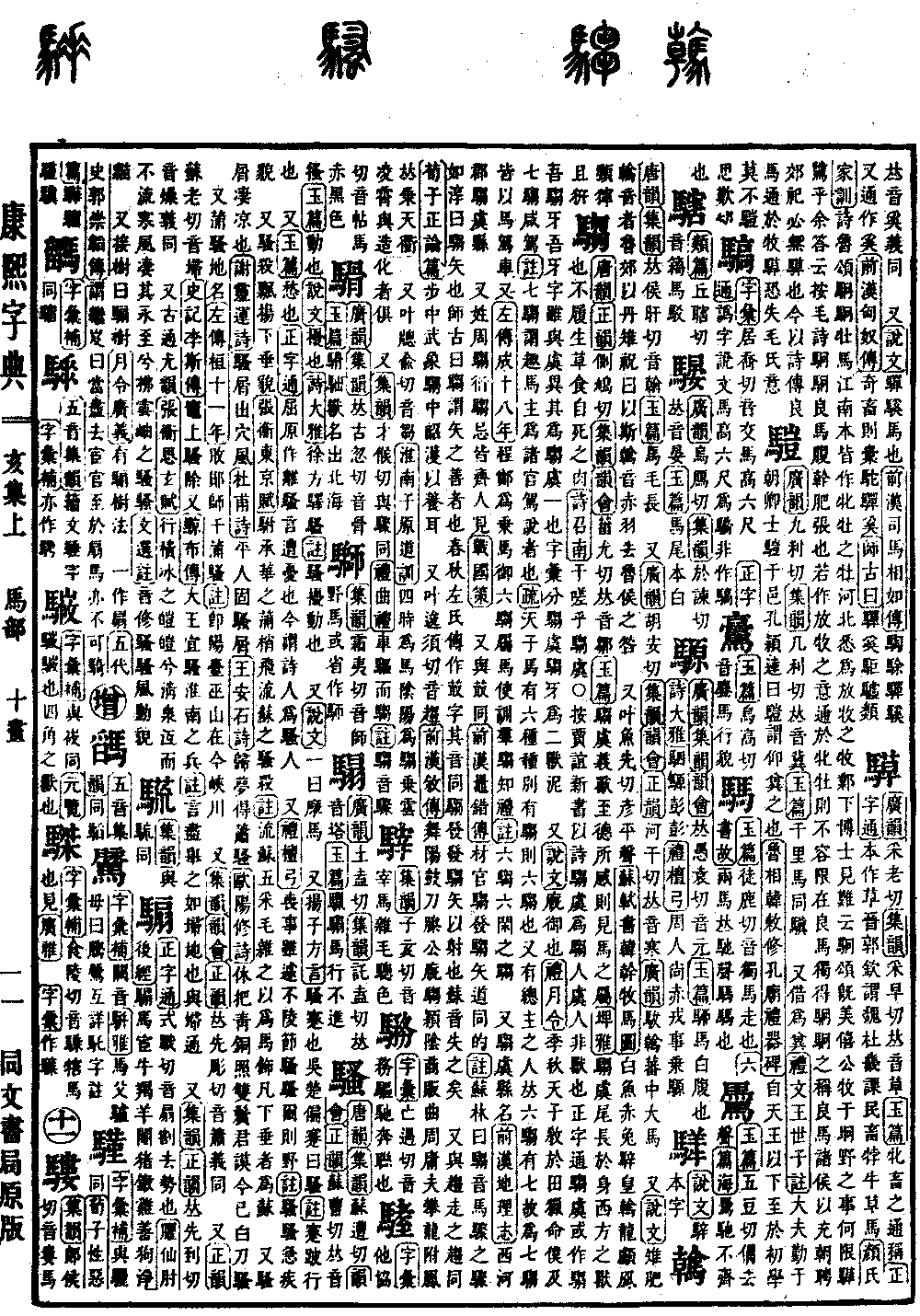
Hai Collection, Upper Volume
Radical: Horse (mǎ)
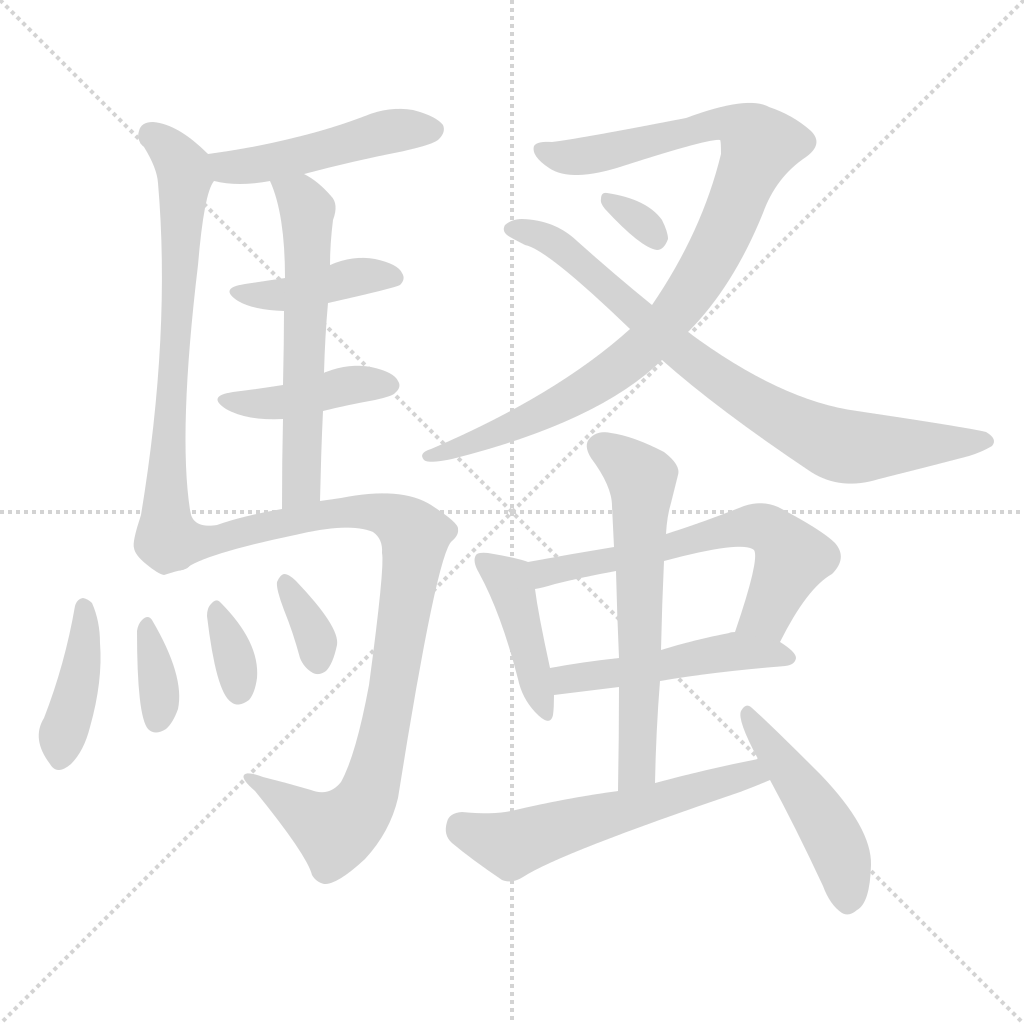
Entry: sao
Kangxi strokes: 20
Page 1443, Entry 19
Tang Rhymes (Tangyun) and Collected Rhymes (Jiyun) state it is pronounced sao. Rhyme Compendium (Yunhui) and Correct Rhymes (Zhengyun) state it is pronounced sao.
Jade Chapter (Yupian): To move.
Explaining Graphs and Analyzing Characters (Shuowen): To disturb.
Book of Odes (Shijing), Greater Odes (Daya): The Xu region is in constant turmoil.
Commentary: Sao means to disturb or agitate.
Also, according to Explaining Graphs and Analyzing Characters, another definition is to rub a horse.
Also, according to Yang Xiong's Dialects (Fangyan): Sao means to be lame. In the regions of Wu and Chu, walking with a limp is called sao.
Commentary: Jian means to walk with a limp.
Also, according to Jade Chapter: To be sorrowful.
Correct Meaning Thoroughfare (Zhengzitong): Qu Yuan wrote the Li Sao, meaning to encounter sorrow. Nowadays, poets are referred to as sao poets.
Also, Record of Rites (Liji), Tan Gong: Even in the urgency of funeral rites, one should not transgress the proper order; being overly hasty appears unrefined.
Commentary: Sao-sao means an appearance of being rushed or hurried.
Also, sao-sha, the appearance of something fluttering or hanging down.
Zhang Heng, Eastern Capital Rhapsody (Dongjing fu): The reins of the carriage flutter like flying tassels.
Commentary: Tassels are made of multi-colored mixed hairs used as horse ornaments; anything hanging down is called a tassel.
Also, sao-xie, cold and desolate.
Xie Lingyun poem: A cold, desolate wind emerges from the cave.
Du Fu poem: The common people are truly troubled and weary.
Wang Anshi poem: The dream of returning is desolate and sad.
Ouyang Xiu poem: Do not look at your temples in the bronze mirror; for you, the white hairs have already arrived.
Also, Pu-sao, a place name.
Zuo Tradition (Zuozhuan), Eleventh Year of Duke Huan: Defeated the Yun army at Pu-sao.
Commentary: This is Yangtai or Wushan, located in the present-day Xia region.
Also, according to Collected Rhymes (Jiyun), Rhyme Compendium (Yunhui), and Correct Rhymes (Zhengyun), it is pronounced xiao. The meaning is the same.
Also, according to Correct Rhymes (Zhengyun), it is pronounced sao.
Records of the Grand Historian (Shiji), Biography of Li Si: Sweeping up the stove.
Also, Biography of Qing Bu: The Great King should summon the troops of Huainan.
Commentary: This means to raise all the troops as if sweeping the ground. It is used interchangeably with the character for sweep.
Also, according to Collected Rhymes (Jiyun) and Correct Rhymes (Zhengyun), it is pronounced zao. The meaning is the same.
Also, in ancient times, it was used interchangeably with the rhyme category for the character you.
Zhang Heng, Rhapsody on Thinking (Si fu): Walking where the accumulated ice is bright white, the clear spring freezes and does not flow. The cold wind is desolate and eternal, brushing against the clouds of the mountain peaks, blowing in a rustling manner.
Anthology of Literature (Wenxuan) Commentary: Pronounced xiu. Sao-sao refers to the appearance of wind moving.