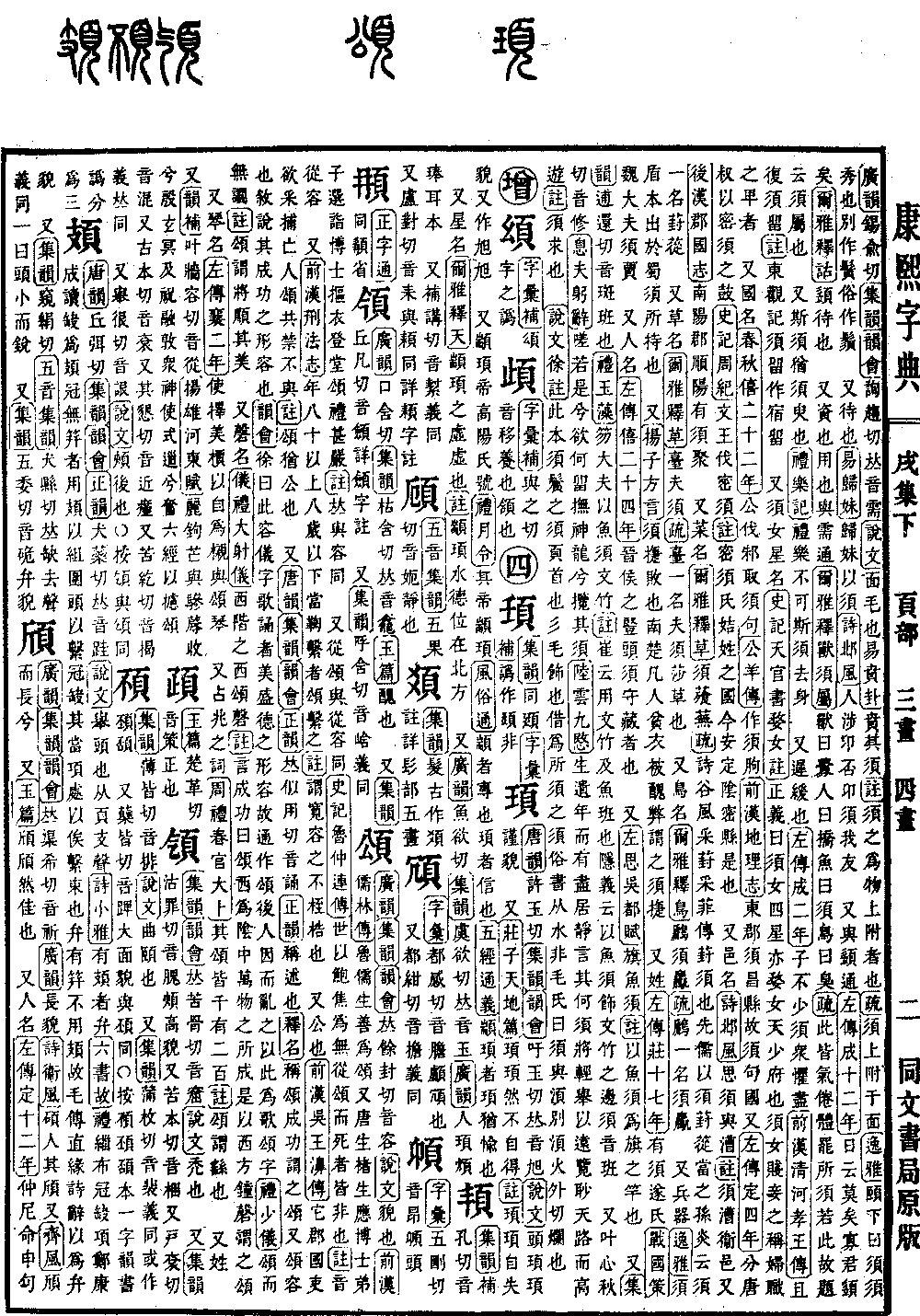
Xu Collection, Lower Volume
Radical: Page (yè)
Kangxi Strokes: 13
Page 1400, Entry 12
Pronounced rong. In the Wide Rhymes (Guangyun), Collected Rhymes (Jiyun), and Rhyme Compendium (Yunhui), the pronunciation is described as combining the sounds of yu and feng. According to the Explaining Graphs and Analyzing Characters (Shuowen), it refers to appearance. In the Book of Han (Hanshu), Biographies of Confucian Scholars: Lu Xusheng was skilled at presentation. Also, Tangsheng and Chusheng, responding to the selection of doctoral students, went to see the doctoral official, lifting their robes to ascend the hall, with a presentation (song) of etiquette that was very solemn. The commentary notes that it is the same as appearance (rong). It is also written as following presentation (song), which is the same as following appearance (cong-rong). In the Records of the Grand Historian (Shiji), Biography of Lu Zhonglian: The world considers Bao Jiao to have died without following the appearance (cong-song), which is all incorrect. The commentary notes the pronunciation as cong-rong. Also in the Book of Han (Hanshu), Treatise on Law: Those eighty years or older, or eight years or younger, who are to be investigated or detained, should be treated with leniency (song-xi). The commentary notes this means to treat with tolerance, without using shackles. It also means public. In the Book of Han (Hanshu), Biography of Prince Bi of Wu: Officials from other commanderies and kingdoms who wished to come and arrest fugitives, the public (song) officials forbade and did not cooperate. The commentary notes that song is similar to public (gong).
Pronounced song. In the Tang Rhymes (Tangyun), Collected Rhymes (Jiyun), Rhyme Compendium (Yunhui), and Correct Rhymes (Zhengyun), it is pronounced by combining the sounds of si and yong. According to the Correct Rhymes (Zhengyun), it means to praise or narrate. In the Explanations of Names (Shiming): To praise or narrate the success of an achievement is called song. Also, song means appearance; it is to narrate and describe the appearance of success. According to the Rhyme Compendium (Yunhui), Xu states: This is a character for appearance and demeanor. To sing or praise is to embellish the appearance of great virtue, therefore it is commonly used as song. Later generations have confused this, using it as the character for singing praises. In the Book of Rites (Liji), Lesser Rituals (Shaoyi): To praise (song) without flattery. The commentary notes that song means to promote and follow along with beauty. It is also the name of a stone chime. In the Book of Etiquette and Ceremonial (Yili), Great Archery Ritual (Dasheyi): The song chime on the west of the western steps. The commentary notes that speaking of success is called song. The west is the center of yin, where all things are completed, which is why the bells and chimes in the west are called song. It is also the name of a zither. In the Zuo Tradition (Zuo Zhuan), Second Year of Duke Xiang: He was told to select beautiful catalpa wood to make a coffin and a song zither. It also refers to the words of divination. In the Rites of Zhou (Zhouli), Spring Officials: Its songs (song) are all one thousand two hundred. The commentary notes that song refers to the oracles (yao). It is also a surname.
In the Rhyme Supplement (Yunbu), it rhymes with the sounds of qiang and rong, pronounced cong. In the River East Rhapsody (Hedong Fu) by Yang Xiong: Adorning Goumang and riding with Rushou, accompanied by Yinming and Zhurong. Urging the many gods to act as examples, brandishing the Six Classics to unfold the eulogies (song).
Editorial Notes: In the Book of Han (Hanshu), Biographies of Confucian Scholars: "Lu Ru-sheng was skilled at presentation." Corrected to "Lu Xu-sheng" according to the original text. In the Book of Han (Hanshu), Biography of Prince Bi of Wu: "Officials from other commanderies and kingdoms, wishing to gather and arrest fugitives..." Corrected to "wishing to come and arrest" according to the original text.