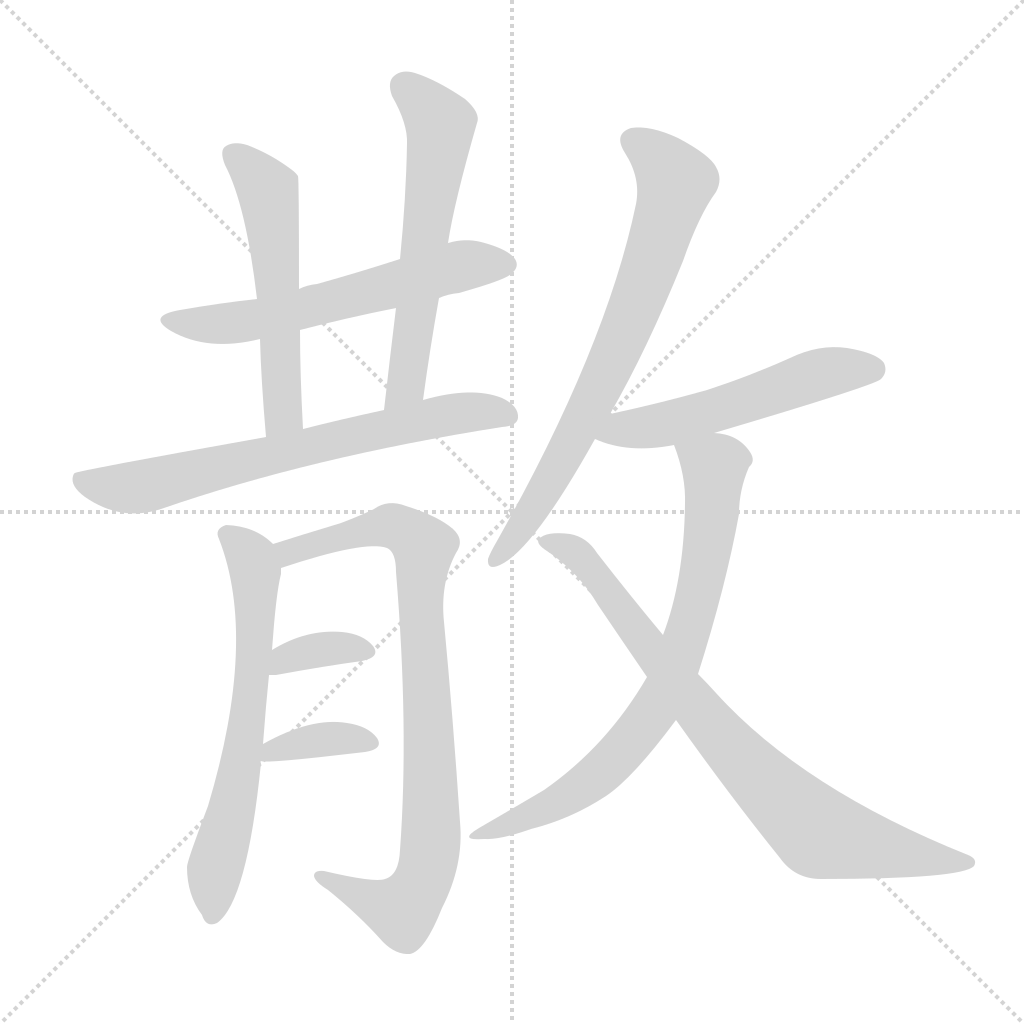
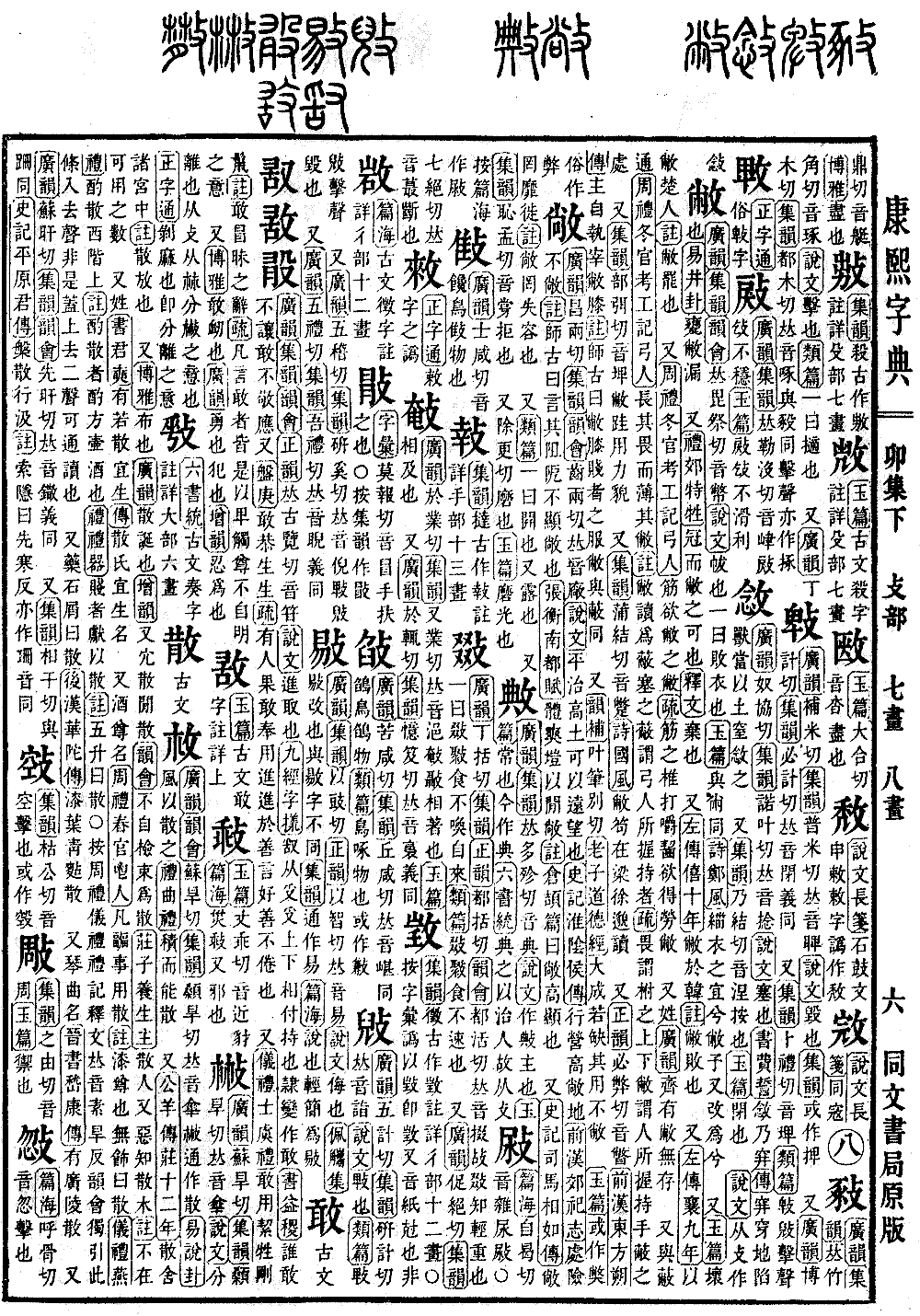
Mao Collection, Lower Volume
Radical: Tap (pū)
Kangxi Strokes: 12
Page 472, Entry 34
In ancient texts, it is also written as a variant form. Broad Rhymes (Guangyun) and Collection of Rhymes (Yunhui) record the pronunciation as san (third tone). Collected Rhymes (Jiyun) records the pronunciation as sang (third tone). It is pronounced the same as umbrella. It is commonly written as scattered.
Book of Changes (Yijing), Explanation of Trigrams (Shuogua) says: The wind can cause things to scatter.
Book of Rites (Liji), Summary of the Rules of Propriety (Quli) says: To accumulate wealth and be able to distribute it to others.
Also, Gongyang Commentary (Gongyang Zhuan), Year 12 of Duke Zhuang records: Dispersed and placed within the palace. The commentary explains: Scatter, means to release.
Also, Guangya explains it as: To disperse or spread.
Broad Rhymes (Guangyun) explains: Scatter, carries the meaning of being unrestrained.
Added Rhymes (Zengyun) also says: It carries the meaning of being redundant or idle.
Collection of Rhymes (Yunhui) explains: To be without self-restraint is called scattered.
Zhuangzi, Master of Nurturing Life (Yangshengzhu) says: How could an idle person understand a tree that is not fit for timber? The commentary explains: This refers to not being in the ranks of those who are useful.
Also used as a surname. Book of Documents (Shangshu), Lord Shi (Jun Shi) records: There was a person like San Yisheng. The commentary explains: San is the surname, and Yisheng is the given name.
Also the name of a type of wine vessel. Rites of Zhou (Zhouli), Spring Officials (Chunguan), Official of Sacrificial Wine (Changren) records: Whenever a sacrificial rite is held, a san is used. The commentary explains: It is a lacquer wine vessel; one without decoration is called a san.
Ceremonial Rites (Yili), Banquet Rites (Yanli) records: Pour the san wine on the western steps. The commentary explains: Pouring the san means pouring wine from a square pot.
Book of Rites (Liji), Vessels of Rites (Liqi) records: Those of low status use the san to offer wine. The commentary explains: A vessel with a capacity of five sheng is called a san. According to the Explanations of Texts (Shiwen) for the Rites of Zhou, Ceremonial Rites, and Book of Rites, it is pronounced su (third tone). The Collection of Rhymes (Yunhui) erroneously categorizes this entry solely under the departing tone, as the rising tone and departing tone are interchangeable.
Additionally, fine particles of medicine are called san. Book of the Later Han (Hou Hanshu), Biography of Hua Tuo records: Lacquer leaf green powder.
Also the name of a piece of zither music. Book of Jin (Jinshu), Biography of Ji Kang records: There is the musical piece Guangling San.
Also, Broad Rhymes (Guangyun) records the pronunciation as san (fourth tone), and Collection of Rhymes (Yunhui) records the pronunciation as xian (fourth tone). It is pronounced the same as a type of crossbow, with the same meaning.
Also, Collection of Rhymes (Jiyun) records the pronunciation as xianggan. It is the same as limp. Records of the Grand Historian (Shiji), Biography of Lord Pingyuan records: Limping while going to draw water. The commentary says: It is pronounced xian (first tone), and is also written as coral. It is pronounced the same.