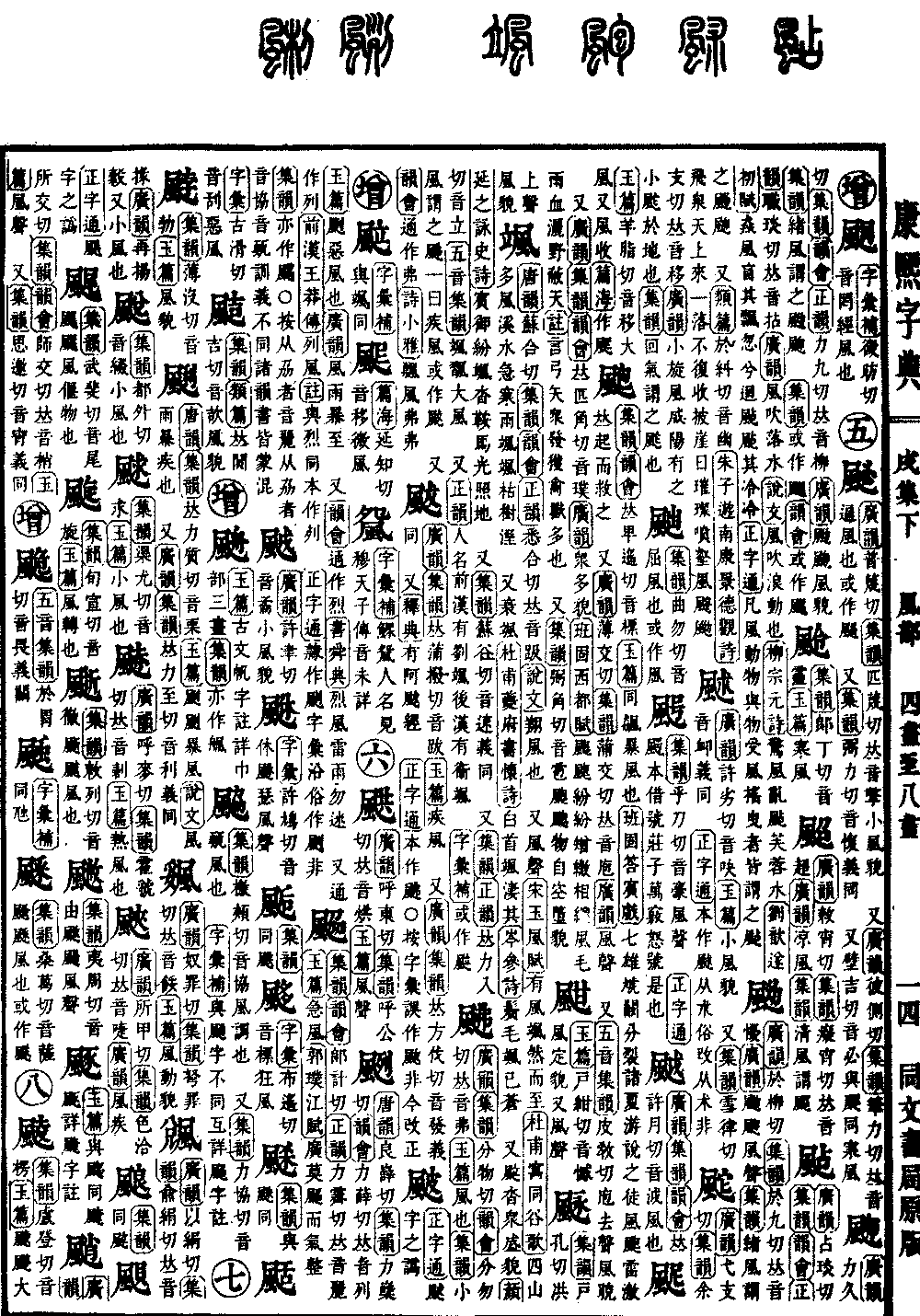
Xu Collection, Lower Volume
Radical: Wind (fēng)
Entry: Sa
Kangxi Stroke Count: 14
Page 1412, Entry 17
Pronounced sa
According to the Explanation of Graphs and Analysis of Characters (Shuowen Jiezi), it describes the soaring of wind. It also refers to the sound of wind. In the Rhapsody on the Wind (Feng Fu) by Song Yu: There is a wind that arrives with a rustling sound. In the poem Living in Tonggu by Du Fu: Four mountains are windy, the stream water rushes, cold rain falls with a rustling sound upon the withered trees.
It also means declining or withered. In the poem Thoughts Written in Kuizhou (Kuifu Shuhuai Shi) by Du Fu: My white hair is sparse and desolate. In a poem by Cen Shen: My temples have turned gray and thin.
It also means bustling, describing a large crowd. In the Poem on History (Yongshi Shi) by Yan Yanzhi: Guests and attendants are bustling in great numbers, their saddles and horses shining upon the ground.
Pronounced su
Same meaning as above.
Pronounced li
According to the Five Sounds Collected Rhymes (Wuyin Jiyun), sa-sui refers to a great wind.
As a proper name. In the Former Han Dynasty there was Liu Sa, and in the Later Han Dynasty there was Wei Sa.
In the Supplement to the Dictionary (Zihui Bu), it is sometimes written in a variant form.