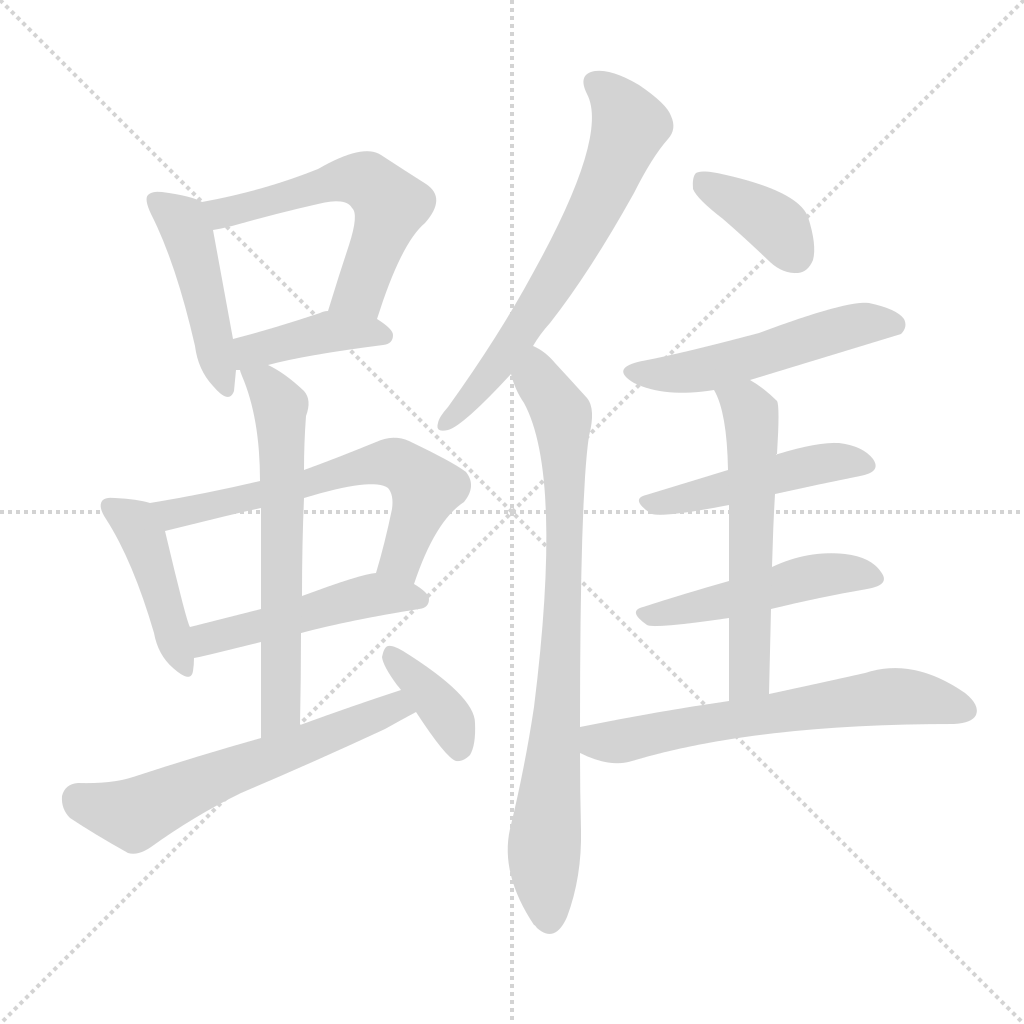
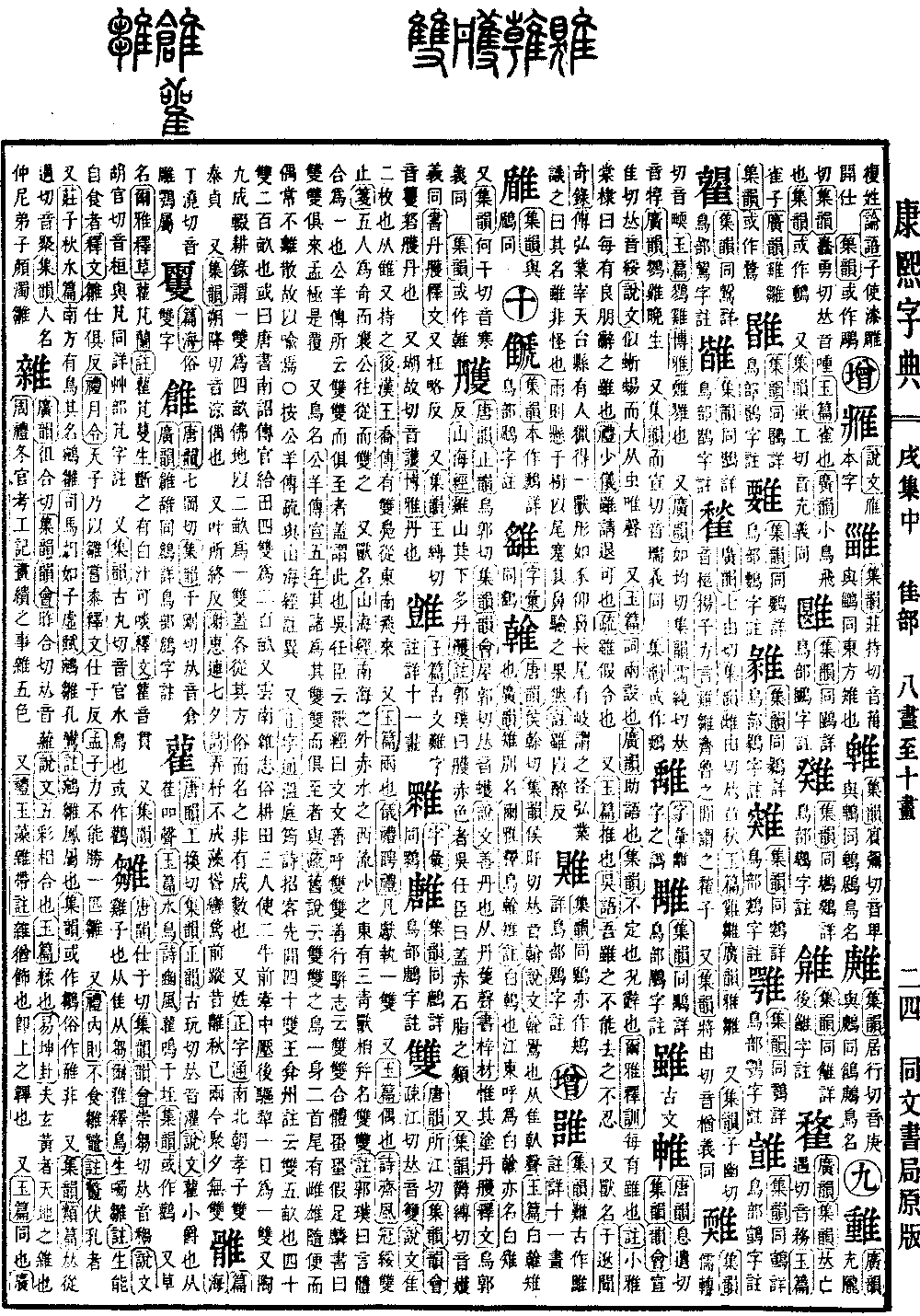
Xu Collection, Middle Volume
Radical: Short-tailed bird (zhuī)
Kangxi stroke count: 17
Page 1368, Entry 22
Ancient form. Pronounced sui. According to the Shuowen Jiezi, it describes an animal similar to a lizard but larger. Formed from the insect radical with the sound of wei.
Also, in the Yupian, it is a word expressing a hypothetical condition. According to the Guangyun, it is a particle. According to the Jiyun, it expresses uncertainty or acts as a progressive particle.
In the Erya, Shixun, the phrase mei you means the same as sui. The commentary on the Book of Odes (Shijing) says: every time there is a good friend, where sui is used to signify a refusal.
In the Book of Rites (Liji), Shaoyi, it says: Even if one requests to withdraw, it is acceptable. The commentary explains that sui means even if or assuming that. In this context, it means that if one requests to withdraw at that time, it is acceptable.
Also, in the Yupian, it means to conjecture.
Also, it is interchangeable with the character wei. In the Book of Rites (Liji), Biaoji, it says: Only the Son of Heaven receives the mandate from Heaven. The commentary notes that wei should be read as sui. In the Xunzi, Xing’e chapter, it says: Does one now believe that benevolence, righteousness, and laws are originally impossible to know or practice? If so, even Yu would not have known benevolence, righteousness, and laws, and could not have practiced them. Yang Liang's commentary states that wei is read as sui.
Textual verification: The citation from the Xiao Ya section of the Book of Odes (Shijing), originally citing the poem Tangdi, has been corrected to refer to the Book of Odes directly. Regarding the passage in the Discourses of Wu (Wuyu), "I cannot do it, yet I cannot bear to leave," the original text uses the character xu rather than sui. The eleven characters following the mention of the Discourses of Wu have been omitted, and two sentences have been added to the previous commentary on the Book of Rites (Liji) to reflect the original text.
Also, it is the name of a beast. According to the Yu Ti Wen Qi Lu, while Fu Hongye was serving as the magistrate of Tiantai County, a hunter captured a wild beast that looked like a pig with an upturned nose and a long, forked tail, referring to it as a monster. Hongye recognized it and said its name was sui, not a monster. When it rains, it hangs itself in a tree and uses its tail to plug its nostrils. Upon verification, this was found to be true. The note states that sui is pronounced zui. However, it is noted that the description of an upturned nose and long tail refers to the animal known as wei, as described in the Erya, and not to the character sui. The Wen Qi Lu incorrectly recorded this as sui, which should not be followed. This section has been omitted and replaced with the note that it is interchangeable with the character wei, as seen in the Book of Rites (Liji), Biaoji, and the Xunzi, Xing’e chapter.