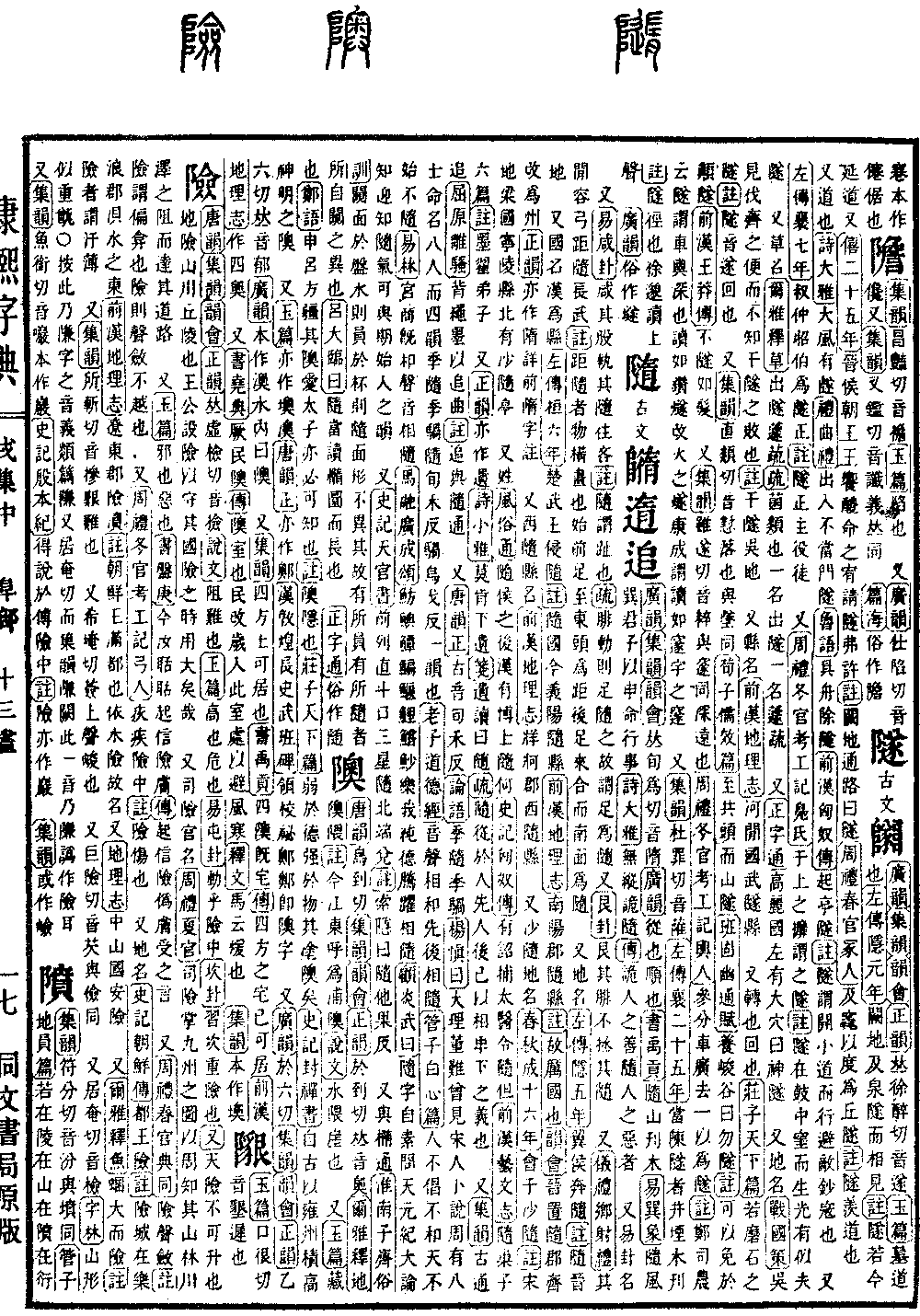
Xu Collection, Middle Volume
Radical: Mound (fù)
Suì; Kangxi Strokes: 21; Page: 1361, Entry 02
According to Guangyun, Jiyun, Yunhui, and Zhengyun, pronounced Xúzuì, like "suì."
Yu Pian defines it as a tomb passage.
In Zuo Zhuan (Zuozhuan), Yin, Year 1: "They dug down to the springs and met in a tunnel."
Annotation: Suì is similar to a modern passage.
Also in Zuo Zhuan (Zuozhuan), Xi, Year 25: "When the Marquis of Jin had an audience with the King of Zhou, the King provided sweet wine and commanded him to assist in drinking. The Marquis of Jin requested to use the suì ritual, but the King did not permit it."
Annotation: Digging a path in the ground is called suì.
In Rites of Zhou (Zhouli), Spring Officers, Tomb Official: "Upon digging the burial pit, the mound and tomb passage were constructed according to regulations."
Annotation: Suì refers to the tomb passage.
Also refers to a road.
In Book of Odes (Shijing), Major Odes: "The great wind has its path."
In Book of Rites (Liji), Summary of the Rules of Propriety: "One should not use the passage in front of the door when entering or exiting."
In Discourses of Lu (Luyu): "Prepare boats, clear the roads."
In History of the Former Han (Hanshu), Account of the Xiongnu: "Constructed watchtowers and passages."
Annotation: Suì refers to opening small paths for passage to avoid enemy raids.
Also in Zuo Zhuan (Zuozhuan), Xiang, Year 7: "Shuzhong Zhaobo served as suìzhèng."
Annotation: Suìzhèng, an official in charge of laborers.
Also in Rites of Zhou (Zhouli), Winter Officers, Artificers' Record, Master Fu: "The groove on the upper part of the bell body is called suì."
Annotation: The suì is in the middle of the drum section, recessed and lustrous, somewhat resembling a tunnel.
Also a name of a plant.
In Erya (Erya), Explication of Grasses: "Chusuì is qúshū."
Commentary: It belongs to the mushroom family. One name is chusuì, another is qúshū.
Also in Corrected Character Compendium (Zhengzitong): "To the left of the Kingdom of Goryeo, there is a large cave called shénsuì."
Also a place name.
In Strategies of the Warring States (Zhanguoce): "The state of Wu only saw the convenience of attacking Qi but was unaware of its defeat at Gànsuì."
Annotation: Gànsuì, a place name in the state of Wu.
Also a county name.
In History of the Former Han (Hanshu), Treatise on Geography: "Wusuì county in Hejian Commandery."
Also refers to rotating, revolving.
In Zhuangzi (Zhuangzi), The World: "Like the turning of a millstone."
Annotation: Suì, pronounced like "suì," means revolving.
Also in Jiyun, pronounced Zhílèi, like "duì." Means to fall; same as zhuì.
In Xunzi (Xunzi), On Confucianism: "Upon reaching Gongtou Mountain, rocks collapsed."
In Ban Gu's (Ban Gu) Ode to Mysterious Communication (Youtong Fu): "Looking back at the deep valley, admonishing not to fall."
Annotation: Can avoid falling down.
In History of the Former Han (Hanshu), Biography of Wang Mang: "Even as fine as a hair, it would not fall."
Also in Jiyun, pronounced Suīsuì, like "cuì." Same as suì. Means deep and distant.
In Rites of Zhou (Zhouli), Winter Officers, Artificers' Record, Wheelwrights: "Divide the width of the carriage into three equal parts, and remove one part as the depth of the carriage."
Annotation: Zheng Sinong said: Suì refers to the depth of the carriage, pronounced like suì in "drilling suì to change fire." Zheng Kangcheng believed: It should be pronounced like suì in "deep suì dwelling."
Also in Jiyun, pronounced Dùzuì, like "duì."
In Zuo Zhuan (Zuozhuan), Xiang, Year 25: "For those on the roads, wells were filled, and trees were felled."
Annotation: Suì, a path. Xu Miao pronounced it in the rising tone.
Guangyun: The popular form is written as suì.
Textual Research: In Ban Gu's (Ban Gu) Ode to Mysterious Communication (Youtong Fu): "Yǎng jùngǔ yuē wùsuì." "Yǎng" should be corrected to "juàn" according to the original text.