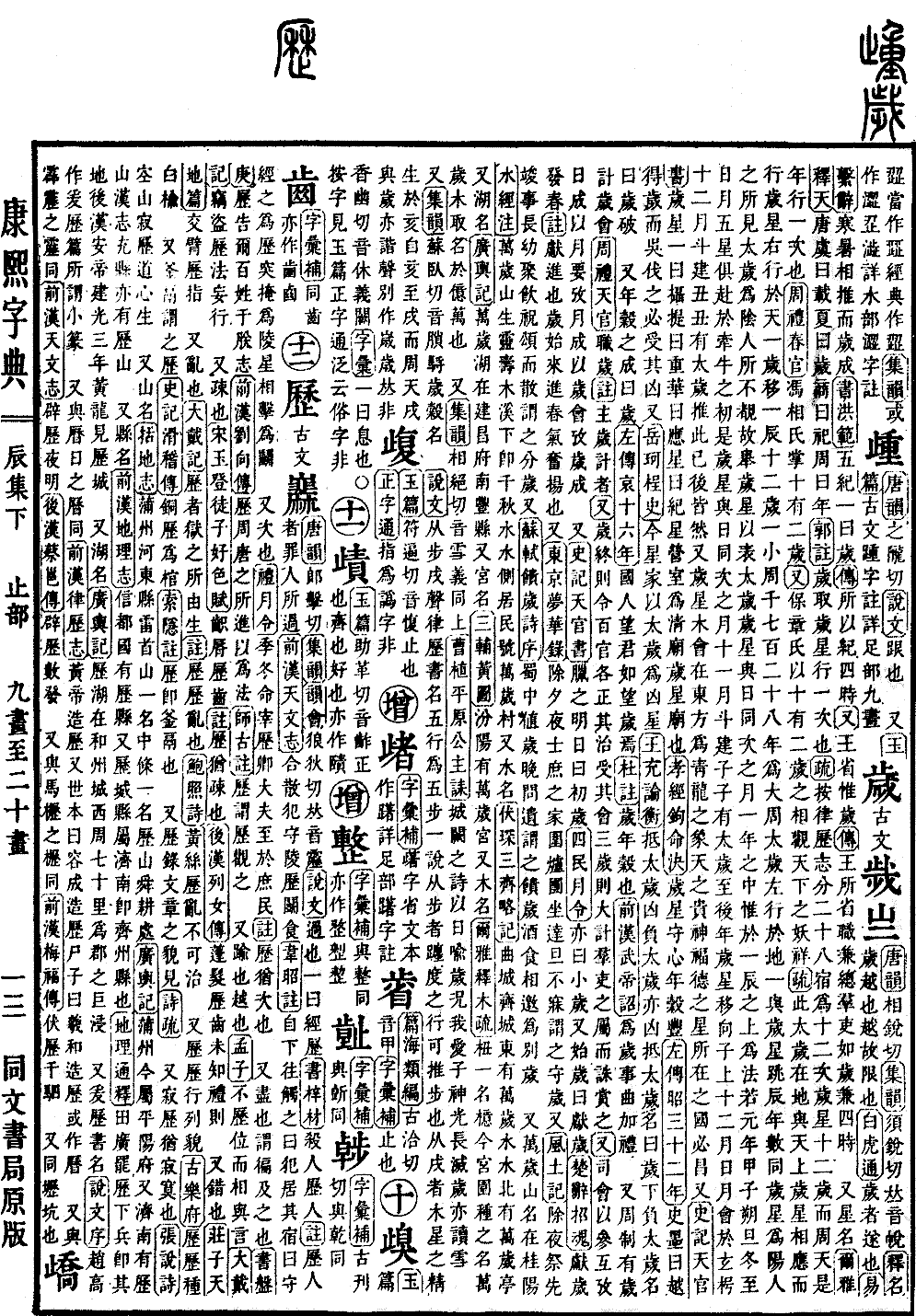
Chen Collection, Lower Volume
Radical: Stop (zhǐ)
Page 577, Entry 01
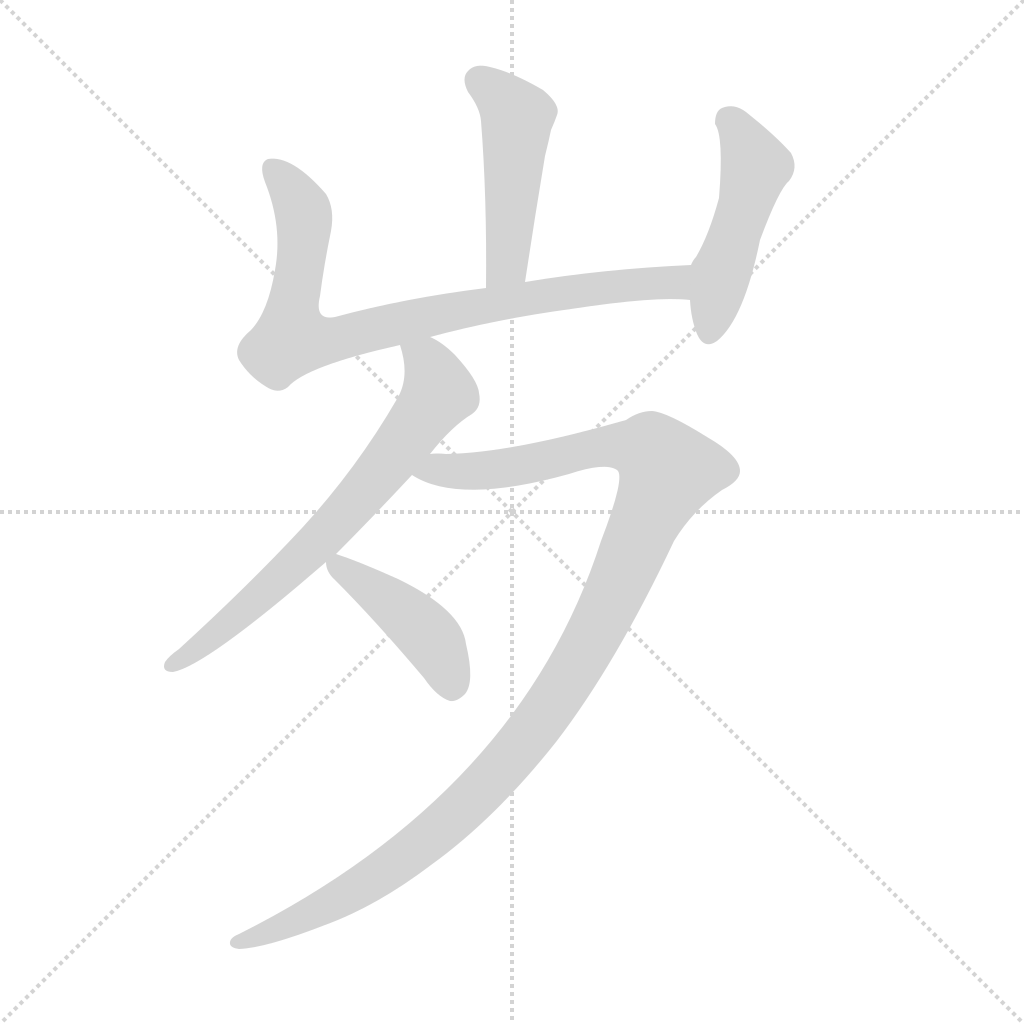
Ancient character form represented as sui.
Pronounced sui (falling tone).
Explanation of Names (Shimin): Sui means to transcend; it signifies the limitation of time passed.
White Tiger Hall Discussions (Baihu Tong): Sui signifies that which proceeds.
Book of Changes (Yijing), Appended Statements: The cold and heat push one another, and the year (sui) is completed.
Book of Documents (Shangshu), Great Plan (Hongfan): The five chronologies, the first is called the year (sui).
Commentary: This is how the four seasons are recorded.
Also: The King examines the year (sui).
Commentary: The official duties the King examines, overseeing all the officials, is like the year encompassing the four seasons.
Also the name of a star.
Approaching Elegance (Erya), Explanation of Heavens: During the Tang and Yu dynasties it was called zai, in the Xia dynasty it was called sui, in the Shang dynasty it was called si, and in the Zhou dynasty it was called nian.
Commentary: Sui is named for the year-star (Jupiter) completing one revolution.
Sub-commentary: According to the Records of the Calendar and Law (Lülizhi), the twenty-eight mansions are divided into twelve divisions. The year-star completes a circuit of the heavens in twelve years, moving through one division each year.
Rites of Zhou (Zhouli), Offices of Spring: The Fengxiangshi official manages the twelve years.
Also: The Baozhangshi official observes the auspicious and inauspicious signs of the twelve years to observe the affairs of the world.
Sub-commentary: This refers to Tai-sui located in the earth, which moves in correspondence with the year-star in the heavens. The year-star moves to the right in the heavens, shifting one earthly branch position each year, completing a minor cycle in twelve years and a major cycle in one thousand seven hundred and twenty-eight years. Tai-sui moves to the left on the earth, corresponding with the year-star in shifting positions, with the number of years being the same. The year-star is Yang and is visible to people; Tai-sui is Yin and is not seen by people, hence the year-star is cited to represent Tai-sui. When the year-star is in the same position as the sun, it is the month of that year. If it is the first year, a Jia-zi day at the dawn of the winter solstice, the sun and the five planets all congregate at the beginning of the Ox constellation; this is the month when the year-star and the sun share a position. In the eleventh month, the Handle of the Dipper points to Zi; Zi contains Tai-sui. By the following year, the year-star moves toward Zi, and in the twelfth month, the sun and moon meet at the Xu constellation. In the twelfth month, the Handle of the Dipper points to Chou; Chou contains Tai-sui. Following this logic, all subsequent years follow the same pattern.
Also, when the year-star, associated with wood, meets in the east, it forms the image of the Azure Dragon, the noble spirit and star of good fortune; the state in which it resides must flourish.
Also, Records of the Grand Historian (Shiji), Treatise on the Celestial Offices: The year-star is also called Sheti, Zhonghua, Yingxing, and Jixing. The Ying chamber is the Pure Temple, which is the temple of the year-star.
Classic of Filial Piety (Xiaojing), Hook of Life Decisions (Goumingjue): When the year-star guards the Heart constellation, the annual harvest is abundant.
Zuo Tradition (Zuo Zhuan), 32nd Year of Duke Zhao: The historian Mo stated: Yue obtained the year-star and Wu attacked it, therefore it must suffer misfortune.
Also, Collected Historical Anecdotes (Chuishi) by Yue Ke: Today, astrologers consider Tai-sui to be a star of misfortune.
Wang Chong, Discourses Weighed in the Balance (Lunheng): Offending Tai-sui brings misfortune, and carrying Tai-sui on one's back also brings misfortune. Offending Tai-sui is called sui-xia, and carrying Tai-sui on one's back is called sui-po.
Also, the completion of the grain harvest is called sui.
Zuo Tradition (Zuo Zhuan), 16th Year of Duke Ai: The people of the state look to their ruler as they look to the harvest (sui).
Commentary: Sui refers to the annual grain harvest.
Former Han Dynasty Imperial Decree: For the affairs of the harvest, add special rites.
Also, under the Zhou system, there was the annual audit (sui-ji) and annual accounting (sui-hui).
Rites of Zhou (Zhouli), Offices of Spring: The Zhuisui official.
Commentary: He who manages the annual audit.
Also: At the end of the year, he commands all officials to set their administration in order and receives their accounts. Every three years, there is a grand audit of the administration of all officials, and rewards or punishments are administered.
Also: The Sikui official uses mutual cross-checking to verify daily results, monthly summaries to verify monthly results, and annual accounts to verify annual results.
Also, Records of the Grand Historian (Shiji), Treatise on the Celestial Offices: The day after the year-end sacrifice is called chu-sui.
Monthly Ordinances for the Four Classes of People (Simin Yueling): Also called xiao-sui.
Also, the beginning of the year is called xian-sui.
Songs of Chu (Chu Ci), Summoning the Soul: Xian-sui ushers in the spring.
Commentary: Xian means to present. The year begins and arrives, and the energy of spring flourishes.
Also, Tokyo Dream Splendor (Dongjing Menghua Lu): On New Year's Eve, scholar-official families gather around the stove, sitting together without sleeping until dawn, which is called shou-sui (keeping the year).
Also, Record of Customs (Fengtu Ji): On New Year's Eve, after making offerings to ancestors, the young and old gather to drink, offer blessings, and then disperse, which is called fen-sui (parting the year).
Also, Su Shi, Preface to the Poem on Gifting the Year: In the Shu region, if one has leisure at the end of the year, one gives gifts called kui-sui (gifting the year). People invite one another for food and wine as a farewell to the year (sui-bie).
Also, Wan-sui (Ten Thousand Years), name of a mountain. Located in Guiyang.
Commentary on the Classic of Waterways (Shuijing Zhu): Wan-sui Mountain grows ling-shou wood, and below the stream is the Qian-qiu (Thousand Autumns) River. The residents by the river call it Wan-sui Village.
Also, name of a river.
Fu Chen, Brief Record of the Three Qi (Sanci Lueli): East of Qucheng and Qicheng is the Wan-sui River; north of the river is the Wan-sui Pavilion.
Also, name of a lake.
Comprehensive Gazetteer of the Empire (Guangyu Ji): Wan-sui Lake, located in Nanfeng County, Jianchang Prefecture.
Also, name of a palace.
Three Appendices of the Map of the Capital (Sanfu Huangtu): Fenyang has the Wan-sui Palace.
Also, name of a tree.
Approaching Elegance (Erya), Explanation of Trees, Commentary: The niu tree is also called the ao. Today, palace gardens plant them and call them Wan-sui trees, taking the name from the concept of ten thousand ten-thousands.
Also, pronounced xue (falling tone). Same meaning as the variant (shuan).
Cao Zhi, Eulogy for Princess Pingyuan: The poem about the castle towers compares the day to the year. How much more so for my beloved child, whose divine light is long extinguished. Sui is also read as xue.
Also, pronounced pi (rising tone). Pi-sui is the name of a type of grain.
Explanation of Simple and Compound Characters (Shuowen): Composed of the radical for walk and the phonetic element xu. The Book of the Calendar and Law refers to the five elements as the five walks. One theory suggests the radical for walk refers to the movement of planetary orbits which can be calculated. The use of xu is because the wood star (Jupiter) is produced in Hai, and from Hai to Xu, it completes a circuit of the heavens. Xu and sui are also phonetic matches. Other forms written as characters are incorrect.