Wei Collection, Upper Volume
Radical: Bamboo (zhú)
Kangxi Strokes: 14
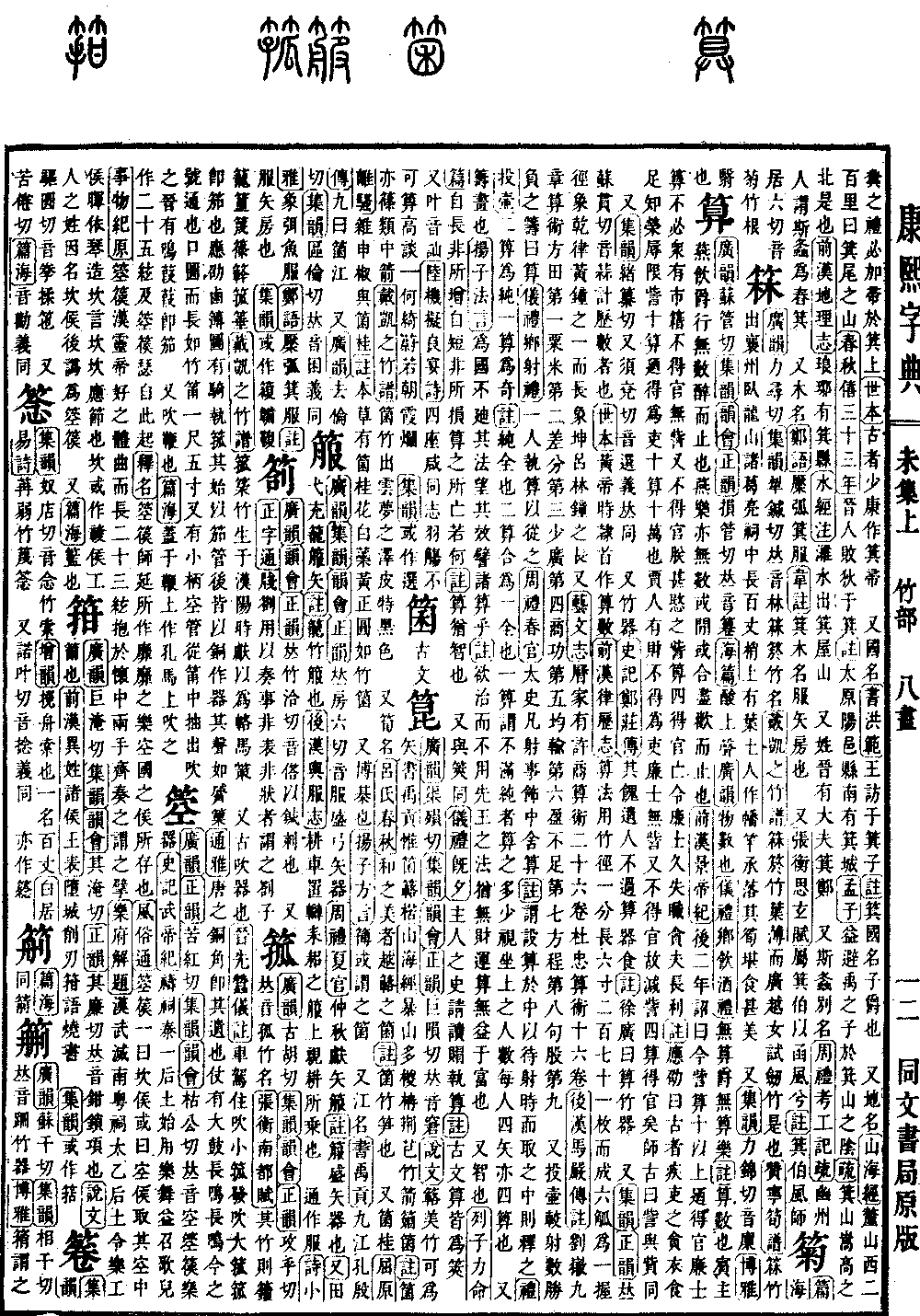
Page 888, Entry 03
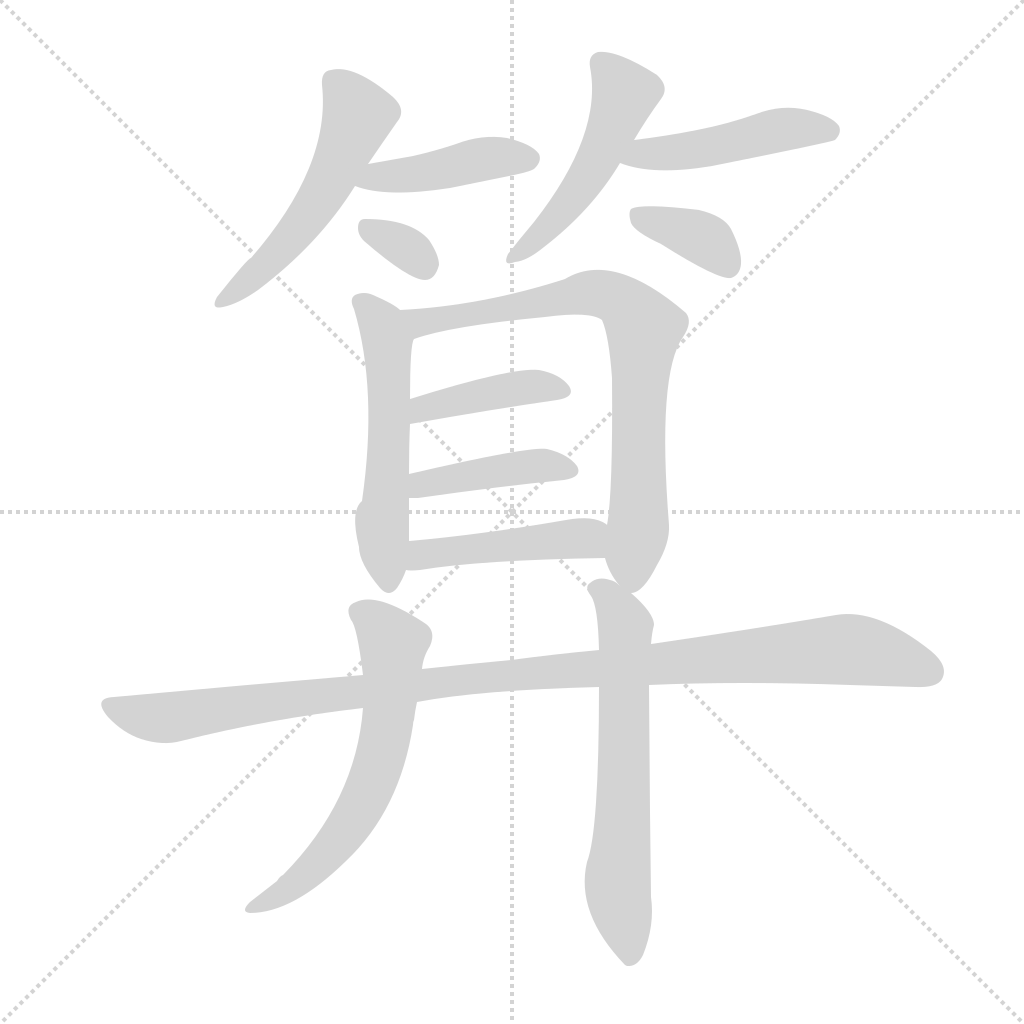
Pronounced suan.
According to the Extensive Rhymes (Guangyun), the Collected Rhymes (Jiyun), the Rhyme Collection (Yunhui), and the Orthodox Rhymes (Zhengyun), it is pronounced suan (rising tone). According to the Sea Compilation (Haipian), it is pronounced suan (rising tone).
The quantity of items.
Book of Etiquette and Ceremonial (Yili), Section on Guest Drinking Rites: There is no limit to the number of wine cups or musical performances. Commentary: Suan means to count. During a banquet between host and guest, there is no fixed limit to the number of times wine is served or music is played; they continue until the participants are satisfied.
History of the Former Han (Qianhan), Biography of Emperor Jing: In the second year of his later reign, the Emperor issued an edict: Currently, to hold office, one must possess property worth at least ten units (suan). However, integrity does not always guarantee wealth; those registered as merchants are barred from office, and the impoverished are also unable to qualify. I sympathize with them. Henceforth, property worth four units shall suffice to hold office, so that men of integrity are not excluded, and the profit-seeking are not left to prosper indefinitely. Commentary: Ying Shao notes that in ancient times, the government detested avarice, believing that only those with sufficient food and clothing could understand honor and shame; thus, they mandated property worth ten units—equivalent to one hundred thousand cash—to serve as an official. Merchants had wealth but were disqualified, while honorable men often lacked property, so the requirement was reduced to four units. Yan Shigu notes that here zǐ is synonymous with zī (property).
Also pronounced xuan. It has the same meaning. It also refers to a bamboo vessel.
Records of the Grand Historian (Shiji), Biography of Zheng Zhuang: His gifts to others did not exceed what could be held in a bamboo vessel. Commentary: Xu Guang states that suan refers to a bamboo container.
Also pronounced suan. A person who calculates mathematical or calendrical data.
Genealogical Records (Shiben): During the time of the Yellow Emperor, Lishou created the art of calculation.
History of the Former Han (Qianhan), Treatise on Harmonics and Calendars: The method of calculation uses bamboo sticks, one fen in diameter and six cun in length. Two hundred and seventy-one sticks are bundled into a hexagonal shape, referred to as one grasp. The diameter symbolizes the length of one fen of the Yellow Bell in the cosmology of Qian, and the length symbolizes the length of the Forest Bell in the cosmology of Kun.
Treatise on Literature and Arts: Among the mathematicians, there are twenty-six volumes of Xu Shang’s Mathematical Arts and sixteen volumes of Du Zhong’s Mathematical Arts.
Commentary on the Biography of Ma Yan in the History of the Later Han (Houhan): The Nine Chapters on the Mathematical Art (Jiuzhang Suanshu) includes nine categories: Field Measurement, Grains and Rice, Proportional Distribution, Extraction of Square and Cube Roots, Construction Engineering, Fair Levies, Excess and Deficit, Rectangular Arrays, and Right-Angled Triangles.
Tokens used to track scores in games such as pot-tossing (touhu) or archery competitions.
Book of Etiquette and Ceremonial (Yili), Section on Archery Rites: A person holds the counting tokens and follows the participants.
Book of Rites (Zhouli), Ministry of Spring: The Grand Scribe oversees the arrangement of containers to hold the counting tokens. Commentary: This refers to placing tokens in a vessel to be retrieved during archery; when a shot lands, a token is deposited.
Book of Rites (Liji), Pot-Tossing: Two tokens are called a pair (chun); one token is called a single (ji). Commentary: Chun means complete; two tokens together form a single unit. A single token refers to less than a full pair. The number of tokens depends on the participants; each person is allowed four arrows, so four tokens are used.
To plan or calculate.
Yangzi’s Model Sayings (Fayan): To govern a state without following the laws of former kings while expecting results is like trying to calculate without using counting tokens. Commentary: Seeking to govern without the laws of ancient sages is like seeking wealth without tools; it provides no benefit.
Wisdom.
Master Lie (Liezi), Section on Strength and Destiny: Natural strengths cannot be increased, natural weaknesses cannot be diminished; what can one do when wisdom is powerless to change things? Commentary: Suan is synonymous with wisdom.
Also written as a variant form (cè).
Book of Etiquette and Ceremonial (Yili), Section on Final Rites: The master’s scribe requests to read the inventory of funeral gifts while holding the counting tokens. Commentary: In ancient texts, suan is often written as cè.
Rhymes with shan.
Lu Ji’s Poem Imitating a Fine Feast: The guests are all of one mind, and the wine cups pass back and forth beyond counting. How splendid the lofty discourse, shining like the morning clouds.
In the Collected Rhymes (Jiyun), it is sometimes written as xuan.