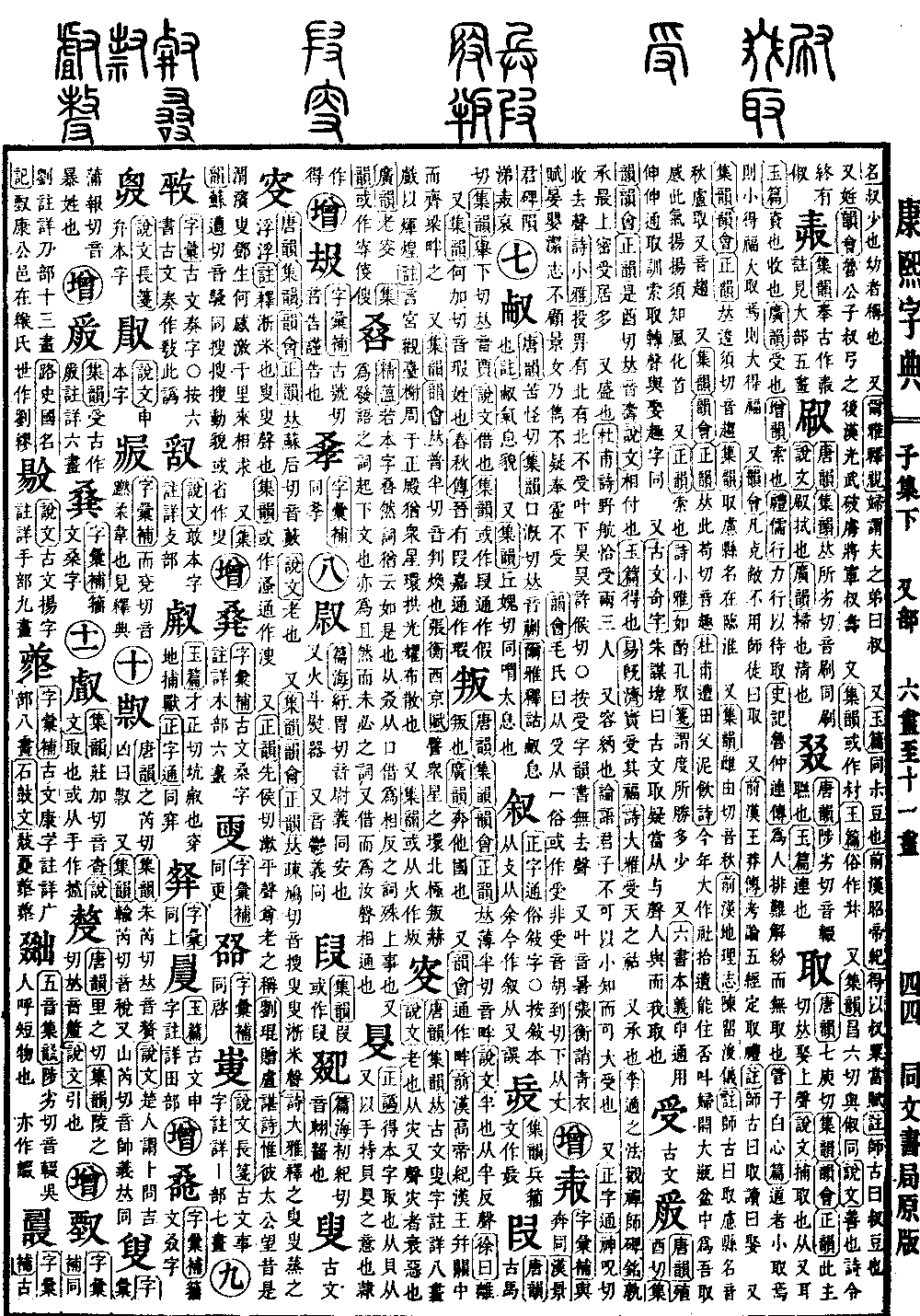
Zi Collection, Page Position: Lower
Radical: Again (yòu)
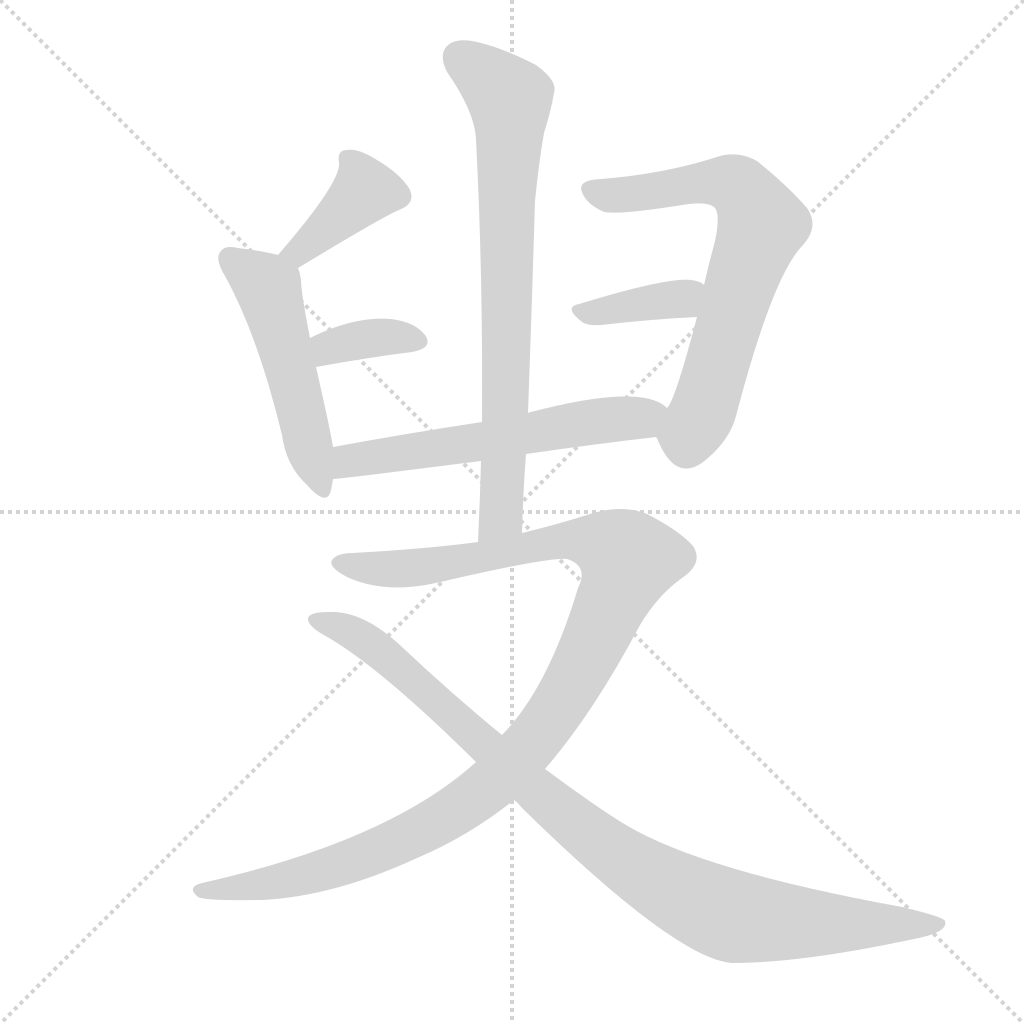
Character: Elderly man
Kangxi strokes: 10
Page 166, Entry 21
Ancient form: Sou (sōu)
Tang Rhyme (Tangyun), Collection Rhyme (Jiyun), Rhyme Meetings (Yunhui), Correct Rhymes (Zhengyun): Pronounced sou (rising tone).
Explaining Writing (Shuowen): An old person.
Also: Collection Rhyme (Jiyun), Rhyme Meetings (Yunhui), Correct Rhymes (Zhengyun): Pronounced sou. Sou-sou, the sound of washing rice.
Book of Odes (Shijing), Greater Odes (Daya): Wash it with a sou-sou sound, steam it until it floats.
Commentary: Wash means to clean rice. Sou-sou is the sound produced.
Collection Rhyme (Jiyun): Sometimes written in a variant form (sao), and also used interchangeably with the variant form (sou).
Also: Correct Rhymes (Zhengyun): Pronounced sou (level tone). An honorific term for an elderly man.
Liu Kun, Poem Presented to Lu Chen: Only that Grand Duke Wang, formerly was the elderly man by the Wei River. Why was Deng Sheng so moved, to come a thousand miles seeking him?
Also: Collection Rhyme (Jiyun): Pronounced sao. Same as the variant form (sou). Sou-sou, the appearance of movement. Sometimes simplified as the character (sou).