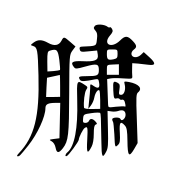
The character is pronounced sou (falling tone).
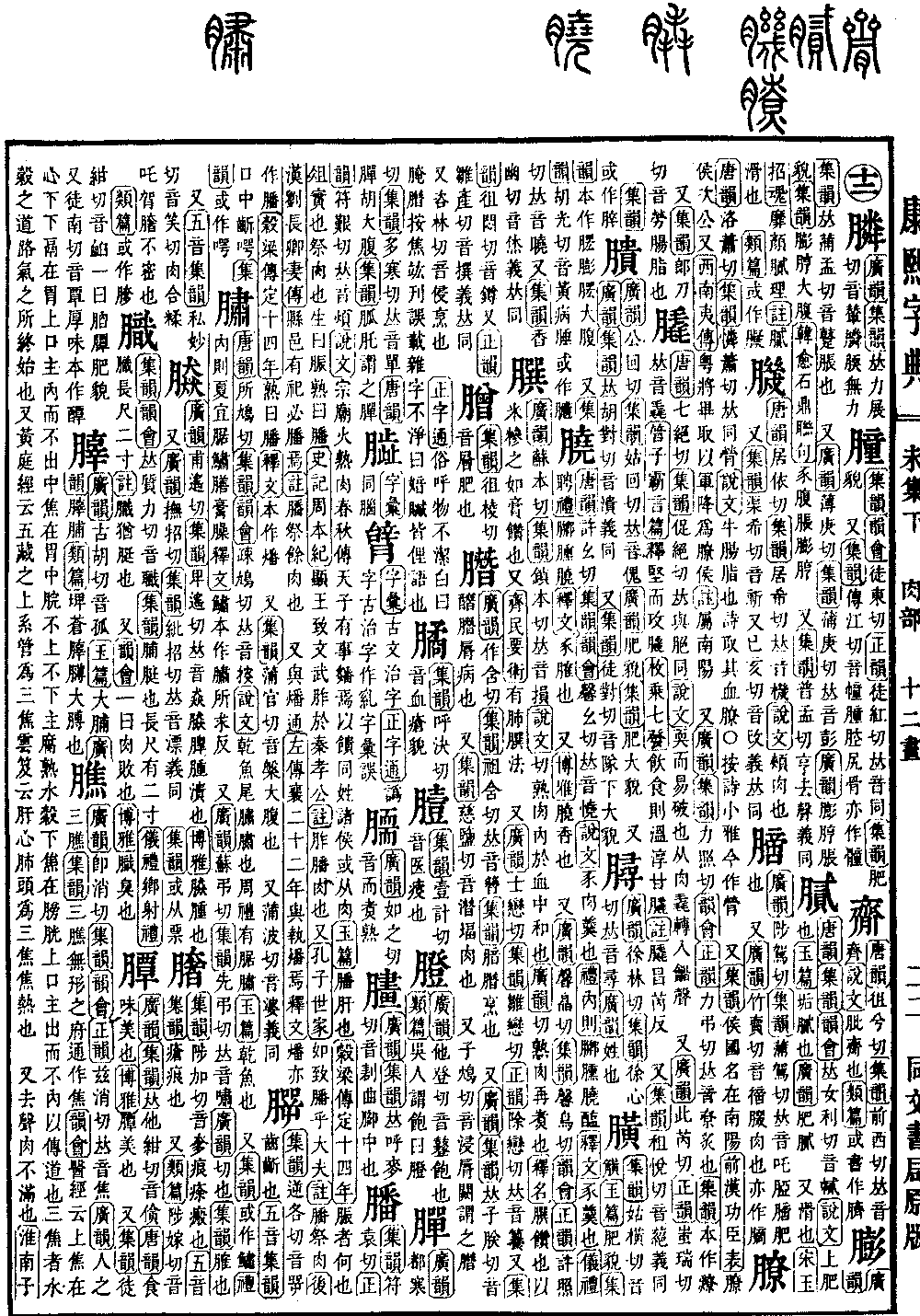
In "Tang Yun" (Tang Yun), it is rhymed with "suo" and "jiu." In "Ji Yun" (Ji Yun) and "Yun Hui" (Yun Hui), it is rhymed with "shu" and "jiu," with the same pronunciation as "sou."
"Shuo Wen Jie Zi" (Shuo Wen Jie Zi) explains it as the appearance of a dried fish's tail shriveling.
The term "腒䐹" appears in "Zhou Li" (Zhou Li).
"Yu Pian" (Yu Pian) explains it as dried fish.
Also, "Ji Yun" (Ji Yun) records that it is sometimes written as "鱐."
The commentary on "Xia yi 腒鱐 shan gao sao" in "Li Ji - Nei Ze" (Li Ji - Nei Ze) states: "鱐," originally written as "䐹," is pronounced by the reverse rhyme of "suo" and "qiu."
Additionally, in "Guang Yun" (Guang Yun), it is rhymed with "su" and "diao." In "Ji Yun" (Ji Yun), it is rhymed with "xian" and "diao," with the same pronunciation as "xiao."
"Guang Yun" (Guang Yun) explains it as cutting meat.
"Ji Yun" (Ji Yun) explains it as finely cut.
Furthermore, in "Wu Yin Ji Yun" (Wu Yin Ji Yun), it is rhymed with "si" and "miao," with the same pronunciation as "xiao." It means to cut meat and mix it together.