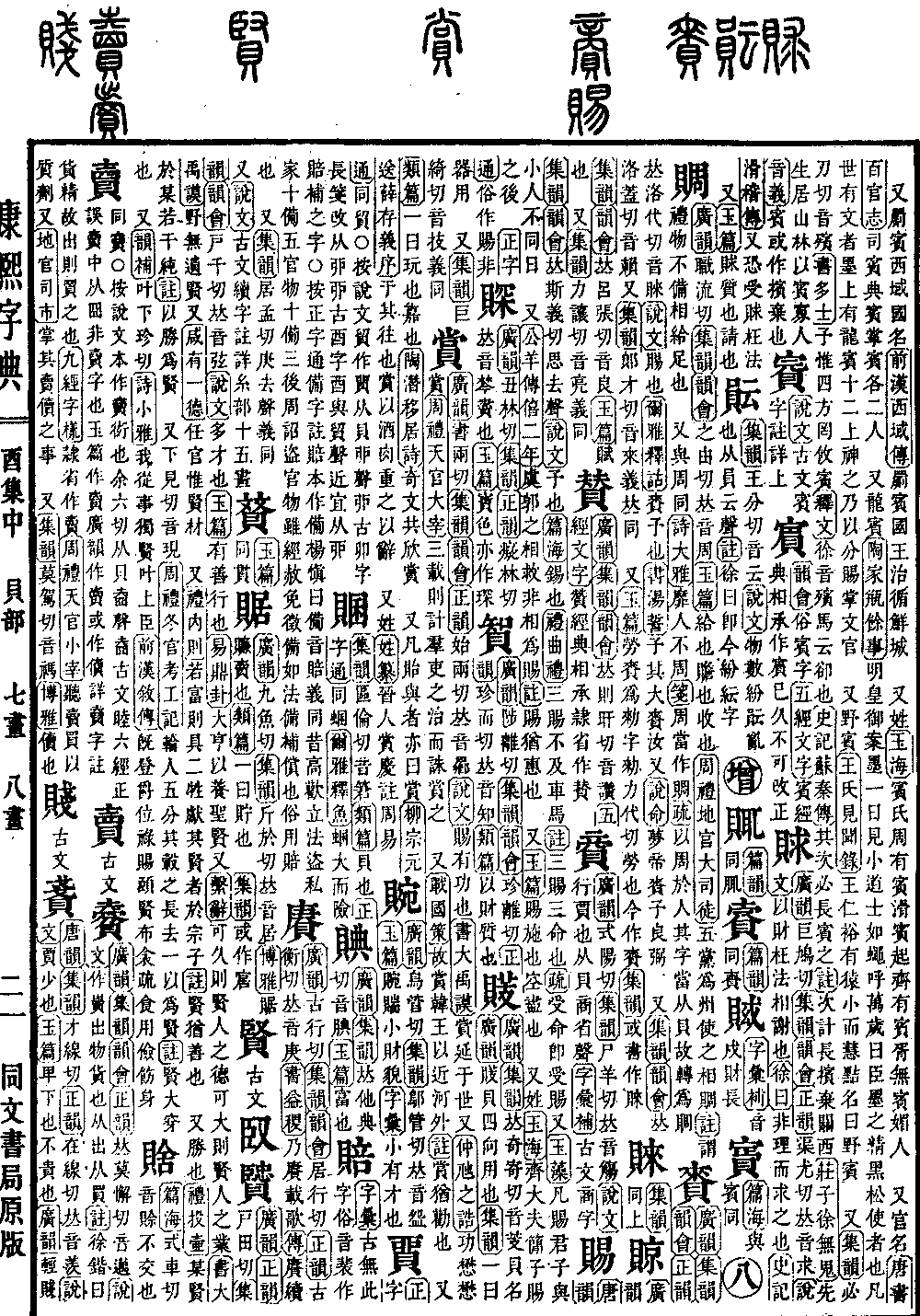
You Collection, Middle Volume
Radical: Cowrie (bèi)
Page 1209, Entry 15
Guangyun (Guangyun) states the pronunciation is shang. Jiyun (Jiyun), Yunhui (Yunhui), and Zhengyun (Zhengyun) state the pronunciation is shang, which sounds the same as xiang.
Shuowen Jiezi (Shuowen Jiezi) defines it as bestowing rewards upon those with meritorious service.
Book of Documents (Shujing) records: Rewards and punishments extend to future generations.
Zhonghui’s Announcement (Zhonghui zhi gao) records: Those with great merit shall receive generous rewards.
Rites of Zhou (Zhouli) records: Every three years, examine the performance of all officials to issue punishments or rewards.
Strategies of the Warring States (Zhan guo ce) records: Thus, reward the King of Han to draw the region outside the Yellow River closer.
Note: It means to encourage.
Leipian (Leipian) states: It also means to appreciate or admire.
Tao Qian’s Moving Poems (Yi ju shi) writes: We appreciate wonderful essays together.
Furthermore, any act of bestowing a gift may also be called shang.
Liu Zongyuan’s Preface to Sending Off Xue Cunyi (Song Xue Cunyi xu) writes: Upon his departure, offer wine and meat as a parting gift, accompanied by parting words.
It also serves as a surname.
Xingzuan (Xingzuan) records: Shang Qing of the Jin dynasty once wrote a commentary on the Book of Changes (Yijing).