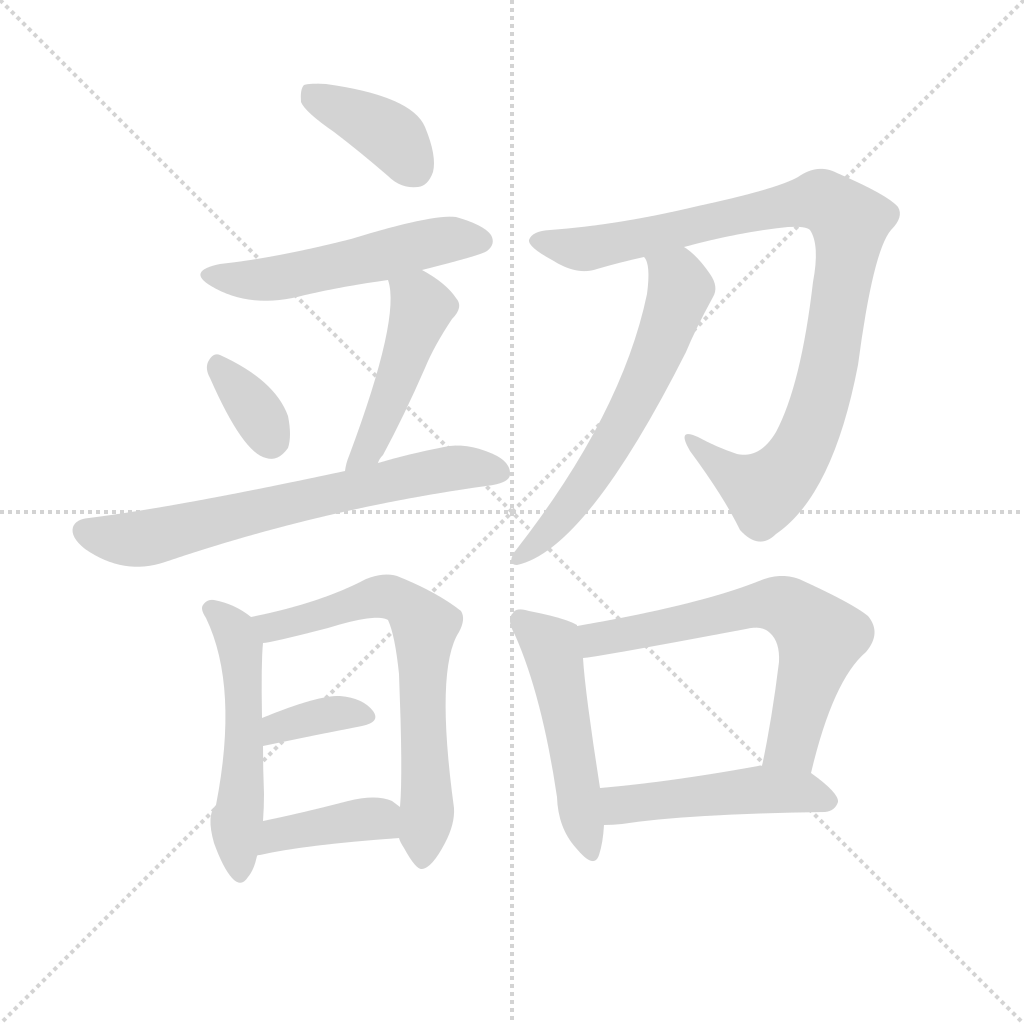
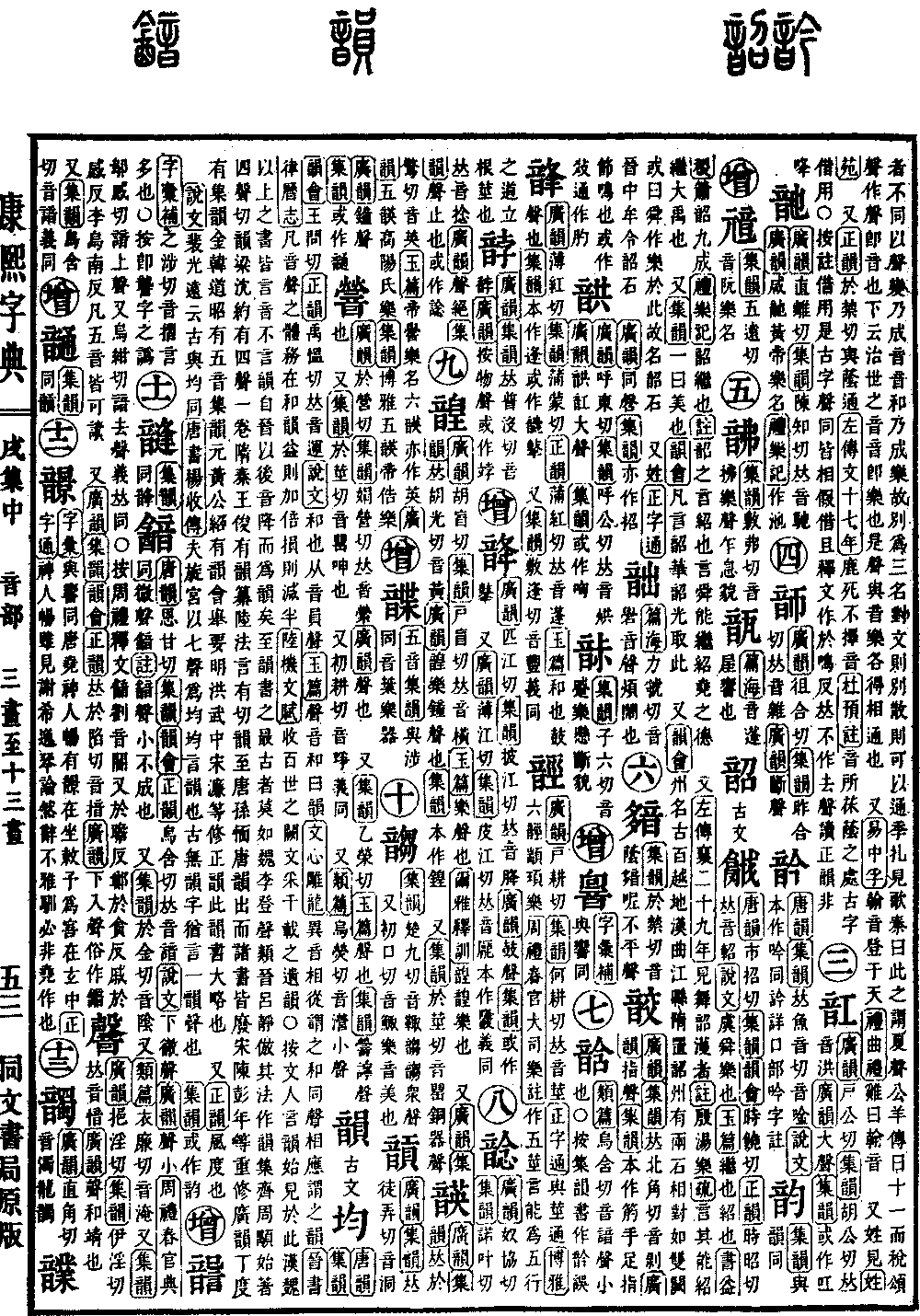
Xu Collection, Middle Volume. Radical: Sound (yīn). Kangxi stroke count: 14. Page 1397, Entry 09. Ancient form.
Pronounced shao.
According to the Explaining and Analyzing Characters (Shuowen Jiezi), this refers to the music of Emperor Shun. According to the Jade Chapters (Yupian), it means to continue or to inherit.
In the Book of Documents (Shangshu), section Benefiting the Multitude (Yiji): The flute music of Shao performed in nine stages.
In the Book of Rites (Liji), section Record of Music (Yueji): Shao means to continue. Commentary: Shao implies inheritance, meaning that Emperor Shun was able to continue and inherit the virtues of Emperor Yao.
In the Zuo Tradition (Zuo Zhuan), twenty-ninth year of Duke Xiang: Witnessing the performance of the Shaohuo music. Commentary: This is the music of King Tang of the Shang dynasty. Sub-commentary: It refers to the ability to inherit and continue the work of the Great Yu.
In the Collected Rhymes (Jiyun), one meaning is beauty.
In the Compendium of Rhymes (Yunhui), the terms shao-hua and shao-guang are derived from this.
In the Compendium of Rhymes (Yunhui), name of a prefecture. It was ancient territory of the Baiyue, during the Han dynasty it was Qujiang County, and during the Sui dynasty, Shao Prefecture was established. There are two stones facing each other like double watchtowers. Some say Emperor Shun composed music here, hence it is called Shao Rock.
Also a surname. In the Rectification of Characters (Zhengzitong), there is a magistrate of Zhongmou during the Jin dynasty named Shao Shi.
In the Broad Rhymes (Guangyun), it is the same. In the Collected Rhymes (Jiyun), it is also written as the variant form zhao.