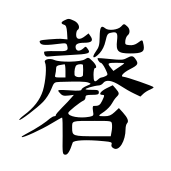
Pronounced shi (rising tone) and zhao (rising tone) according to Guangyun, shi (rising tone) and rao (rising tone) according to Jiyun, and shi (rising tone) and zhao (rising tone) according to Zhengyun. The pronunciation is the same as "shang." It has the same meaning as "shao." The "Book of Rites (Chun Guan)" records that the Grand Music Master used music and dance to educate the sons of the state, and the dances included "Yunmen," "Dajuan," "Daxian," "Daao," "Daxia," "Dahu," and "Dawu." It also states that playing the "Guxian" tune, singing the "Nanlü" tune, and dancing the "Daao" dance were used to sacrifice to the gods of the mountains and rivers in the four directions. The commentary explains: "Daao" is a musical piece from the time of Shun. It means that Shun's virtue could inherit the orthodox teachings of Yao.
Additionally, according to Tangyun and Jiyun, the pronunciation is tu (level tone) and dao (level tone), which is the same as "tao." It is the name of a type of drum. It is the same as the character "tao." The seal script is written as "ao."