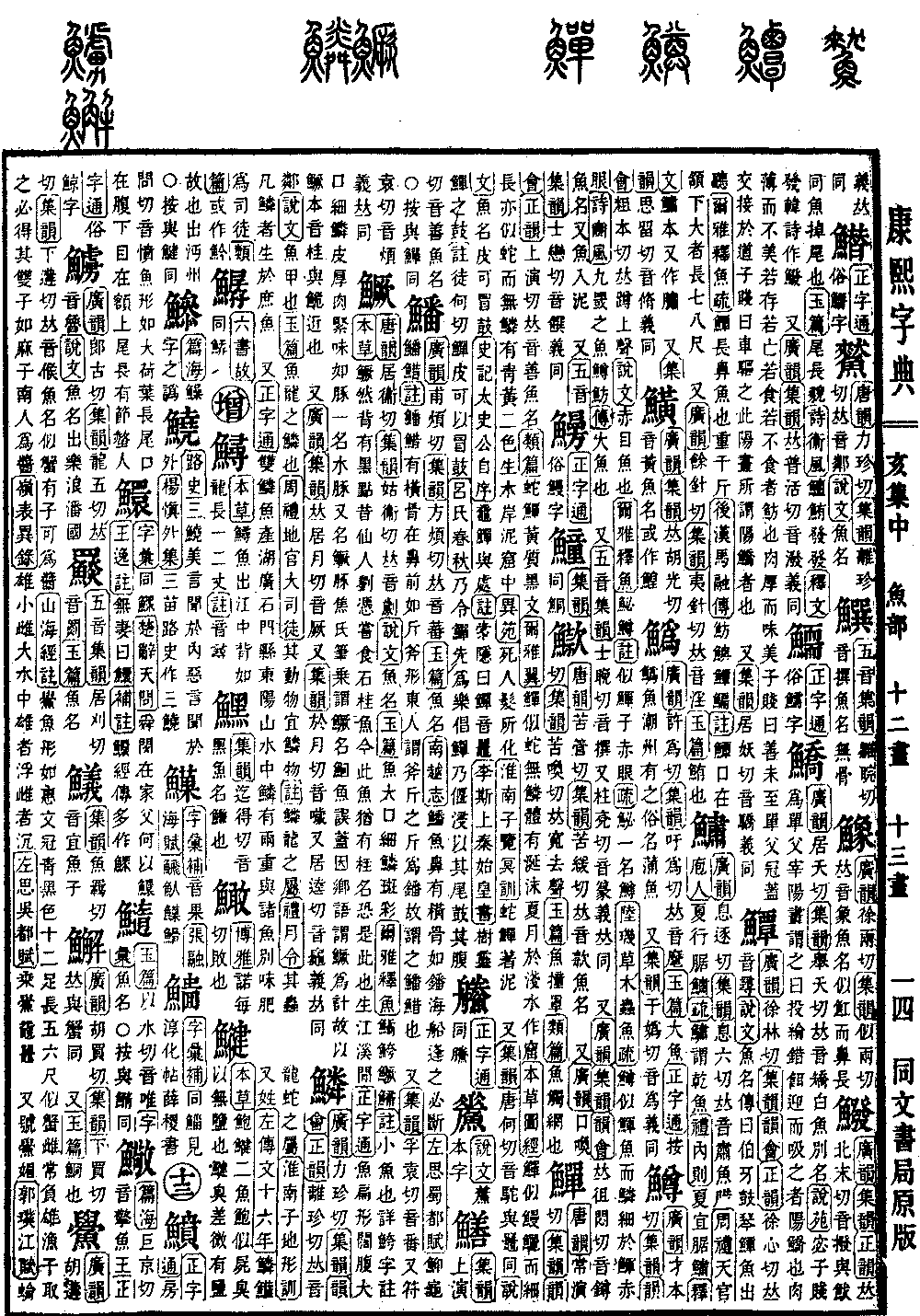
Hai Collection, Middle Volume
Radical: Fish (yú)
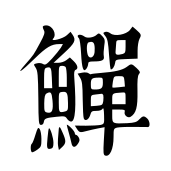
Entry: Shan
Kangxi stroke count: 23
Page 1478, Entry 16
Pronounced shan (falling tone). A type of fish. According to the Classified Compendium (Leipian), it is the snake-shan, which has a yellow base with black patterns. According to the Wings of the Erya (Erya Yi), the shan resembles a snake and has no scales; its body is covered in mucus, and in the summer, it creates burrows in shallow water. According to the Illustrated Classics of Materia Medica (Bencao Tujing), the shan resembles an eel but is thinner and longer; it also resembles a snake but has no scales, comes in blue and yellow varieties, and lives in mud holes near the water. According to the Garden of Marvels (Yiyuan), it is formed from the hair of the dead. According to the Huainanzi (Huainanzi), snakes and shan dwell in the mud.
Also pronounced tuo. Same as the alligator (tuo). According to the Explaining Graphs and Analyzing Characters (Shuowen), it is the name of a fish; its skin can be used to cover drums. According to the Records of the Grand Historian (Shiji), it dwells together with the giant soft-shell turtle and the shan. The Note in the Search for Mysteries (Suoyin) states: The shan is pronounced tuo. In the Memorial to the First Emperor of Qin (Li Si shang Qin Shi Huang shu), it mentions the setting up of drums covered with the skin of the spiritual alligator. The note states: Pronounced tuo, its skin can be used to cover drums. According to the Mr. Lu's Spring and Autumn Annals (Lüshi Chunqiu), a command was given for the shan to act as the conductor of the orchestra, so the shan lay on its back, submerged itself, and used its tail to strike its belly.