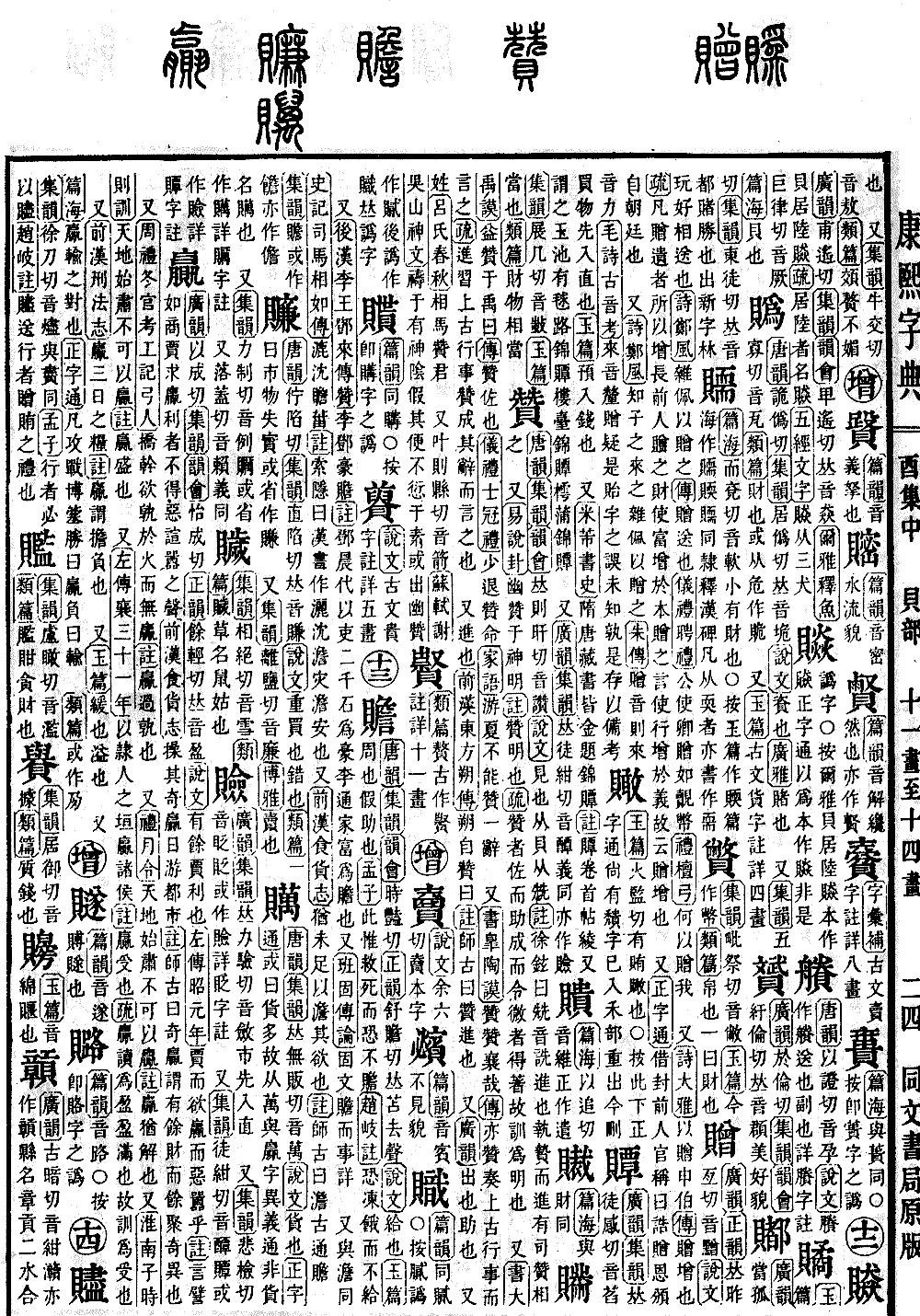
You Collection, Lower Volume
Radical: Shellfish (bèi)
Kangxi Strokes: 20
Page 1212, Entry 28
Pronounced shan (falling tone).
In the Shuowen Jiezi (Dictionary of Explanations of Characters), it means to supply. In the Yupian (Jade Chapters), it means to assist or provide for, and also to lend aid.
Mencius (Mengzi): This is only enough to save those facing death, and one still fears it will not be enough to supply them.
Zhao Qi commentary: Fearing they will suffer from cold and hunger and cannot be provided for.
Also in the History of the Later Han (Hou Hanshu), Biography of Li, Wang, Deng, and Lai: Li Tong and Deng Chen were wealthy and provided for.
Commentary: Deng Chen served for generations as an official with a salary of two thousand shi, which is called wealthy; Li Tong's family was well-to-do, which is called provided for.
Also in the discourse on Ban Gu’s biography: Ban Gu’s writings were opulent and his narrative was exhaustive.
Also the same as the character dan.
Records of the Grand Historian (Shiji), Biography of Sima Xiangru: Filter out the sediment, settle the disasters.
Commentary: The Suoyin commentary says the Book of Han (Hanshu) writes this as settle and stabilize disasters. Dan means to stabilize.
Also in the Book of Han (Hanshu), Treatise on Food and Money: It is still insufficient to satisfy their desires.
Commentary: Yan Shigu says dan was used interchangeably with shan in ancient times.
In the Jiyun (Standard Rhymes), shan is sometimes written as a variant form. It is also written as dan.