Wu Collection, Lower Volume
Radical: Spirit (shì)
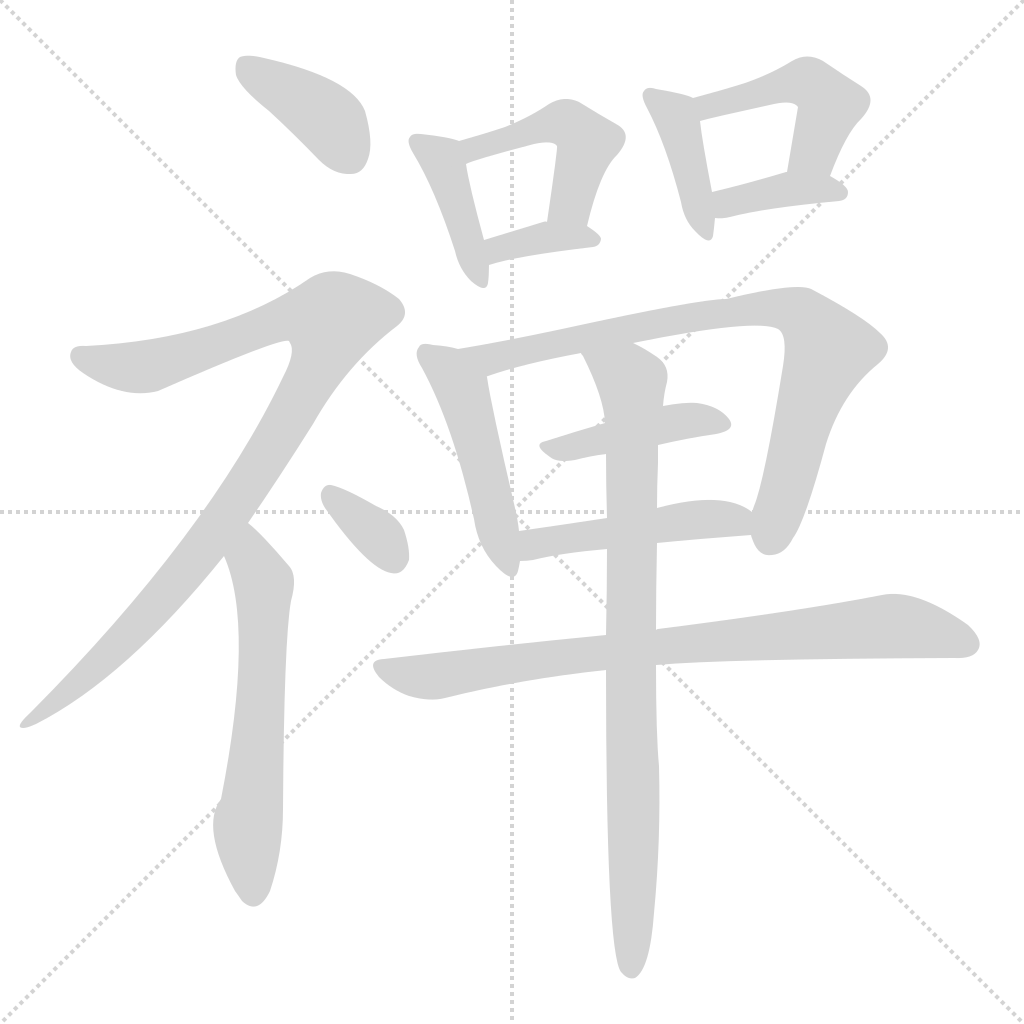
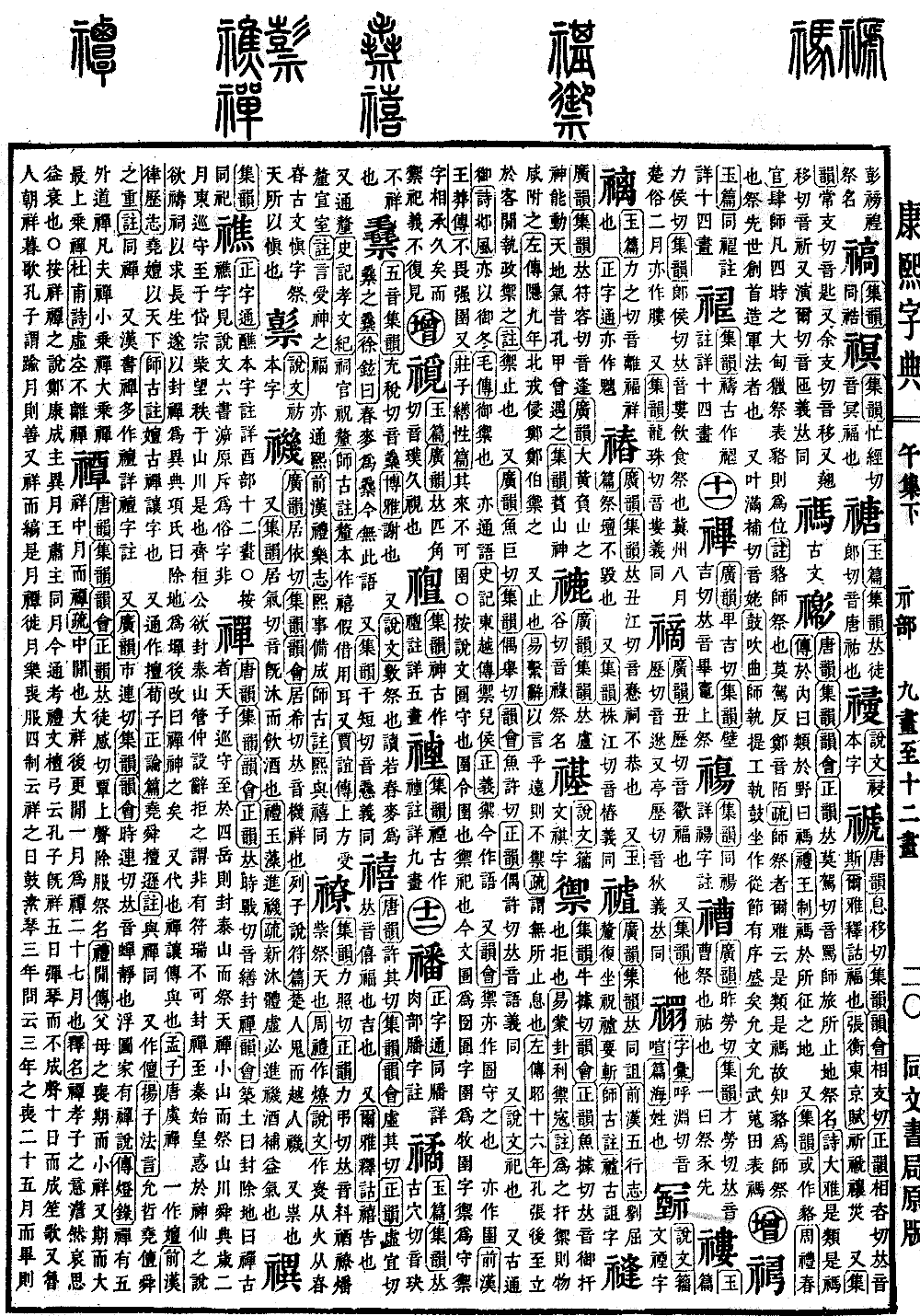
禪
Kangxi Strokes: 17
Page 846, Entry 36
Pronounced shàn. Fengshan (state sacrifices to Heaven and Earth).
Yunhui (Collection of Rhymes) states: Piling up earth is called feng, clearing the ground is called shan. In ancient times, when the Emperor toured the four quarters and arrived at the four sacred mountains, he would pile earth on Mount Tai to offer sacrifices to Heaven, and clear a space on a smaller mountain to offer sacrifices to the mountains and rivers.
The Canon of Shun (Shundian) records that every year in the second month, he traveled east to reach Mount Tai, burned wood to sacrifice to Heaven, and in order, looked toward the mountains and rivers to perform sacrifices; this is that very ritual.
When Duke Huan of Qi wanted to perform the fengshan sacrifice on Mount Tai, Guan Zhong found a reason to refuse him, saying that without auspicious omens, the fengshan sacrifice could not be performed.
By the time of the First Emperor of Qin, he was misled by tales of immortals and, wishing to attain immortality through prayer and sacrifice, transformed the fengshan sacrifice into an extraordinary ceremony.
The Xiang family states: Clearing the ground as a place for sacrifice is called shan, and later it was changed to be called chan, which was an attempt to make it seem divine.
It also indicates to replace or abdicate. Shanrang means to pass the throne to another.
Mencius (Mengzi) records that Emperor Yao and Emperor Shun practiced abdication.
It is also written as the variant form (shàn).
The Treatise on Harmonics and Calendars in the Book of Han (Qianhan lüli zhi) records that Yao yielded the empire to Shun.
Shigu's commentary states: Shan is the ancient term for abdication.
It is also used interchangeably with the form (shàn).
The Correct Arguments (Zheng lun pian) in the Xunzi states that Yao and Shun abdicated and yielded. The commentary explains this as being the same as chan.
It is also written as the variant form (tán).
Yangzi's Model Sayings (Fayan) states that one should be as wise as Yao and as yielding as Shun. The commentary explains this as the same as chan.
Furthermore, in the Book of Han (Hanshu), the character chan is often written as the variant form. Refer to the notes for that character for further details.
Pronounced chán. It means quiet or meditative.
Buddhism has the doctrine of chan.
The Records of the Transmission of the Lamp (Chuandeng lu) records that there are five types of chan: externalist chan, ordinary person's chan, lesser vehicle chan, greater vehicle chan, and supreme vehicle chan.
Du Fu's poetry mentions that the void is never separated from chan.