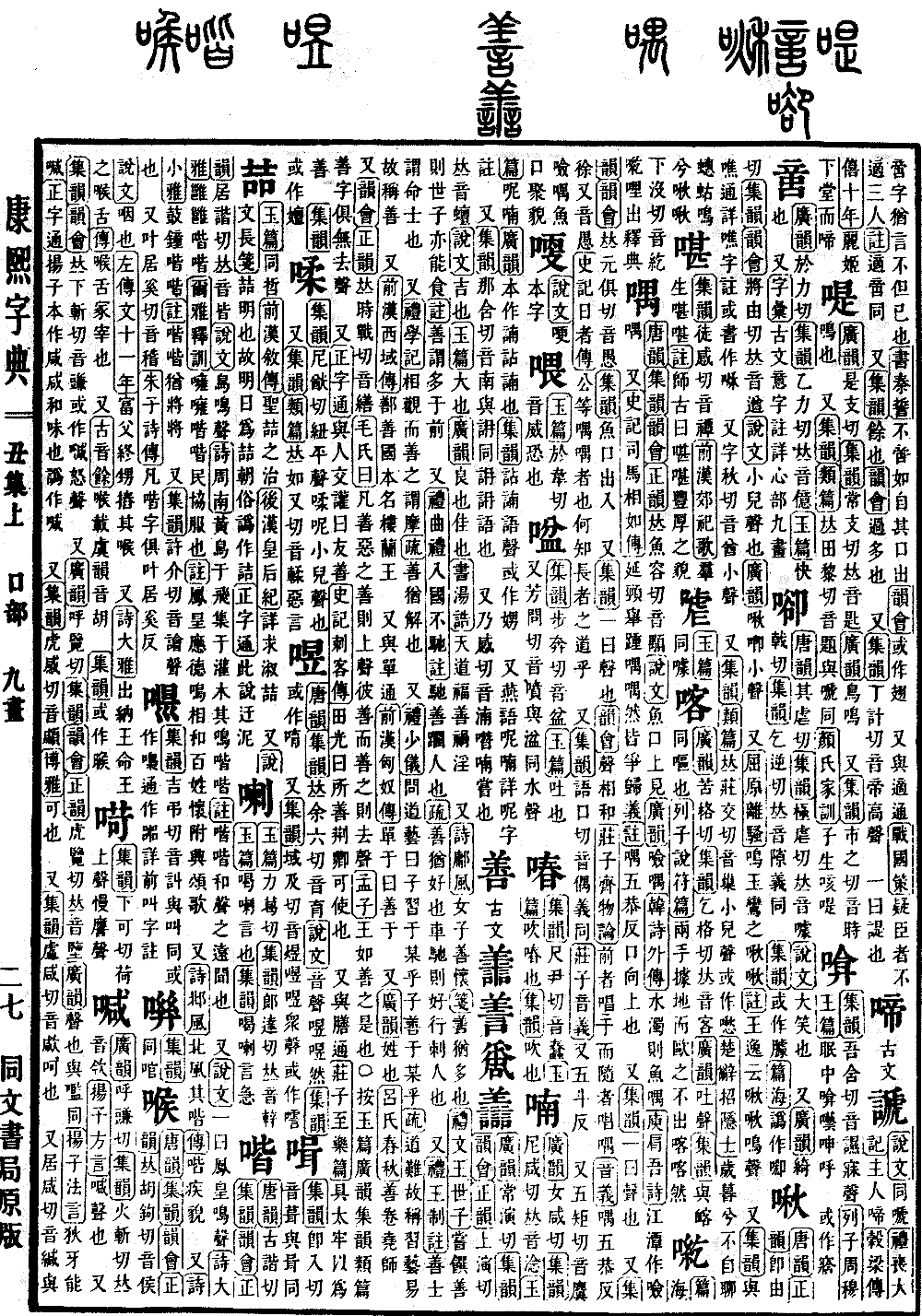
Chou Collection, Upper Volume
Radical: Mouth (kǒu)
Kangxi stroke count: 12
Page 197, Entry 18
In ancient script, it is written as a variant form (shàn).
According to Broad Rhymes (Guangyun), it is pronounced yan (rising tone). According to Rhyme Collection (Jiyun), Rhyme Compilation (Yunhui), and Correct Rhymes (Zhengyun), it is pronounced yan (rising tone), which is the same as the pronunciation of shan (rising tone).
Explaining Characters and Phrases (Shuowen Jiezi) defines it as: auspicious.
Jade Chapters (Yupian) defines it as: big.
Broad Rhymes (Guangyun) defines it as: good, fine.
Book of Documents (Shangshu), Chapter on Tang’s Announcement (Tanggao) contains the phrase: "The way of Heaven blesses the good and brings calamity upon the licentious."
Also, Book of Odes (Shijing), Odes of Yong (Yongfeng) contains the phrase: "A young woman who is good at longing." Zheng Xuan’s commentary notes: "Good here means much or many."
Book of Rites (Liji), Hereditary Princes of King Wen (Wenwang Shizi) contains the phrase: "When the offerings were good, the hereditary prince would also be able to eat." The commentary explains: "Good refers to more than before."
Also, Book of Rites (Liji), Summary of the Rules of Propriety (Quli) contains the phrase "Do not gallop when entering a state," and the commentary explains: "Galloping is likely to cause harm to people." The sub-commentary explains: "Good here means easy or fine; when a carriage gallops, it easily injures people."
Also, Book of Rites (Liji), Royal Regulations (Wangzhi) commentary states: "Good scholars refer to appointed scholars."
Also, Book of Rites (Liji), Record of Learning (Xueji) contains the phrase: "Observing one another and encouraging them to be good is called stimulation." The sub-commentary explains: "Good here means to understand."
Also, Book of Rites (Liji), Minor Rites (Shaoyi) contains the phrase: "In asking about the Way and the arts, one says: Are you practiced in such-and-such? Are you good at such-and-such?" The sub-commentary explains: "The Way is difficult, so it is called practiced; the arts are easier, so it is called good."
Also, History of the Former Han (Qian Hanshu), Record of the Western Regions records: "The kingdom of Shanshan, originally named King of Loulan."
It is also interchangeable with the character shan (dan). History of the Former Han (Qian Hanshu), Record of the Xiongnu (Xiongnu Zhuan) contains the phrase: "The Chanyu is called the Shanyu."
Also, Broad Rhymes (Guangyun) records it as a surname. Master Lu’s Spring and Autumn Annals (Lüshi Chunqiu) contains the phrase: "Shan Juan, the teacher of Yao."
Also, Rhyme Compilation (Yunhui) and Correct Rhymes (Zhengyun) state it is pronounced shan (fourth tone), which is the same as the pronunciation of shan (fourth tone). Master Mao says: "Whenever the word good (shan) refers to good and evil, it is pronounced in the rising tone; when it indicates considering someone good or affirming them, it is pronounced in the fourth tone." The word good (shan) in the phrase "If the King considers it good" from Mencius is an example of this. Note: The dictionaries Jade Chapters (Yupian), Broad Rhymes (Guangyun), Rhyme Collection (Jiyun), and Categorized Compilation (Leipian) do not contain a fourth-tone pronunciation for the character good (shan).
Also, Correct Meaning through Investigation (Zhengzitong) explains: associating with people in a friendly manner is called being on good terms. Records of the Grand Historian (Shiji), Biographies of Assassins (Cike Liezhuan) features Tian Guang saying: "The person I am on good terms with, Jing Ke, can be sent on this mission."
It is also interchangeable with the character shan (shan, meaning cooked food). Zhuangzi, Chapter on Perfect Happiness (Zhile) contains: "Prepared the sacrificial oxen as a feast (shan)." In Rhyme Collection (Jiyun), it is sometimes written as a variant form (shan).