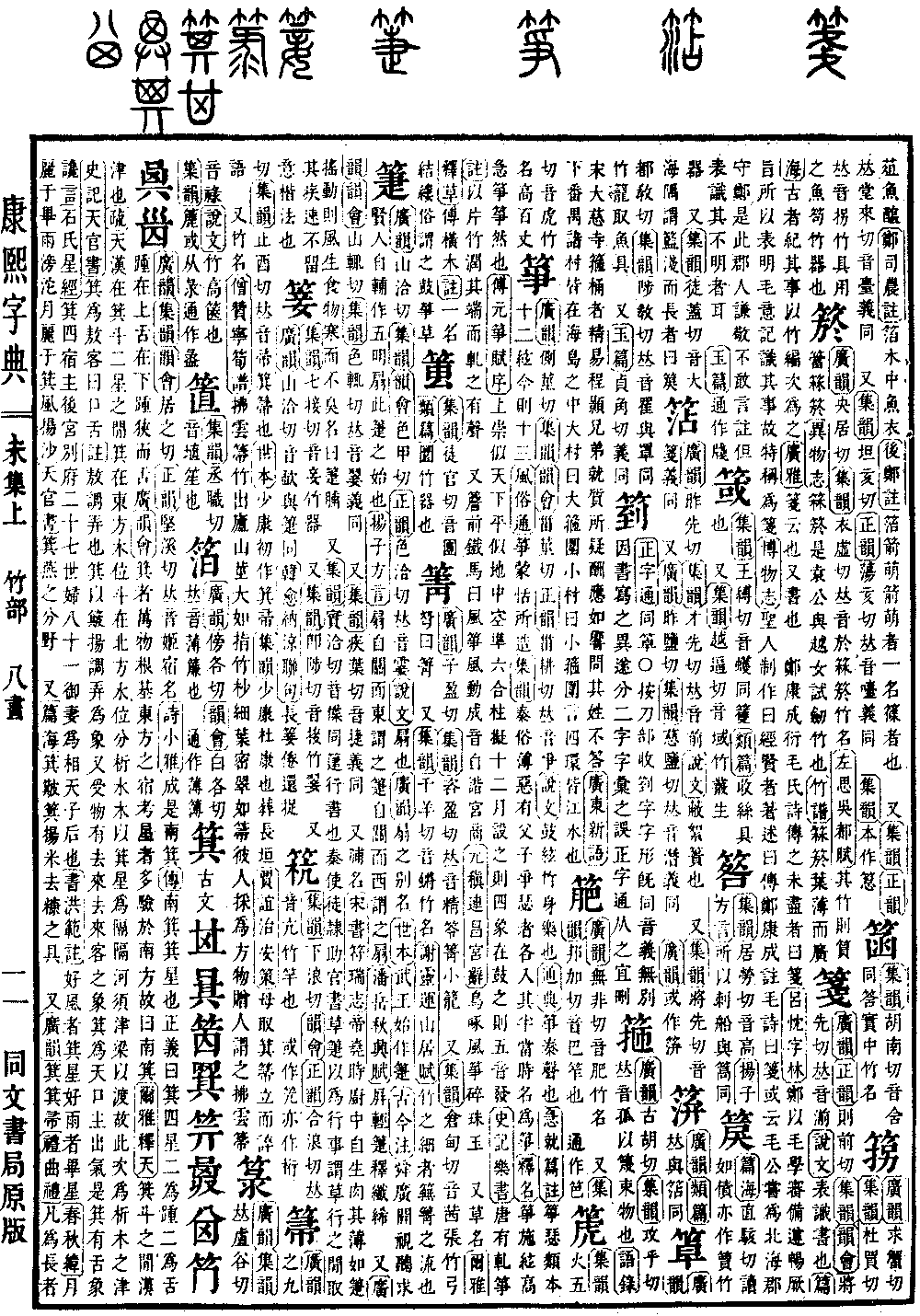
Wei Collection, Upper Volume
Radical: Bamboo (zhú)
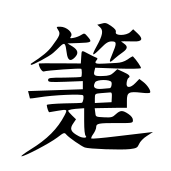
Sha
Kangxi strokes: 14
Page 887, Entry 18
Pronounced sha.
According to the Explaining Graphs and Analyzing Characters (Shuowen), it is a fan.
According to the Broad Rhymes (Guangyun), another name for a fan.
According to the Genealogy of Generations (Shiben), King Wu was the first to make a sha.
According to the Commentary on Ancient and Modern Matters (Gujinzhu), Emperor Shun broadened his vision and hearing, seeking worthy men to assist him, and created the Five-Bright Fan; this was the beginning of the sha.
According to Yangzi in the Dialects (Fangyan), for a fan, from the pass to the east it is called sha, and from the pass to the west it is called shan.
From the Rhapsody on Autumn Inspiration (Qiuxing Fu) by Pan Yue: Putting aside the light fan, releasing the fine hemp cloth.
Pronounced sha. Meaning is the same.
Pronounced jie. Meaning is the same.
A type of preserved meat.
According to the Treatise on Omen and Portents in the Book of Song (Songshu Furui Zhi), during the time of Emperor Yao, meat grew spontaneously in the kitchen. It was thin like a sha; when shaken, it generated a breeze, cooling the food and preventing it from spoiling. It was called sha-preserved meat.
Pronounced ye. The same as cursive script. When Qin officials ordered subordinates to help manage official documents, they drafted them as sha for temporary purposes, meaning that in the midst of rapid work, they prioritized speed and did not focus on formal regular script.