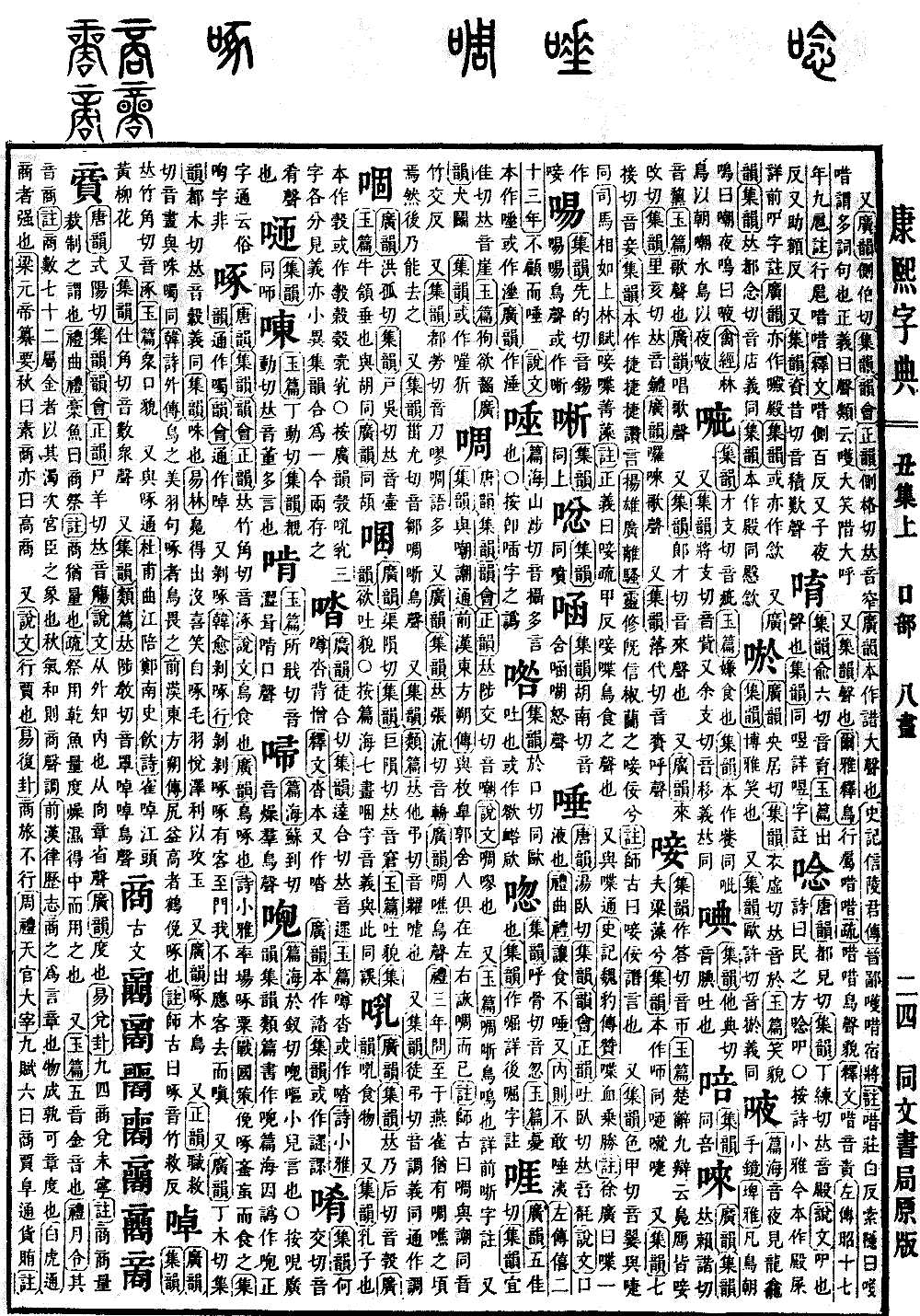
Chou Collection, Upper Volume
Radical: Mouth (kǒu)
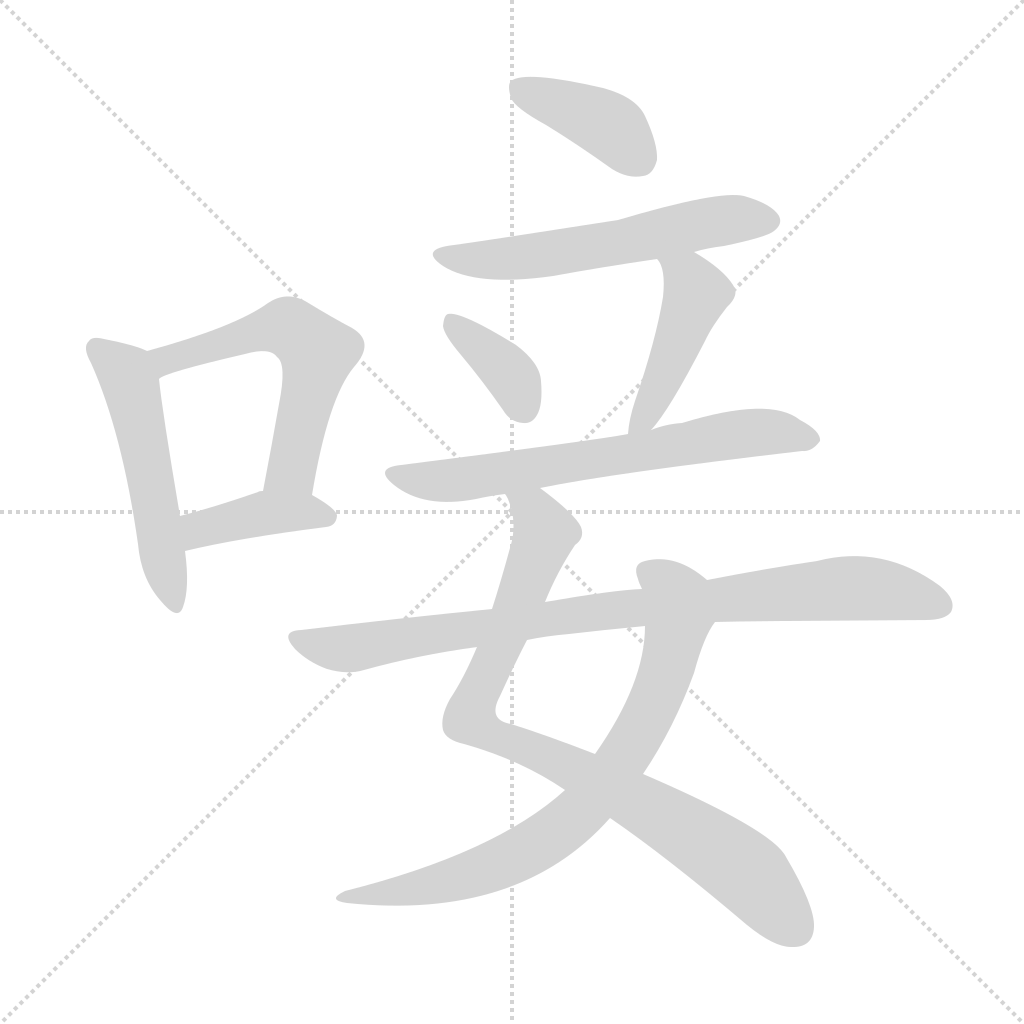
Character: Sha
Kangxi stroke count: 11
Page 194, Entry 09
Collected Rhymes (Jiyun) says it is pronounced za.
Jade Chapters (Yupian) cites the Nine Arguments (Jiubian) of the Songs of Chu (Chuci): The wild ducks and geese all nibble at the water weeds on the bridge.
Collected Rhymes (Jiyun) notes that this is the original form of the character. It is the same as the characters pronounced cu and die.
Also, Collected Rhymes (Jiyun) says it is pronounced qie.
Collected Rhymes (Jiyun) notes that this is the original form of the character meaning to act with agility. Jiejie refers to slanderous speech.
Yang Xiong's Extending the Lament (Guang Lisao) states: The sovereign has already trusted the slanderous flattery of pepper and orchid.
Commentary: Shigu says that slanderous flattery means to speak calumniously.
Also, Collected Rhymes (Jiyun) says it is pronounced sha. It is the same as the character pronounced die.
Sima Xiangru's Imperial Park Rhapsody (Shanglin Fu) mentions nibbling and swallowing water plants.
Commentary: The Correct Meaning (Zhengyi) states: Sha is pronounced in the manner of the character for loose. Nibbling and swallowing is the sound of birds eating.
Also, it is used interchangeably with the character pronounced die.
Records of the Grand Historian (Shiji), Biography of Wei Bao, mentions blood dripping while riding the momentum of victory.
Commentary: Xu Guang says that the character die is sometimes written as sha.
Textual Research: Collected Rhymes (Jiyun) notes that this is the original form of the character for agile. Jiejie refers to slanderous speech. We have corrected the word praise to slander in accordance with the original text.