Wei Collection, Lower Volume
Radical: Meat (ròu)
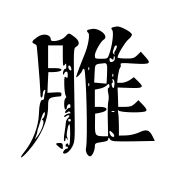
Shui
Kangxi strokes: 14
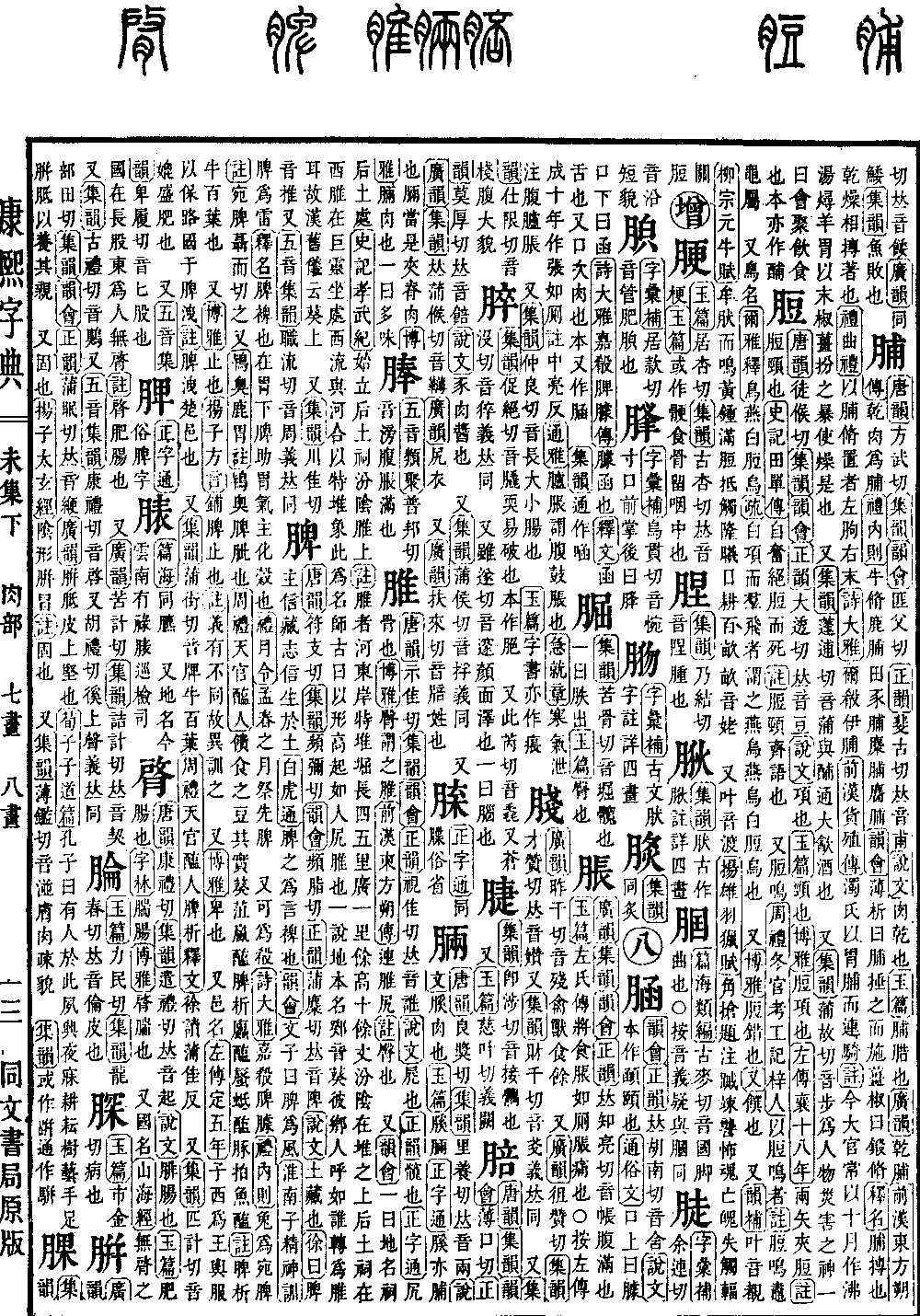
Page 985, Entry 22
Pronounced shui.
Explication of Characters (Shuowen): The buttocks.
Correct Rhymes (Zhengyun): The hip bone.
General Explanations of Characters (Zhengzitong): The tailbone.
Broad Refinement (Boya): The buttocks are called shui.
History of the Former Han (Qianhan), Biography of Dongfang Shuo: Joined at the buttocks and tailbone. Annotation: The buttocks.
Also, Dictionary of Rhymes (Yunhui): One source states it is a place name, the site of the Hou Tu altar.
Records of the Grand Historian (Shiji), Annals of Emperor Wu: Began the construction of the Hou Tu altar upon the shui of Fenyin. Annotation: Shui refers to a prominent mound on the eastern bank of the Yellow River, four or five li long, over one li wide, and over ten zhang high. The Hou Tu altar is located to the west of the mound at Fenyin; the shui is at the site of the Ju Ling mountain spirit's seat, where the flow turns west to join the river, named for its resemblance to a prominent mound. Yan Shigu states: Because its shape rises high like a human buttocks. Another account states the place was originally named Kui, pronounced kui, but the local people called it like shui, which eventually changed to the character shui, thus the Han Rituals (Han Jiuyi) state: Upon the Kui.
Also, Collected Rhymes (Jiyun): Pronounced tui.
Also, Five Sounds Collected Rhymes (Wuyin Jiyun): Pronounced zhou. The meaning is the same.