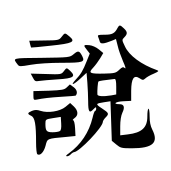
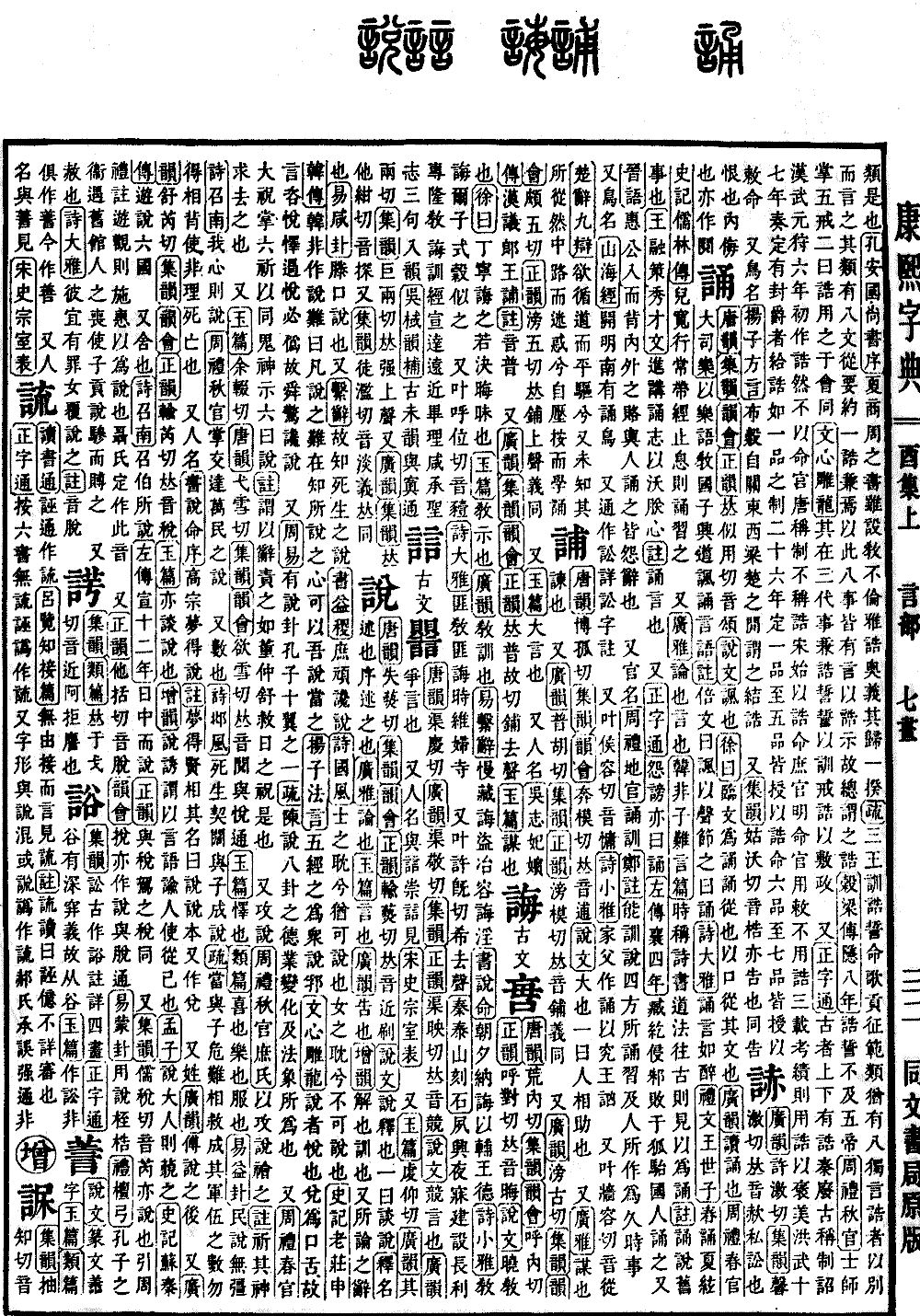
You Collection, Upper Volume
Radical: Speech (yán)
Kangxi Strokes: 14
Page 1164, Entry 01
Pronounced shuā
According to the Explaining Graphs and Analyzing Characters (Shuowen Jiezi), it means to explain. Another definition refers to discussing or speaking.
According to the Names of Definitions (Shiming), it means to narrate, to state in order.
According to the Broad Excerpts (Guangya), it means to argue or discuss.
According to the Jade Chapters (Yupian), it means to speak.
According to the Broad Rhymes (Guangyun), it means to inform.
According to the Expanded Rhymes (Zengyun), it means to explain or to instruct. It also refers to the spoken arguments themselves.
In the Book of Changes (Yijing), Xian Hexagram, it is the appearance of opening the mouth to speak.
Also, in the Appended Statements (Xici), it is the means by which one knows the principles of life and death.
In the Book of Documents (Shujing), Yi and Ji chapter, it refers to the many foolish and stubborn people who speak slanderous words.
In the Book of Odes (Shijing), Guo Feng, it states that a man caught in love may still be released, but a woman caught in love cannot be released.
In the Records of the Grand Historian (Shiji), Biography of Laozi, Zhuangzi, Shen Buhai, and Han Fei, Han Fei writes in The Difficulty of Persuasion that the difficulty of lobbying lies in understanding the psychology of the person one is lobbying and using one's own arguments to adapt to them.
In the Model Sayings (Fayan) by Yang Xiong, the Five Classics are described as the confluence of various doctrines.
In The Literary Mind and the Carving of Dragons (Wenxin Diaolong), it states that to speak is to please. The Dui trigram symbolizes the mouth and tongue, thus speech should bring joy to others. Excessive flattery is necessarily false, which is why Emperor Shun was wary of slanderous speech.
Also, in the Book of Changes, there is the Discussion of Trigrams (Shuogua), one of the Ten Wings authored by Confucius.
The commentary explains the virtues, deeds, changes, and natural phenomena emulated by the eight trigrams.
Also, in the Rites of Zhou (Zhouli), Spring Offices, Great Invocation, it describes the mastery of six types of prayers used to communicate with spirits, the sixth of which is called shuo.
The commentary notes that this refers to using words to rebuke, similar to the prayer used by Dong Zhongshu to alleviate a solar eclipse.
It also refers to the sacrificial rite known as gongshuo.
In the Rites of Zhou, Autumn Offices, Shushi, it mentions using gongshuo and hui sacrifices to expel poisonous insects.
The commentary notes this as a prayer to spirits requesting the removal of harm.
Pronounced yue
Used interchangeably with the character for joy (yue).
According to the Jade Chapters, it means to be happy.
According to the Classified Characters (Leipian), it means to be pleased, happy, or convinced.
In the Book of Changes, Yi Hexagram, it describes the common people as boundlessly happy.
In the Book of Odes, Zhao Nan, it states that my heart is pleased.
In the Rites of Zhou, Autumn Offices, it mentions managing the joy and harmony of the ten thousand people.
It also refers to numbers or agreements.
In the Book of Odes, Bei Feng, it says that in life and death, separation and union, I have made a pledge with you.
The commentary explains this as a promise to share trials and support one another, and to form our military ranks, so as not to abandon each other and lead to unreasonable death.
It also refers to a person's name.
In the Preface to the Charge to Yue (Shuoyue Xu), it describes how the Shang King Gaozong dreamed of finding Fu Yue.
The commentary notes he dreamed of finding a wise prime minister named Yue. Some versions write this name as Dui.
It also refers to a surname.
According to the Broad Rhymes, this person is a descendant of Fu Yue.
Pronounced shui
According to the Jade Chapters, it also means to discuss or lobby.
According to the Expanded Rhymes, it means to persuade or induce, referring to the use of words to make someone understand and comply.
In the Works of Mencius (Mengzi), it states that when lobbying feudal lords and great men, one should treat them with contempt.
In the Records of the Grand Historian, Biography of Su Qin, it describes lobbying the six states.
It also refers to resting or pausing.
In the Book of Odes, Zhao Nan, it mentions the place where the Duke of Shao rested.
In the Zuo Tradition (Zuozhuan), Duke Xuan 12th Year, it mentions resting when the sun reaches its zenith.
The standard rhymes equate this to the character for unyoking a carriage (shui).
According to the Classified Rhymes, it is also pronounced rui, meaning to lobby. Citing the Rites of Zhou commentary: when traveling out for observation, one bestows grace to please the people. Nie Chongyi confirmed this pronunciation.
Pronounced tuo
According to the Rhyme Collection (Yunhui), it is also written as a variant form of the character for remove (tuo). It is used interchangeably with the character for discard or release.
In the Book of Changes, Meng Hexagram, it is used to remove shackles.
In the Book of Rites (Liji), Tan Gong, it states that when Confucius went to the State of Wei and encountered the funeral of his former host, he had Zilu remove the side horses from his carriage to present to the bereaved family to assist with the funeral.
It also refers to pardoning or exculpating.
In the Book of Odes, Great Odes, it says that although that person was truly guilty, you nevertheless exculpated him.
The commentary notes the pronunciation as tuo.