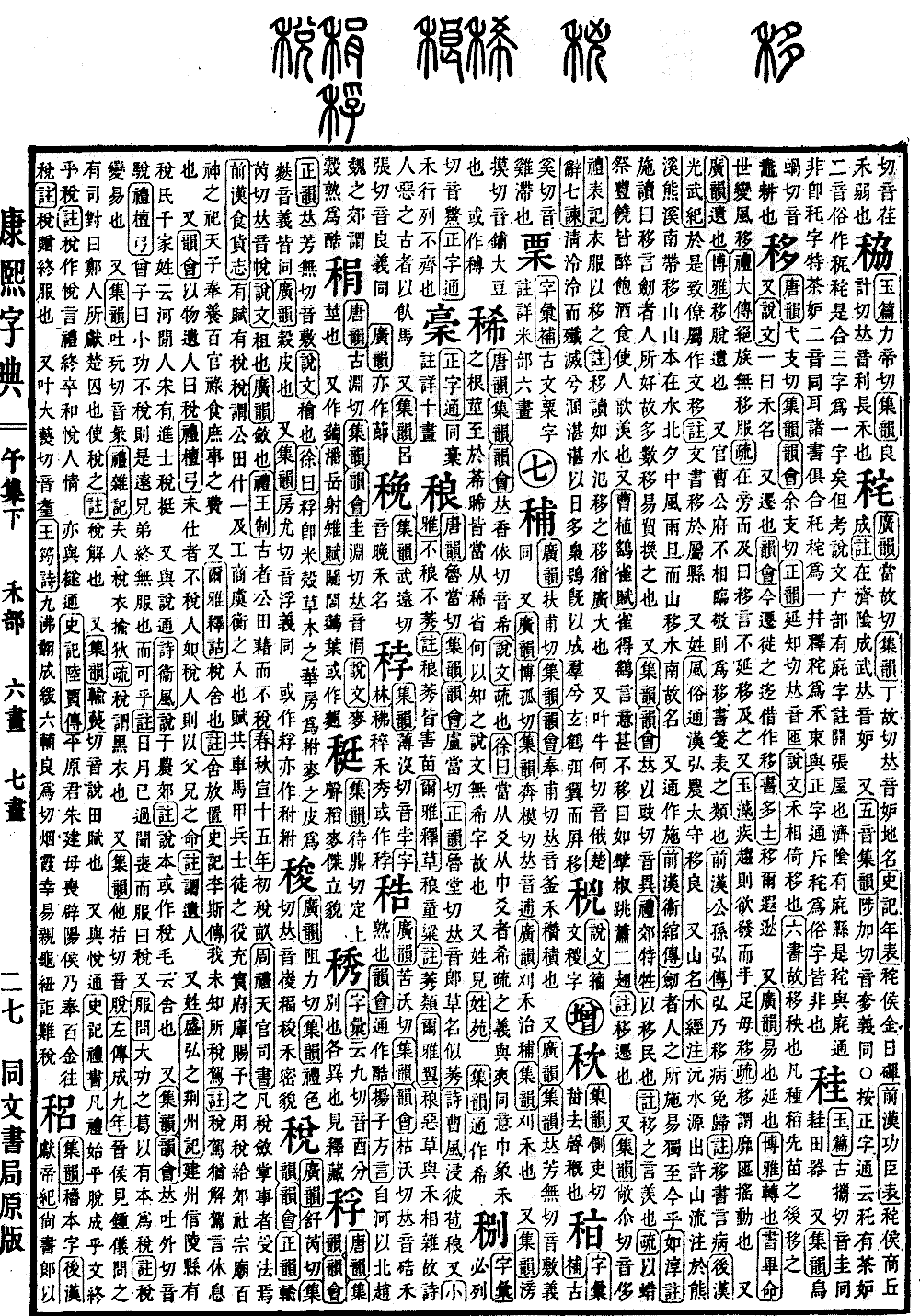
Wu Collection, Lower Volume
Radical: Grain (hé)
Kangxi Strokes: 12
Page 853, Entry 22
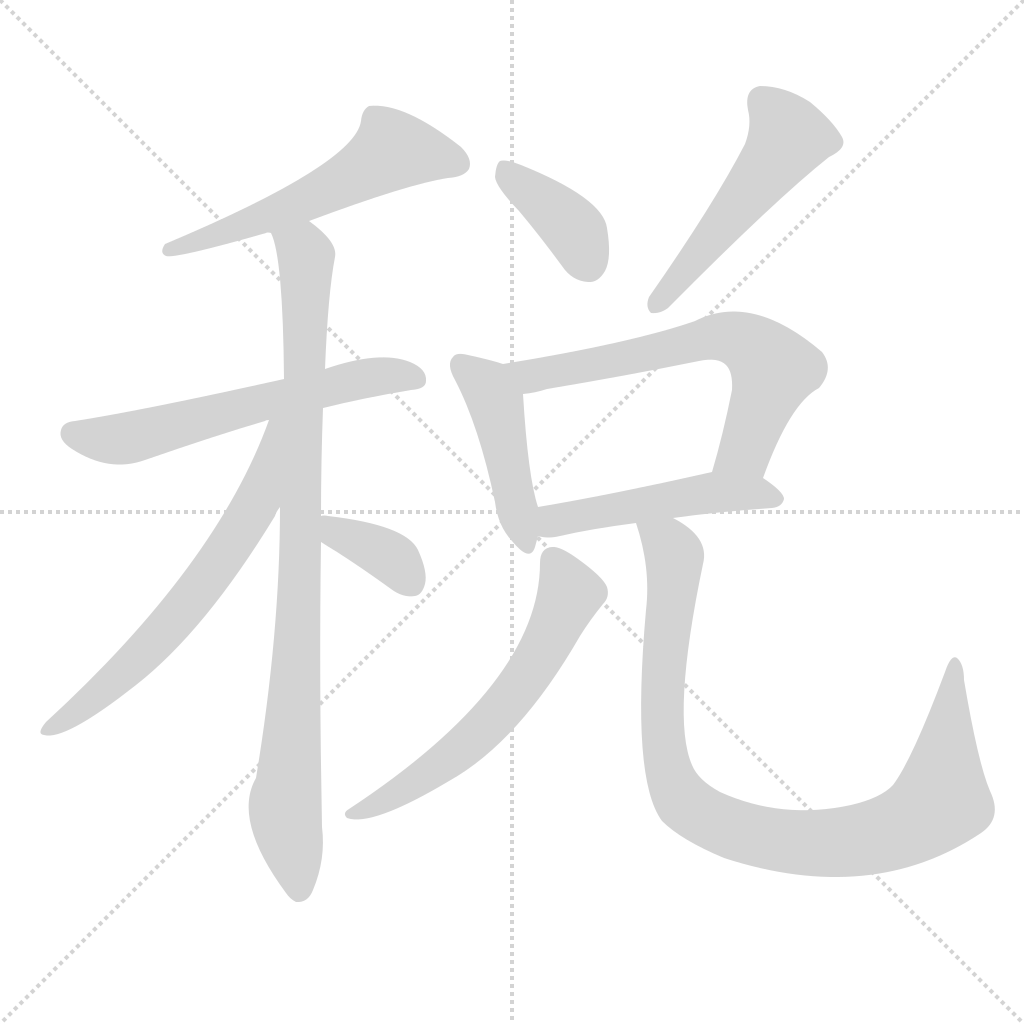
Pronounced shui (falling tone).
According to the Broad Rhymes (Guangyun), it means to tax.
According to the Broad Rhymes (Guangyun), it means to collect.
In the Book of Rites (Liji), section titled Royal Regulations (Wangzhi), it states: in ancient times, public fields were cultivated using the labor of the people without collecting taxes.
In the Spring and Autumn Annals (Chunqiu), in the fifteenth year of Duke Xuan, it records the beginning of taxing based on the acreage of fields.
In the Rites of Zhou (Zhouli), section titled Heavenly Officials (Tianguan), official in charge of records (Sishu), it states: for all taxes collected, those in charge of affairs must act according to the law.
In the History of the Former Han (Qianhan), section on Food and Money (Shihuozhi), it states: there are levies and there are taxes. Tax refers to one-tenth of the income from public fields, as well as income from industry, commerce, mountains, forests, rivers, and marshes. Levies were used for supplying carriages, horses, weaponry, military service, filling the national treasury, and bestowing rewards. Taxes were used for offerings to heaven and earth, ancestral temples, all spirits, the support of the Son of Heaven, the salaries of officials, and the expenses of various affairs.
Also, according to the Literary Expositor (Erya), section on Explaining Proof (Shizheng), tax means to put down. The commentary explains: to put down means to place.
In the Records of the Grand Historian (Shiji), Biography of Li Si, it states: I do not know where to rest. The commentary explains: to unhitch the carriage, similar to unyoking the horses, meaning to rest.
Also, according to the Collection of Rhymes (Yunhui), giving something to someone is called tax.
In the Book of Rites (Liji), section titled Tangong, it states: those who are not officials cannot give gifts; if they must give, they should do so in the name of their father or elder brother. The commentary explains: it refers to the act of gifting.
Also a surname. According to Sheng Hongzhi's Record of Jingzhou (Jingzhouji), there are people with the surname Tax in Xinling County, Jianzhou. The Thousand Family Surnames (Qianjiaxing) states: they are from Hejian. In the Song Dynasty, there was a scholar named Tax Ting.
Also interchangeable with the character meaning to speak or persuade (shui).
In the Book of Odes (Shijing), Odes of Yong (Yongfeng), it states: to rest in the suburban fields. The commentary explains: to rest; some versions write this as tax. Mao's commentary states: it means to rest.
Also pronounced tui (falling tone).
In the Book of Rites (Liji), section titled Tangong, Zengzi said: if a person wearing mourning clothes for a lesser degree of intimacy hears of the death only after the mourning period has passed, and does not observe the mourning rites, then distant brothers would never have mourning rituals; is this acceptable? The commentary explains: when the days and months have passed and one hears of the death only then, it is called tax.
Also in the section titled Questions on Mourning (Fuwen), it mentions the ge-hemp cloth used for major mourning garments, which requires changing because of the original mourning status. The commentary explains: tax means to change.
Also pronounced tuan (level tone).
In the Book of Rites (Liji), section titled Miscellaneous Records (Zaji), it mentions the lady wearing black ceremonial robes with pheasant patterns. The sub-commentary explains: tax refers to the black robes.
Also pronounced tuo (level tone).
In the Zuo Tradition (Zuozhuan), in the ninth year of Duke Cheng, the Marquis of Jin saw Zhong Yi and asked who he was. The official in charge replied: he is a captive from the State of Chu presented by the people of Zheng. He ordered him to be untied. The commentary explains: tax means to untie.
Also pronounced shui (falling tone). It refers to land tax.
Also interchangeable with the character for joy (yue).
In the Records of the Grand Historian (Shiji), section on the Treatise on Ritual (Lishu), it states: all rituals begin in simplicity, are formed by refinement, and conclude in harmony and joy. The commentary explains: tax is written as joy, meaning that ritual ultimately brings people harmony and joy.
Also interchangeable with the character for mourning gift (sui).
In the Records of the Grand Historian (Shiji), Biography of Lu Jia, it states: when the mother of Lord Pingyuan, Zhu Jian, passed away, the Marquis of Biyang presented one hundred gold pieces as a funeral gift. The commentary explains: tax means the gift of mourning clothes.
Also pronounced die (entering tone).
In the poetry of Wang Yun: nine boilings turn to slowness, six aids are truly cut; by good fortune, mist and clouds are easy to approach, how could the tortoise-knob seal be difficult to untie.