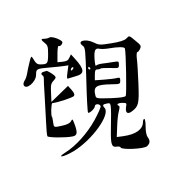
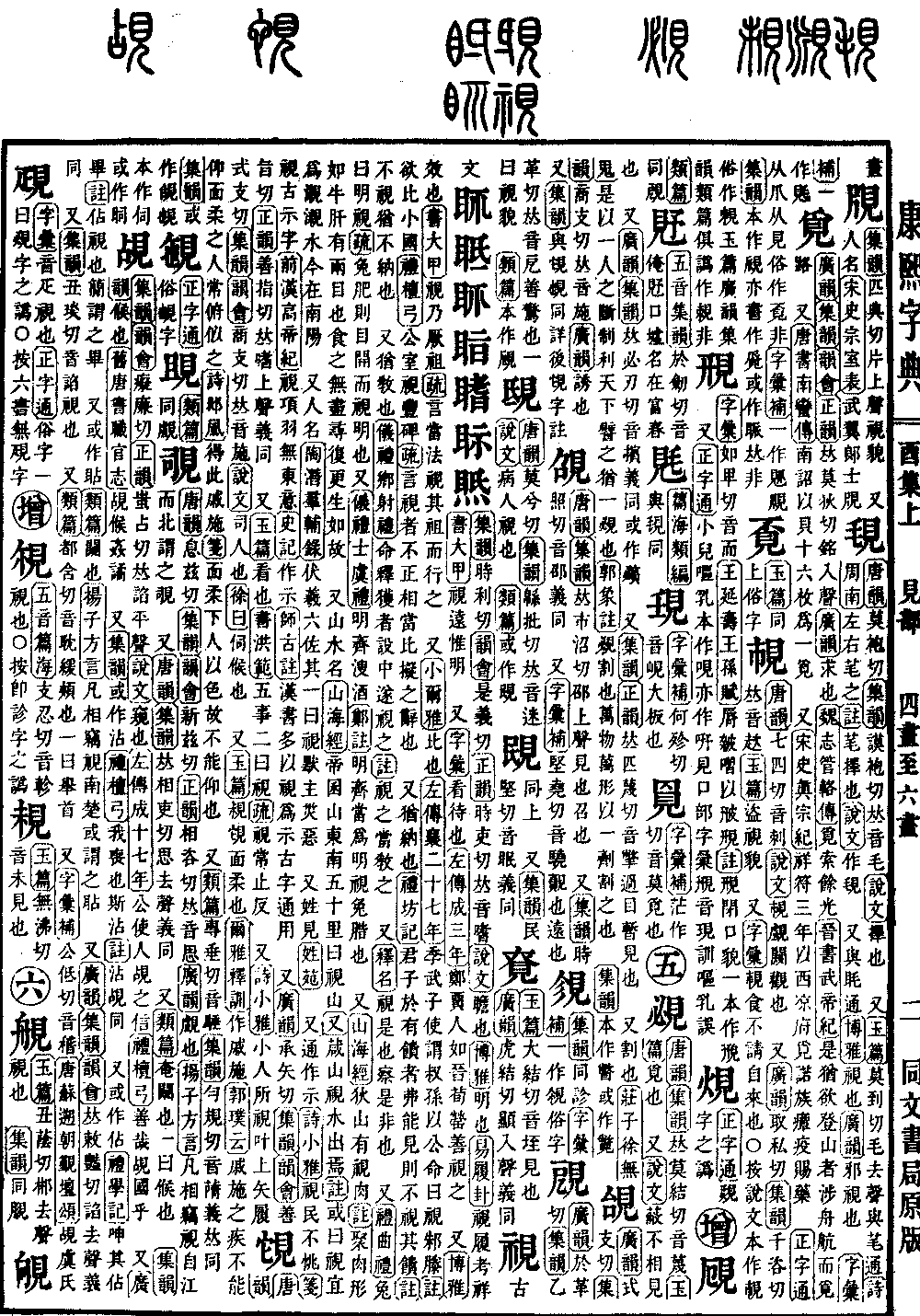
In "Tang Yun" (Tang Yun), the pronunciation is given by fanqie using the characters "shi" and "zhi", and is read the same as "shi". In "Jiyun" (Jiyun) and "Yunhui" (Yunhui), the pronunciation is given by fanqie using the characters "shang" and "zhi", and is read the same as "shi". "Shuowen Jiezi" (Shuowen Jiezi) explains it as observing people. Xu Kai's commentary states that it means to spy.
Furthermore, "Yupian" (Yupian) records that 䙾 refers to a gentle and flattering facial expression. "Erya - Shixun" (Erya - Shixun) writes it as "戚施" (qī shī). Guo Pu's commentary says that people suffering from 戚施 disease cannot lift their heads, and those with gentle and flattering expressions often lower their heads, resembling this condition. The "Book of Odes - Bei Feng" (Shijing - Beifeng) has the line "得此戚施" (dé cǐ qī shī). Zheng Xuan's commentary states that it means having a gentle and flattering expression, using a fawning countenance towards inferiors, and therefore being unable to look up.
Additionally, in "Leipian" (Leipian), the pronunciation is given by fanqie using the characters "zhuan" and "chui", and is read the same as "zhui". In "Jiyun" (Jiyun), the pronunciation is given by fanqie using the characters "yun" and "gui", and is read the same as "gui". The meanings are the same. "Jiyun" (Jiyun) also sometimes writes it as .